
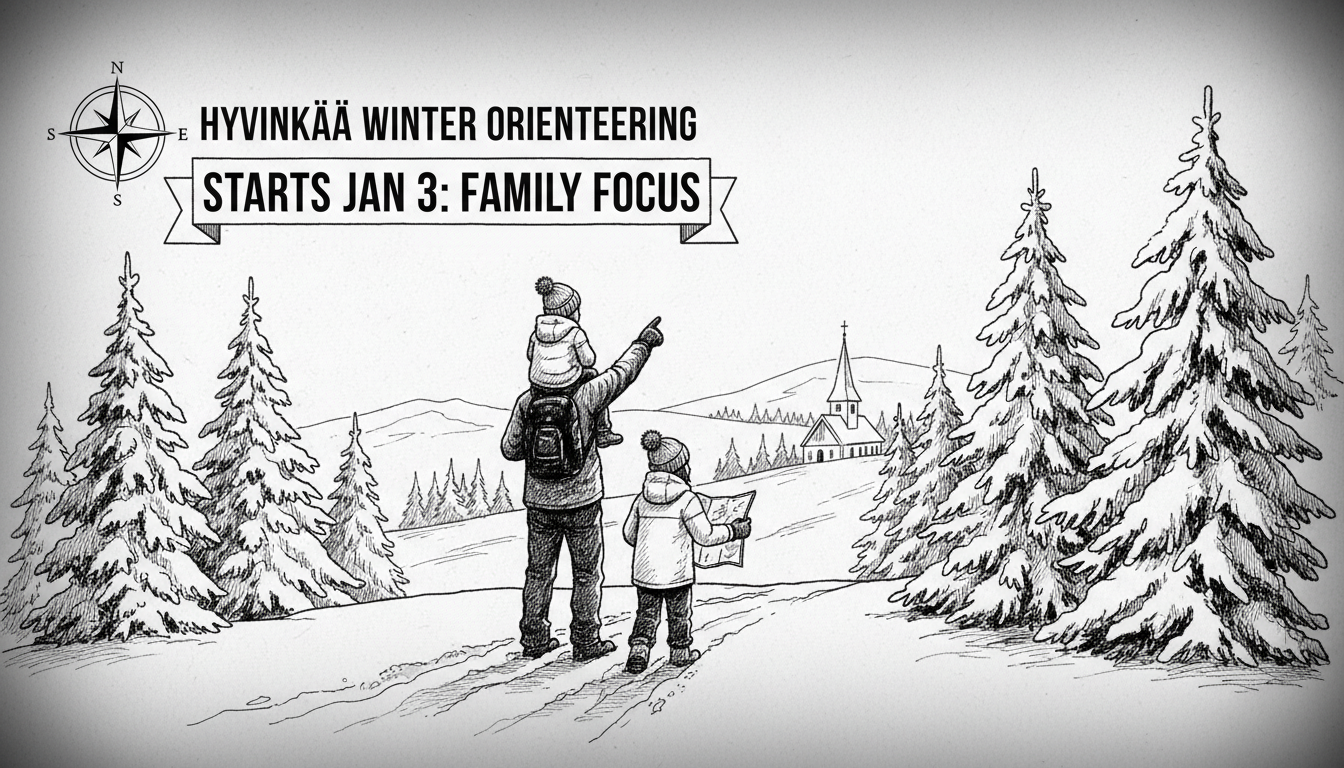
Finland orienteering enters its frosty season as the Hyvinkää Rasti club launches its winter program on January 3rd. The first event assembles at Martintalo in the Martti district, with starts between 10:00 and 11:00, marking a popular community tradition that persists through the darkest months. This annual series highlights a distinctly Nordic approach to outdoor activity, where sub-zero temperatures and snow-covered terrain are invitations, not obstacles.
A light frost clings to the pine trees surrounding Martintalo as families and individuals pull on studded orienteering shoes. The air is crisp, the snow squeaks underfoot, and detailed maps are clutched in mittened hands. This scene, repeated across Finland every weekend, represents a deep cultural commitment to outdoor life. Hyvinkää Rasti's decision to tailor its shortest routes specifically for children underscores a foundational principle of the sport: accessibility and lifelong skill-building.
A Club at the Heart of Community Sport
Hyvinkää Rasti is one of hundreds of local orienteering clubs that form the backbone of Finnish sports culture. These clubs operate largely on volunteer effort, organizing weekly events that are open to all, from national champions to complete beginners. The winter season, running from January through March, presents unique logistical challenges. Course setters must account for snow depth, ice conditions, and the limited daylight of the Finnish winter. The club's announcement emphasizes that the short courses in Martti are excellent for children, a deliberate design choice to encourage family participation.
“The winter series is crucial for maintaining skills and community spirit during the long cold period,” explains a veteran club organizer, who notes that participation often spikes in January as New Year's resolutions meet structured outdoor opportunities. The model is simple: participants turn up, pay a small fee, receive a map, and start at their chosen time within the one-hour window. It is a low-barrier, high-engagement sport that aligns perfectly with the Finnish concept of 'liikuntalukutaito,' or sports literacy.
The Unique Challenge of Snow and Ice
Winter orienteering, or 'talvirastikausi,' is not merely summer orienteering with extra layers. It requires specialized techniques and equipment. Runners use shoes with metal studs or spikes for grip on ice and hard-packed snow. The snow cover also transforms the landscape, hiding small paths and contour details that are visible in summer, while sometimes making larger features like boulders or depressions easier to see. Navigation becomes a process of interpreting the white-shrouded terrain, adding a fresh layer of mental challenge.
For children, these events are often an introduction to map-reading and decision-making in a safe, controlled environment. The short courses in Martti will likely use distinct paths and clear forest features suitable for young navigators. This developmental approach is key to Finland's sustained success in the sport at an elite international level. Many world-class orienteers first found their way with a simple club map on a Saturday morning.
More Than a Sport: Wellbeing in Winter
The social and health benefits of these regular events are significant, particularly in a season associated with seasonal affective disorder and reduced physical activity. Psychologists in Finland frequently recommend regular outdoor exercise as a primary defense against the winter blues. The orienteering club provides a structured reason to leave the house, meet others, and engage in purposeful exercise in nature. The combination of physical exertion and intense mental focus on navigation creates a state of flow that can boost mood and reduce stress.
Community clubs like Hyvinkää Rasti also fill an important gap in public health provision. They offer affordable, regular, and geographically accessible activity without the need for expensive facilities or memberships. In the context of Finland's public health goals, which aim to increase citizen activity levels, these volunteer-run events are a powerful, organic tool. They promote not just cardiovascular health, but also spatial awareness, problem-solving, and a tangible connection to local forests and parks.
The Finnish Model of Grassroots Sport
Finland's orienteering ecosystem is envied worldwide for its density and inclusivity. The structure relies on a national federation supporting a vast network of local clubs. Events are standardized, with insurance and timing systems provided at a national level, but the execution is hyper-local. This allows a club like Hyvinkää Rasti to choose venues that suit its community, like the Martti area, and tailor courses for its participants' needs. The model ensures the sport remains relevant and rooted in places, not just in competition calendars.
The emphasis on children and families also serves a strategic purpose: securing the sport's future. By making the initial experience positive and manageable, clubs foster a generation that associates orienteering with fun, adventure, and community. This stands in contrast to youth sports models that prioritize early specialization and intense competition. Here, the primary goal is participation and the cultivation of a skill set that allows one to move confidently through forests in all seasons.
Navigating the Season Ahead
The January 3rd event is just the starting point for Hyvinkää Rasti's winter calendar. Subsequent events will move to different areas around Hyvinkää, testing participants' skills in varying terrains. Each week presents a new puzzle, as snow conditions change and course setters find new ways to challenge both newcomers and experts. For residents of Hyvinkää and the surrounding Uusimaa region, these events become a rhythmic part of the winter week, a constant amidst the shifting weather.
As Finland continues to champion its outdoor culture, activities like winter orienteering offer a compelling template. They demonstrate how a sport can be competitive at the highest level while remaining profoundly accessible at the grassroots. The simple act of gathering at Martintalo on a Saturday morning represents a choice to engage actively with the winter environment. It is a statement that the cold season is not a time for hibernation, but for a different kind of exploration. The map is folded, the start clock beeps, and another orienteer disappears into the white silence of the forest, following a line only they can see.
Will the tradition of community-based winter sports remain strong as leisure habits change? The consistent turnout for events like those organized by Hyvinkää Rasti suggests a deep-seated cultural appreciation for this blend of sport, nature, and mental challenge. It is a uniquely Nordic answer to the universal question of how to live well, and actively, through the long winter months.