
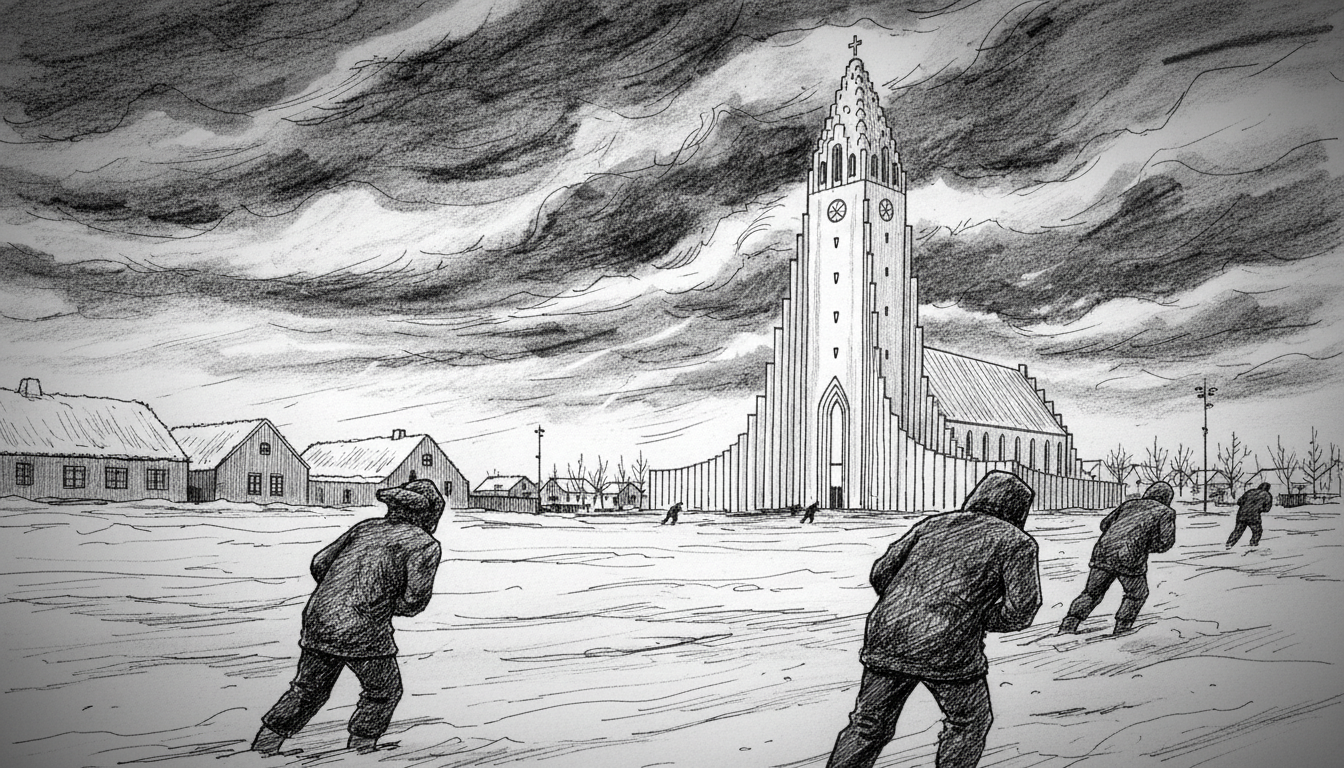
Iceland's weather service Veðurstofan warns a powerful cold front is sweeping eastward across the country. The 'kuldaskil' brings rain, sleet, and mountain snow, with winds reaching 10 to 18 meters per second. Gusts near northeast and eastern mountains pose particular hazards for travel and coastal areas.
This rapid weather shift underscores Iceland's volatile climate at the edge of the Arctic. The front moved in from the North Atlantic overnight, marking a sharp transition from recent conditions. Meteorologists note the system is moving quickly but packing significant punch, especially for the western and southern regions receiving the initial impact.
"After noon, there is a likelihood of sharp wind gusts near mountains in the Northeast and East, but in the afternoon the wind decreases, it clears up almost everywhere and gets colder," a Veðurstofan meteorologist stated in their forecast analysis. This pattern highlights the localized dangers that can emerge even as broader conditions improve.
A Nation Accustomed to Weather Whiplash
Icelanders monitor forecasts with a vigilance born from necessity. The nation's location, straddling the Mid-Atlantic Ridge and brushed by the Irminger Current, creates a meteorological battleground. Warm maritime air collides with Arctic influences, generating the rapid changes for which Iceland is famous. A sunny morning in Reykjavik can turn into a stormy afternoon in the highlands without much warning.
This specific front illustrates the phenomenon perfectly. West and southwest winds of 10-18 m/s (22-40 mph) are forecast for many areas. While not hurricane-force, these winds are strong enough to make driving difficult, especially for rental camper vans and high-sided vehicles common on tourist routes. The inclusion of rain or sleet at lower elevations and snow in the mountains complicates travel further, reducing visibility and creating slick conditions.
Weekend Forecast: From Gusts to Calm
The Icelandic Meteorological Office provides a detailed outlook through the weekend. Saturday will see southwest winds of 8-15 m/s, lighter in the south. Cloud will thicken over the west with a little precipitation possible in the afternoon. Temperatures will range from a modest 1 to 7 degrees Celsius (34-45°F), while the eastern part of the country stays partly cloudy and cooler.
A shift arrives on Sunday. Winds from the west and southwest will drop to 5-13 m/s, easing further after noon. The day will be cloudy with patches of light rain in some areas, though the southeast should stay dry. Temperatures will hover between 0 and 6 degrees Celsius (32-43°F). This easing pattern suggests the front's main energy will have passed, leaving behind more typical, unsettled Icelandic spring weather.
The Critical Role of Veðurstofan
For residents and visitors alike, Veðurstofan is an essential daily resource. The office does more than just issue forecasts; it provides critical warnings for wind, snow, and avalanche risk. Their data feeds into the national road administration's condition reports, a vital tool for anyone planning to drive outside the capital region. In a country where weather can be a genuine threat to safety, this information infrastructure is a public safety cornerstone.
Experts consistently stress checking these sources frequently, not just once in the morning. Conditions can evolve faster than the six-hour update cycle. For those traveling, especially into the Highlands or along the vulnerable Ring Road in the south and east, a last-minute check can be the difference between a safe journey and a dangerous situation. The forecasted gusty winds near northeast and eastern mountains are a classic example of a localized hazard that requires specific awareness.
Environmental and Economic Ripples
Beyond immediate safety, such weather systems have broader implications. For Iceland's crucial fishing industry, strong winds and sea state changes affect fleet operations in ports like Hafnarfjörður, Akranes, and the Westfjords. While the fleet is built for tough conditions, scheduling and safety margins shift with these forecasts.
Renewable energy production, primarily geothermal and hydroelectric, is also weather-sensitive. Hydropower reservoir inflows are influenced by precipitation type—rain provides immediate runoff, while snow acts as a delayed reservoir. The forecasted mountain snow from this front will contribute to the seasonal snowpack, a key water source for summer energy production. Geothermal plants, however, operate independently of these atmospheric vagaries, providing a stable baseload.
From a climate perspective, meteorologists track the frequency and intensity of such frontal systems. While a single front proves nothing, long-term data collected by Veðurstofan contributes to understanding how North Atlantic storm tracks may be altering. Iceland sits in a prime observation post for studying Arctic amplification and its effects on mid-latitude weather patterns.
A Nordic Perspective on Preparedness
Iceland's approach to weather communication and public preparedness holds lessons within the Nordic region. While Sweden, Norway, and Finland deal with greater seasonal temperature extremes, Iceland's challenge is rapid volatility. The national emphasis on real-time, accessible data through Veðurstofan mirrors best practices in neighboring countries, like Norway's Meteorologisk institutt and Sweden's SMHI.
Cooperation across Nordic meteorological services is robust, particularly for modeling North Atlantic and Arctic systems. The data shared improves forecast accuracy for all. For a traveler embarking on a Nordic tour, moving from Iceland's frontal winds to Norway's fjords or Sweden's forests, understanding this localized forecasting culture is part of the journey. The principles remain the same: respect the environment, plan with reliable data, and be prepared to change those plans.
Living with the Arctic's Mood Swings
As the cold front moves through, from the Reykjanes peninsula to the fjords of the east, life adapts. In Reykjavik's neighborhoods like Höfði or Breiðholt, residents will secure garden furniture and perhaps postpone a coastal walk. In the countryside, farmers will ensure livestock have shelter. Tour operators will adjust itineraries for the Golden Circle or South Coast based on the latest wind and precipitation maps.
This is the rhythm of Iceland. The weather is not small talk here; it is a primary planning factor. The forecast from Veðurstofan is the script for the day's activities. The passing of this 'kuldaskil' will be followed by another system, then another, in an endless dance of high and low pressure. The resilience built by this constant engagement with the elements is a defining national trait. It fosters a community-wide awareness that, in the end, human plans are secondary to the forces moving across the North Atlantic. The key is to listen carefully to the forecast, understand what it means for your patch of this volcanic island, and act accordingly.