
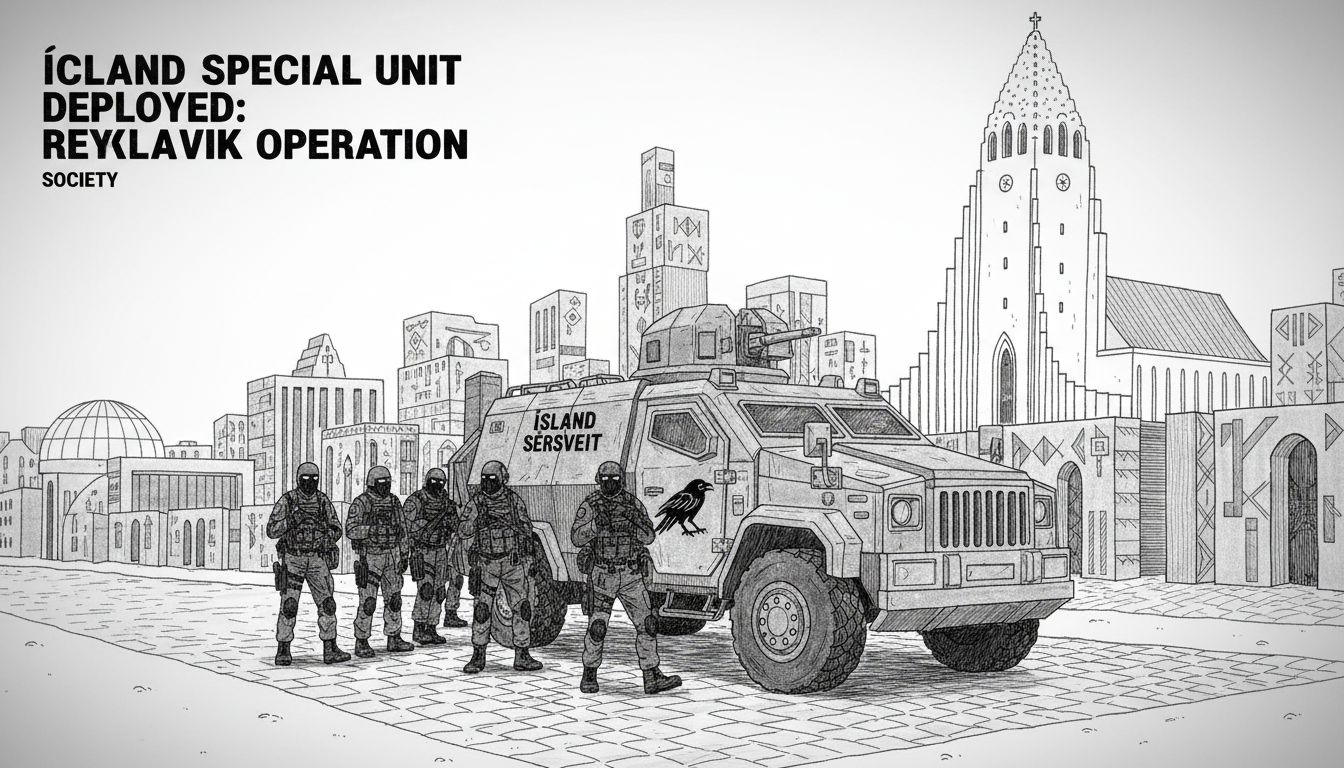
Iceland's elite police unit, the Sérsveitin, assisted Reykjavik police in an operation in Grafarvogur district tonight. The National Police Commissioner's office confirmed the unit's involvement but provided no details on the nature of the incident or any arrests. Police remained on the scene late into the evening, with the operation described as ongoing. This rare deployment in one of Europe's safest capitals immediately raises questions about public safety and police transparency.
A Rare Event in a Peaceful Capital
The activation of the Special Unit, known formally as Sérsveit Ríkislögreglustjóra, is an uncommon occurrence in Iceland. The unit operates under the direct command of the National Police Commissioner and is reserved for high-risk scenarios. These typically include armed standoffs, hostage situations, or operations against potentially dangerous suspects. Their deployment in Grafarvogur, a large residential area in eastern Reykjavik, signals that local police assessed a situation beyond their standard capabilities. Helena Rós Sturludóttir, communications director for the National Police Commissioner, confirmed the unit had "completed its tasks at the scene," but the broader police operation continued.
Iceland consistently boasts one of the world's lowest violent crime rates. Its homicide rate rarely exceeds one per 100,000 inhabitants, a figure that places it among the safest nations globally. Most police work in Reykjavik involves community policing, traffic control, and responding to minor incidents. The sight of specialized, armed officers is jarring for residents accustomed to a visible but largely non-confrontational police presence. The lack of immediate information from the Capital Area Police about the operation's purpose fueled public speculation and concern across social media and local networks.
The Balance of Secrecy and Public Information
The police's tight-lipped approach following the operation highlights a recurring tension in Icelandic law enforcement. On one hand, there is a legitimate need for operational security, especially during active investigations or when pursuing suspects. Releasing details prematurely could compromise an investigation or endanger officers. On the other hand, Iceland's society is built on a high degree of trust and transparency. When a significant police action, involving a elite unit, occurs in a residential neighborhood, the public expects timely information to allay fears.
"The police are navigating a difficult line," said a former senior officer who requested anonymity due to ongoing connections with the force. "In a small, close-knit society like Reykjavik, rumors spread faster than official statements. While they cannot disclose everything, a basic framework—indicating whether this was related to a weapons threat, a search for a specific individual, or another matter—would help maintain public confidence." The expert noted that the Special Unit's involvement almost certainly means police were acting on intelligence suggesting a elevated threat level, rather than responding to a spontaneous event.
Grafarvogur: A Community in the Spotlight
The choice of location adds another layer to the story. Grafarvogur is not typically associated with serious crime. It is a sprawling, primarily residential district known for its family homes, schools, and proximity to the Ellidaárdalur valley. It is a cornerstone of Reykjavik's suburban expansion. A major police operation there disrupts the community's sense of insulated safety. Residents reported seeing increased police activity but were given no official guidance, a situation that can erode trust between the public and law enforcement.
This incident will likely prompt discussions at the municipal level, possibly within the Reykjavik City Council's welfare committee, which oversees community safety. Councillors may demand briefings on the operation and seek assurances about communication protocols for future events. The environmental angle, often central to Icelandic affairs, is less direct here but touches on the concept of environmental security—the safety and integrity of one's immediate living environment. For residents, a large, unexplained police action fundamentally alters the security of their local environment.
Nordic Context: Exceptionalism Tested
Viewed from a Nordic perspective, Iceland's situation remains unique. While Sweden and Denmark have grappled with gang-related violence and shootings in recent years, leading to more frequent use of specialized police tactics, Iceland has largely been an exception. This operation, if it reveals a more complex criminal threat, could signal a subtle shift. It tests the Nordic model of policing, which in Iceland has heavily emphasized prevention and social cohesion over militarized response.
Cooperation between the National Police's special unit and the Capital Area Police is standard protocol, but its execution is rare enough to be newsworthy. It demonstrates that the infrastructure for handling serious incidents exists, even if it is seldom used. Other Nordic police forces, like Sweden's National Task Force or Norway's Delta Force, have higher public profiles due to more frequent deployments. Iceland's Sérsveitin operates in the shadows, its successes often measured by incidents that never make headlines because they were prevented.
The Path Forward: Awaiting Answers
The immediate aftermath of the Grafarvogur operation is a waiting game. The police have concluded their tactical field operation but the investigative work continues. Charges may be filed, a suspect may be arraigned, or the public may learn that the operation was a precautionary measure that yielded no arrests. Each outcome carries different implications for the narrative around crime and policing in Iceland.
Parliamentary oversight is also a factor. Members of the Althingi's General Committee, which oversees judicial affairs, may seek a report from the Minister of Justice on the deployment. "The use of state's coercive power, especially its specialized armed unit, warrants democratic scrutiny," said a member of the opposition from the Left-Green Movement. "We need to understand the threshold for such deployments to ensure it remains appropriately high."
Ultimately, this single night in Grafarvogur serves as a reminder. It underscores that no society is immune to incidents that require a robust police response, no matter how impressive its crime statistics. The true test for Iceland will be how its institutions manage the aftermath: the clarity of communication, the rigor of oversight, and the preservation of the profound public trust that is the bedrock of its safety. The coming days will reveal whether this was an isolated anomaly or a sign of a changing landscape in the North Atlantic.