
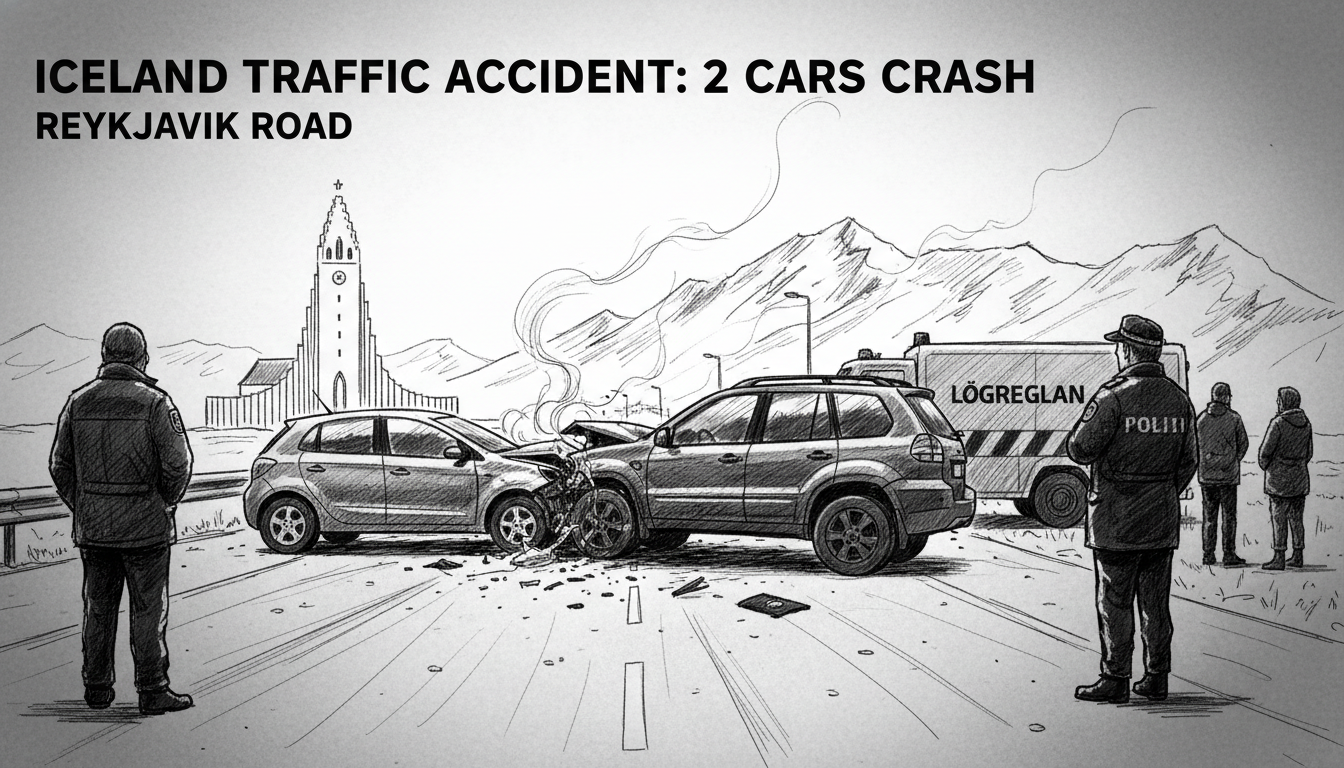
Iceland traffic accident news today centers on a two-vehicle collision on a major Reykjavik artery. The crash occurred at the intersection of Suðurlandsbraut and Engjavegur at 10:00 AM, according to Ásgeir Valur Flosason, assistant chief of the capital area fire department. Both an ambulance and a fire engine were dispatched to the scene. Neither driver required transport to a hospital, but the incident forced crews to clean debris from the road, causing significant morning traffic disruption.
A City's Vulnerability Exposed
Suðurlandsbraut is not just another road; it is a critical traffic artery connecting Reykjavik's eastern and western districts. For a city of Reykjavik's size, with a metropolitan population just over 240,000, a single accident on this route can paralyze commutes from Hafnarfjörður to the city center and beyond. The 10:00 AM timing meant the crash impacted late-morning traffic, but had it occurred during the 8:00 AM rush, the gridlock would have been severe. This event highlights the city's dependence on a handful of key roadways and its vulnerability to sudden disruptions. "When Suðurlandsbraut sneezes, the whole capital area catches a cold," remarked a city councilor from the Reykjavikurborg planning department last year during a debate on traffic resilience.
The Immediate Aftermath and Response
Ásgeir Valur Flosason confirmed that each vehicle involved had a single occupant. The rapid response from emergency services—both a rescue unit and a fire truck—is standard protocol for traffic incidents with potential for injury or vehicle damage. The fact that neither driver needed hospital transfer is the most positive outcome from the morning. However, the logistical cleanup created its own challenges. Crews had to clear broken vehicle parts and potential fluid spills from the intersection, a process that required partial lane closures. Both damaged cars were eventually towed from the scene, restoring full traffic flow after a delay of over an hour. This efficient cleanup is a testament to the coordination between the Reykjavik Fire Department and the capital area police, but it also consumed considerable public safety resources for a non-injury crash.
A Deeper Look at Reykjavik's Traffic Safety
While this specific crash had a fortunate outcome, it raises persistent questions about traffic safety in Iceland's growing capital region. Suðurlandsbraut has seen multiple redesigns and expansions over the decades to handle increasing volume. The intersection with Engjavegur, where this crash occurred, is a complex junction with multiple turning lanes and traffic signals. Traffic safety experts often point to a combination of factors in Icelandic accidents: rapidly changing weather conditions affecting visibility and road grip, driver behavior, and sometimes, outdated intersection design struggling to cope with modern traffic density. A 2023 report from the Icelandic Transport Authority noted that while fatal accidents have decreased, property-damage collisions in urban areas like Reykjavik remain stubbornly common. The police investigation into this morning's crash will seek to determine the precise cause, whether it was a failure to yield, distracted driving, or another factor.
The Nordic Perspective on Urban Mobility
This minor crash offers a moment to consider Iceland's approach to urban transportation within a Nordic context. Compared to its Scandinavian neighbors, Reykjavik has a higher rate of private car ownership and use per capita. Cities like Copenhagen, Oslo, and Helsinki have invested more heavily in segregated bicycle lanes, extensive metro or tram systems, and policies designed to reduce car dependency in core urban areas. Reykjavik's public bus system, Strætó, has improved but still battles perceptions of infrequency and limited route coverage, especially in newer suburbs. The city's ongoing debates about a potential light rail or tram line, often stalled by cost concerns and geological assessments, underscore the challenge. Every traffic disruption on a road like Suðurlandsbraut strengthens the argument for diversifying the city's transport network to build resilience, a lesson well-learned in other Nordic capitals.
Environmental and Economic Ripple Effects
Beyond the immediate inconvenience, such accidents have subtle environmental and economic costs. Idling cars in stalled traffic increase local emissions in city-center districts like 101 Reykjavik and nearby 107. For a country that prides itself on clean geothermal energy for heating and ambitious carbon neutrality goals, transportation remains a hard-to-decarbonize sector. Commercially, delivery vans and service vehicles caught in the delay face lost productivity. The incident also ties up emergency service vehicles that could be needed elsewhere. While a single event's impact is small, the cumulative effect of frequent minor disruptions can affect local business efficiency and air quality goals. It’s a systems problem that requires a systems solution, looking beyond the asphalt to integrated urban planning.
Looking Ahead: Infrastructure and Policy
The Althing, Iceland's parliament, and the Reykjavik city council continually grapple with infrastructure funding. Major projects like the ongoing improvements to the Miklabraut corridor or the debate over a potential underwater tunnel in Faxaflói Bay command headlines and large budgets. However, the safety and efficiency of existing intersections, like Suðurlandsbraut and Engjavegur, are just as critical. Investment in smarter traffic light sequencing, improved signage, and perhaps even AI-assisted traffic monitoring could prevent future collisions. Some traffic planners advocate for more roundabouts, which have proven to reduce serious T-bone collisions at intersections across Iceland. The political will and budgetary priority must align to make these incremental but vital improvements.
Today's crash on Suðurlandsbraut was a routine incident with a best-case outcome: no serious injuries. But it serves as a recurring reminder of the pressures on Reykjavik's infrastructure as the city expands. It underscores the need for a continuous, data-driven review of traffic safety, not just reactive responses after crashes. As Iceland positions itself as a modern, sustainable Nordic nation, the flow of traffic in its capital is more than a convenience—it's a measure of systemic planning and quality of life. The question for policymakers is whether they will simply keep clearing the debris from these crashes, or actively design a system where they become far less frequent.