
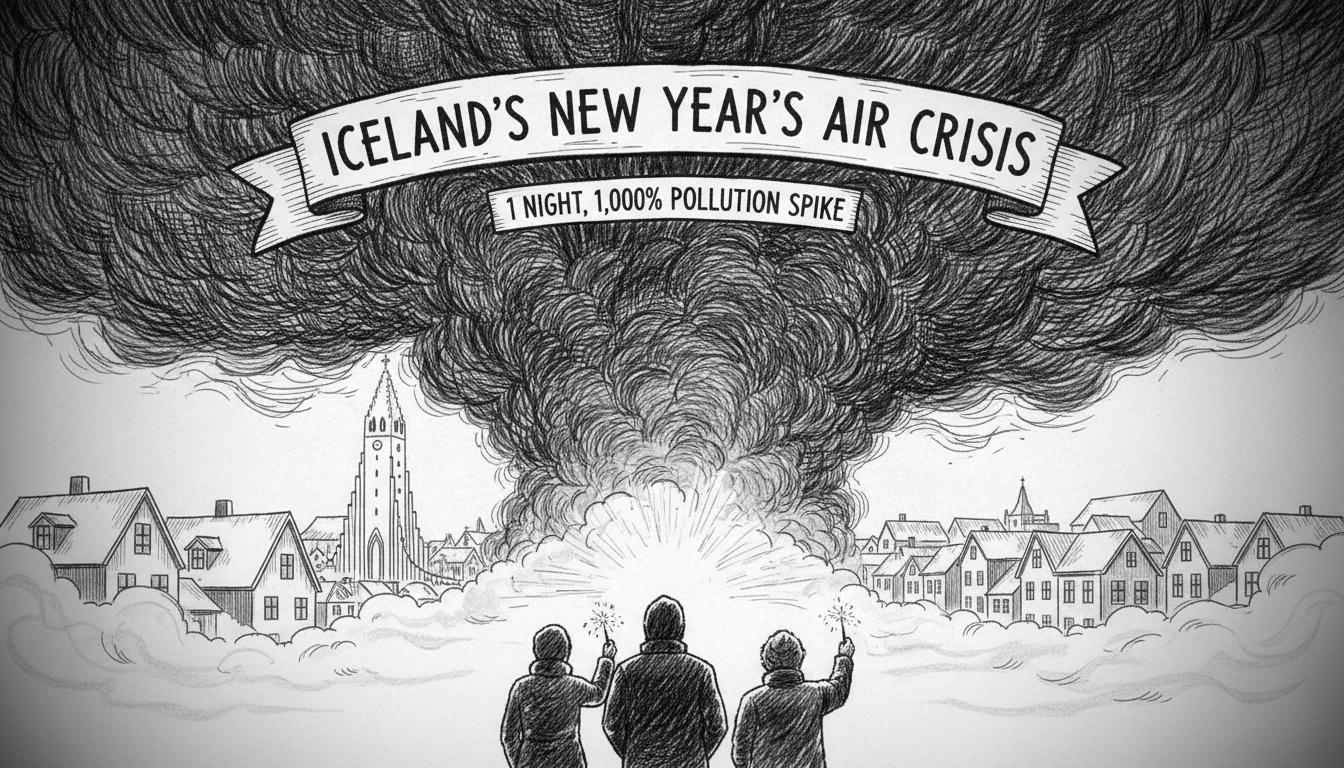
Iceland's New Year's Eve fireworks tradition is set to create a severe air pollution crisis in Reykjavik tonight. Calm weather forecasts predict particulate matter levels will skyrocket, trapping toxic smoke over the capital for hours. Experts warn the first hours of 2025 could be the most polluted of the year.
"We're just kind of stuck with this," said air quality specialist Þorsteinn Jóhannsson of the Environment Agency, describing the impending situation. He anticipates dangerously high concentrations of fine particulate matter (PM2.5) in the capital region immediately after midnight. Winds are predicted to be a mere two meters per second, far below the three meters per second needed for dispersion.
This annual environmental event highlights a growing tension between deep-seated cultural practice and modern public health standards. While the spectacle lights up the Arctic night, it also creates the single worst air pollution episode Iceland experiences annually. The country's famed clean air vanishes in a haze of gunpowder smoke.
A Perfect Storm of Calm and Combustion
Weather conditions are conspiring to make this year particularly bad. The Icelandic Met Office forecasts near-still winds for the Reykjavik area on New Year's Eve. "When you get down to such light winds, you often get no prevailing direction either," explained Þorsteinn. "Then the pollution just drifts back and forth."
This meteorological stagnation acts like a lid on the capital region's bowl-like topography. Fireworks smoke, containing metal particles and other toxic compounds from colored effects, has nowhere to go. The result is a dense, lingering fog that can irritate lungs and pose serious risks to children, the elderly, and those with respiratory conditions like asthma.
Monitoring at loftgaedi.is will show real-time data as pollution levels climb. Historical data reveals that PM2.5 concentrations can increase by over 1,000% compared to a normal winter night. These microscopic particles are small enough to enter the bloodstream through the lungs, carrying associated health risks far beyond temporary discomfort.
The Cultural Weight of a Pyrotechnic Tradition
The use of fireworks on Gamlárskvöld (New Year's Eve) is deeply embedded in Icelandic culture. The tradition is linked to the belief that loud noises scare away evil spirits, a folk custom that evolved into a nationwide, family-oriented pyrotechnic display. For many Icelanders, the smell of gunpowder and the sight of the sky ablaze are inseparable from the celebration.
Spending on fireworks is substantial, with revenues often directed towards Iceland's search and rescue volunteer teams, who sell them as a major annual fundraiser. This creates a complex economic and social incentive to continue the practice. A full ban is considered politically untenable, a point often raised in Althing debates on the subject.
"It's a classic clash between collective tradition and individual health," says Birna Jónsdóttir, a Progressive Party MP from the Northeast constituency. "We must find a balance. No one wants to be the politician who cancelled New Year's, but we also cannot ignore the science." She advocates for public education on reduced usage rather than outright prohibition.
Health Experts Sound the Alarm
Medical professionals have grown increasingly vocal. The Icelandic Lung Association issues annual warnings, noting a predictable surge in emergency room visits for breathing difficulties in the days following January 1st. The concentrated exposure is a significant public health anomaly for a nation that otherwise enjoys pristine air quality, largely thanks to geothermal and hydroelectric power.
Dr. Helga Sigurðardóttir, a Reykjavik pediatrician, stresses the impact on vulnerable groups. "We tell parents of young children and asthmatic kids to essentially shelter in place. Keep windows sealed, use air purifiers if possible, and avoid being outside during the peak pollution hours. It's sad that a celebration comes with this advice."
The pollution is not evenly distributed. Densely populated districts like Breiðholt and Grafarvogur in Reykjavik, where housing is tightly packed, often experience higher ground-level concentrations. The smoke lingers in streets and courtyards, penetrating homes despite closed windows.
Seeking Solutions in a Smoke-Filled Sky
The debate has spurred innovation and discussion about alternatives. Some municipalities have invested in larger, organized public fireworks displays, arguing that a single professional show creates less overall pollution than thousands of scattered amateur ones. The city of Akureyri has experimented with this model, combining it with laser light shows.
Other suggestions include promoting "greener" fireworks, though their availability and cost are prohibitive, or establishing "fireworks-free" zones in urban centers. The most consistent recommendation from authorities is moderation: if families must use fireworks, use fewer of them.
From a Nordic perspective, Iceland's situation is unique. While Denmark and Sweden also have New Year's fireworks, their larger landmasses and more frequent winter winds prevent such intense, localized pollution events. Norway's stricter regulations on public sale offer a contrasting model. Finland's emphasis on community bonfires (kokko) presents a different cultural focus with less atmospheric contamination.
A Clear Look at a Murky Future
As the clock ticks toward midnight, Reykjavik residents face a familiar choice. They can participate in a beloved tradition knowing its environmental cost, or they can retreat indoors to protect their health. For Þorsteinn Jóhannsson and his colleagues, it will be another night of monitoring the charts as the numbers soar.
The data collected tonight will feed into the ongoing policy discussion. Each year of extreme pollution adds weight to arguments for change. The question for Iceland is not if the tradition will evolve, but how and when. Can a nation famed for environmental consciousness find a way to celebrate its new year without poisoning its own air? The answer, for now, remains lost in the smoke.