
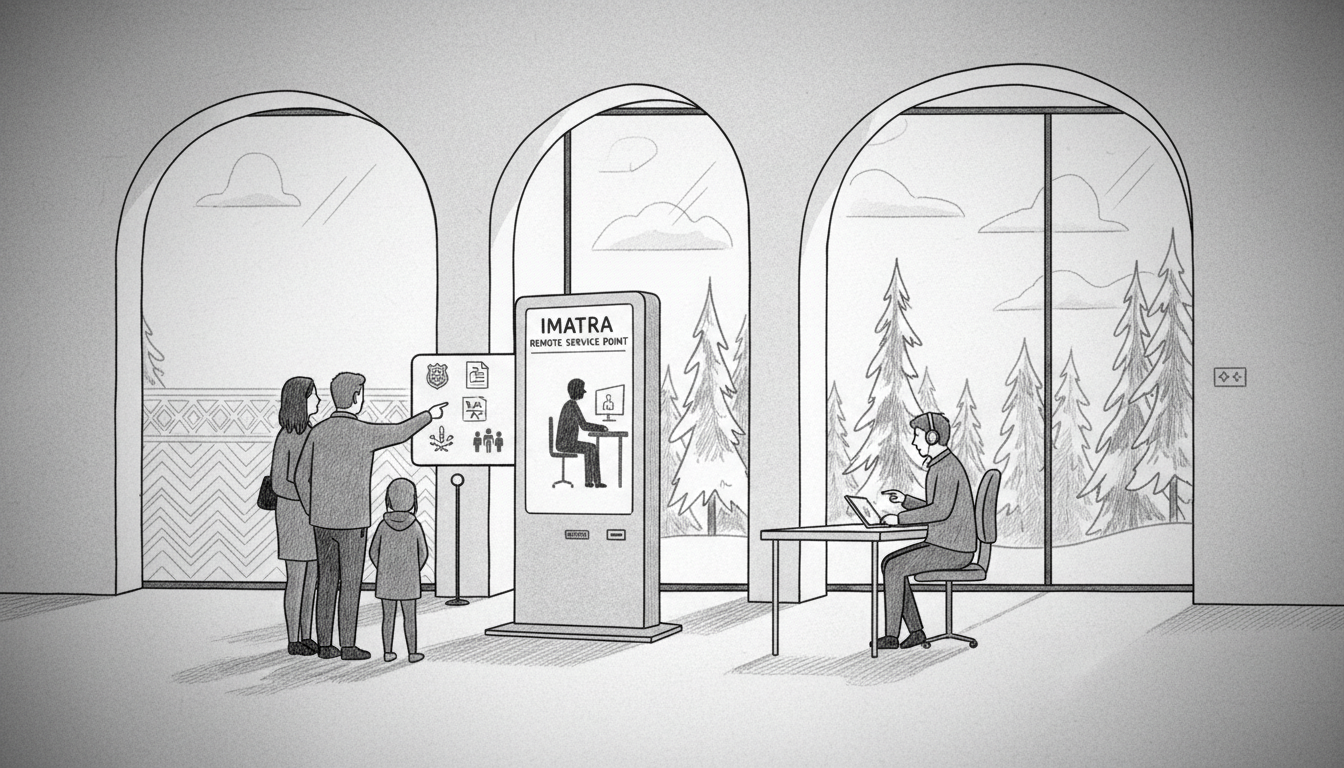
The city of Imatra has launched an experimental remote service point offering citizens direct access to four major government agencies from a single location. Located in the Koskenlinkki district, this facility enables residents to handle matters with Southeast Finland Police Department, the Tax Administration, Kela social security agency, and the Digital and Population Data Services Agency. The initiative represents a collaborative effort among national authorities to maintain essential in-person services despite increasing digitalization pressures across Finnish public administration.
Finnish authorities confirmed the remote service point began operations in early September following the city hall's relocation. This pilot project will continue through the end of February, testing whether consolidated physical access points can effectively serve residents who struggle with fully digital services. The timing coincides with broader national discussions about service accessibility in Finland's sparsely populated regions.
Police officials acknowledged that despite the convenience offered, no residents have yet utilized the facility for filing police reports or other official business. This low initial uptake raises questions about public awareness and whether physical service points remain relevant in an increasingly digital society. The remote service point specifically aims to ensure accessibility of government services throughout Finland, particularly for elderly residents and those with limited digital skills.
Finland's government has prioritized digital transformation of public services while maintaining physical access options as a safety net. This Imatra experiment reflects ongoing tension between cost-efficient digital services and equitable access for all citizens. Similar remote service points have been tested in other Finnish municipalities with varying success rates, highlighting the challenge of serving diverse demographic groups across the country's vast geography.
The initiative connects to broader European Union digital governance objectives while addressing Finland's specific geographical challenges. EU cohesion policy emphasizes reducing regional disparities in service access, making this pilot project relevant beyond national borders. As Finland continues its digital transition, experiments like Imatra's remote service point provide crucial data about how to balance efficiency with inclusion in public service delivery.
What does this mean for Finland's digital future? The Imatra case illustrates the practical difficulties in implementing nationwide digitalization policies. While the government pushes for more efficient online services, real-world experiments reveal the continued need for physical access points in certain communities. The coming months will show whether targeted communication and community engagement can increase utilization of this hybrid service model.