
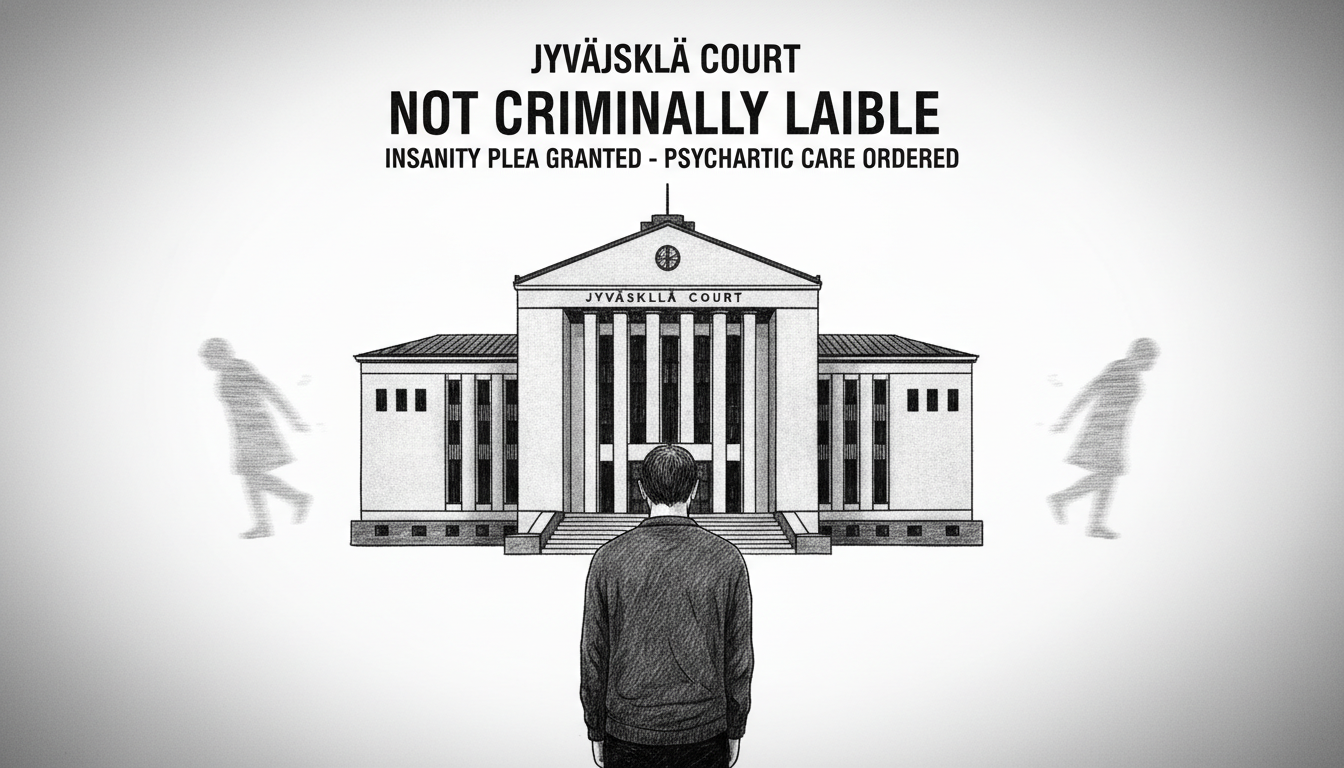
A district court in Jyväskylä has issued a ruling in a tragic double homicide case. The court found a man in his early thirties not criminally responsible for the deaths of his parents. The Keski-Suomi District Court determined the man was legally insane at the time of the attacks. This finding means he will not face a prison sentence for the crimes.
The incident occurred in January in a residential apartment in the Kangaslampi district of Jyväskylä. The man's parents, aged 74 and 75, had come to his home to assist him. The court described the attack as sudden and unprovoked. The father died in an ambulance en route to the hospital. The mother was already deceased when police arrived at the scene.
In its written judgment, the district court characterized the homicides as particularly brutal and cruel. The court assessed the overall nature of the acts as aggravated. A forensic psychiatric examination was conducted on the defendant. Both the examination and the court's own assessment concluded the man lacked criminal responsibility due to his mental state. The National Institute for Health and Welfare ordered the man, now 33, into involuntary psychiatric care in November.
This case highlights the complex intersection of criminal law and mental health in the Finnish justice system. Finnish law draws a clear distinction between punishment for criminal acts and compulsory care for individuals deemed not responsible. The legal standard for criminal insanity, or 'syyntakeettomuus', is strict. A finding requires that the defendant's capacity to understand the consequences of their actions or to control their behavior was severely impaired.
Finland's approach prioritizes treatment over incarceration in such instances. The decision reflects a societal and legal consensus that individuals in a state of severe psychosis require medical intervention, not penal retribution. The case will now shift from the criminal courts to the healthcare system. The man will receive treatment under the supervision of health authorities for as long as deemed necessary by medical professionals. The outcome, while legally sound, offers little solace for the broader tragedy of two lives lost and a family shattered by severe mental illness.
What does this mean for public safety? The involuntary care order is not time-limited. Release depends on professional assessment that the individual no longer poses a danger. The system aims to balance rehabilitation with security. Cases like this are statistically rare but provoke difficult questions about prevention and support for families dealing with severe mental health crises. The Finnish model demonstrates a clear policy choice to treat such tragedies primarily as public health failures rather than purely criminal matters.