
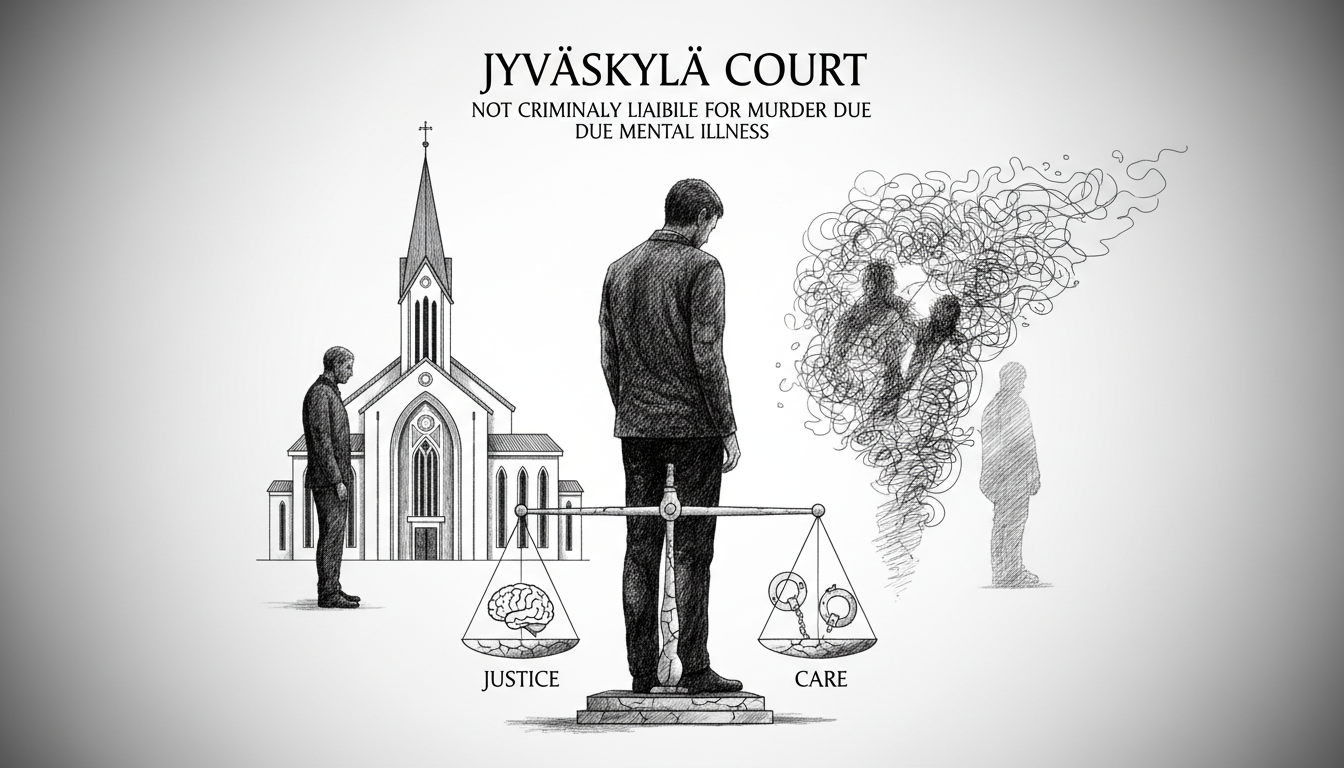
A district court in Central Finland has ruled that a man in his thirties was not criminally responsible when he killed his parents in their Jyväskylä home earlier this year. The Keski-Suomen käräjäoikeus court did not impose a prison sentence, instead ordering the man to undergo compulsory psychiatric care. This case highlights the complex intersection of Finland's criminal justice system and mental health protocols, a recurring challenge for Nordic legal frameworks.
The violent incident occurred in the Kangaslammin district of Jyväskylä. The man's 75-year-old father and 74-year-old mother visited his apartment. According to the court documents, the son attacked his father in the kitchen with a utility knife, inflicting deep wounds to the neck. The father sustained defensive wounds on his hand before collapsing. The man then turned on his mother, stabbing her in the neck and striking her with a frying pan and a screwdriver.
The court rejected the defendant's claim that the acts constituted manslaughter rather than murder. Prosecutors argued the violence was unprovoked and that the parents had come to help their son. The ruling stated the man continued his assault despite clear signs the victims were trying to defend themselves. It noted neither victim died immediately, prolonging their suffering.
This verdict rests on the Finnish legal principle of 'syyntakeettomuus,' meaning a lack of criminal responsibility due to a severe mental disorder at the time of the act. It is a high threshold, requiring the court to find the defendant could not understand the nature or wrongfulness of their actions. The court's decision to mandate treatment instead of punishment reflects this finding.
Neighbors reported the man's behavior had grown increasingly strange in recent years. Police found him lying in bed after breaking into the apartment, with his parents' bodies on the floor. He offered no motive for the attacks during the trial.
Finland's system for dealing with such cases involves secure forensic psychiatric hospitals. The focus shifts from punishment to treatment and risk management. This approach often sparks public debate about justice for victims and community safety. The case will likely proceed to a court of appeal, as murder rulings typically do in Finland.
The tragedy underscores ongoing discussions about mental health service accessibility and intervention in Finland. While the legal outcome may seem clinical, it represents a difficult balance the justice system must strike between accountability, public protection, and medical reality.