
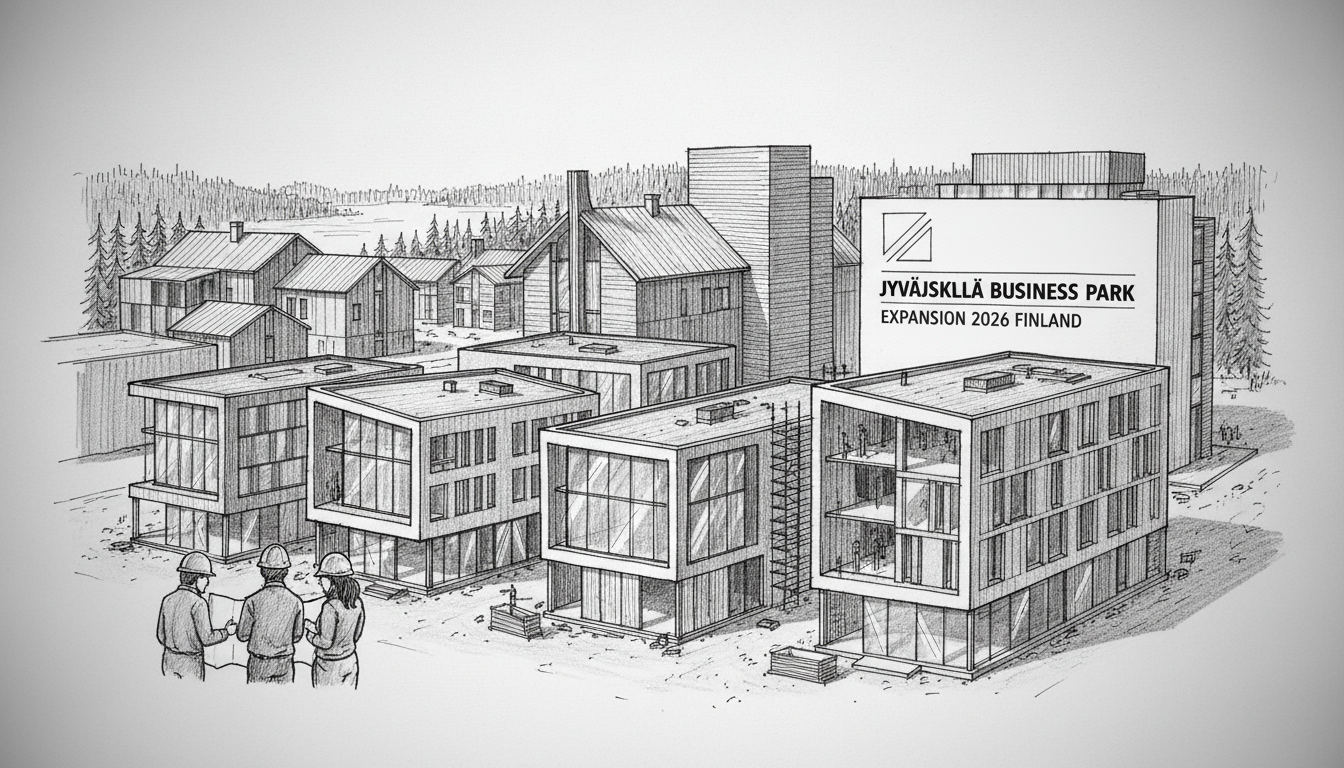
Finland's city of Jyväskylä, home to over 140,000 residents, has launched a strategic expansion of its Lintukangas business park to address growing industrial demand. The move, initiated on December 9th, aims to develop new plots northwest of the Highway 4 interchange for businesses classified as non-environmentally disturbing. This planning process highlights Central Finland's push to balance economic growth with sustainable development, reflecting broader national priorities under Prime Minister Petteri Orpo's government.
The Strategic Expansion Blueprint
Jyväskylä's city planning authority has set in motion the detailed zoning process for Lintukangas's second phase. The target area lies adjacent to the existing business park, leveraging its proximity to Highway 4 (E75), a major arterial route connecting Helsinki to Lapland. A draft plan is scheduled for completion by late winter 2026, with public consultation periods embedded in the timeline. This expansion is designed exclusively for light industry and service enterprises that minimize noise, emissions, and other disruptions, aligning with Finland's stringent environmental regulations.
The Lintukangas area currently hosts a mix of logistics firms, technology startups, and small-scale manufacturers. Its expansion addresses a critical shortage of serviced industrial land in the Jyväskylä region, where vacancy rates for business plots have dropped below 5% in recent years. City planners emphasize that the new zone will offer modern infrastructure, including high-speed digital connectivity and efficient transport links, to attract knowledge-intensive sectors.
Economic Drivers and Regional Ambitions
Jyväskylä's economy relies heavily on its status as an education hub, with the University of Jyväskylä and JAMK University of Applied Sciences producing a skilled workforce. However, local officials have long identified a gap in commercial land supply that hinders business retention and foreign direct investment. The Lintukangas expansion directly responds to this by providing up to 50 new hectares for development, potentially accommodating dozens of additional companies.
Mayor Timo Koivisto of Jyväskylä stated in a press release, 'This expansion is essential for our city's competitiveness. We are creating opportunities for clean industries that bring high-value jobs and diversify our economic base.' The project aligns with the Finnish government's national regional development strategy, which prioritizes growth outside the Helsinki metropolitan area. Eduskunta, Finland's parliament, recently allocated increased funding for provincial infrastructure projects in the 2024 budget, supporting initiatives like Lintukangas.
Environmental Safeguards and Sustainable Design
A key feature of the Lintukangas plan is its focus on environmentally benign businesses. The zoning ordinance explicitly excludes heavy manufacturing, waste processing, and other high-impact activities. Instead, planners encourage sectors like green technology, research and development, and advanced logistics. This approach mirrors Finland's commitment to carbon neutrality by 2035, a goal embedded in both national law and EU climate directives.
Environmental experts have welcomed the cautious framework. Dr. Elina Salo, a regional development scholar at the University of Jyväskylä, noted, 'Jyväskylä is setting a precedent for low-impact industrial zoning. By restricting land use to cleaner operations, the city mitigates urban sprawl and protects surrounding nature reserves.' The plan includes provisions for green corridors and stormwater management systems, reflecting EU-funded urban sustainability projects common across Finland.
EU Context and Funding Implications
The expansion intersects with European Union cohesion policy, which aims to reduce regional disparities. Central Finland qualifies for EU regional development funds, and projects like Lintukangas could attract financing from programs like the European Regional Development Fund (ERDF). Finland's government often channels EU money into local infrastructure to boost lagging regions, a tactic seen in previous business park developments in Oulu and Tampere.
From Brussels, the European Commission has encouraged member states to develop 'smart specialization' strategies, where regions focus on their unique strengths. Jyväskylä's emphasis on clean industry paired with its academic resources fits this model perfectly. This alignment may streamline future applications for EU grants, providing additional resources for roads, utilities, and innovation hubs within the expanded zone.
Public Participation and Political Consensus
Finnish planning law mandates extensive public involvement, and the Lintukangas process is no exception. The draft plan will be available for citizen and stakeholder feedback in early 2026, with opportunities to suggest modifications. This participatory model ensures transparency and builds community support, reducing legal challenges that often delay projects. Local business associations, including Keski-Suomen Yrittäjät (Central Finland Entrepreneurs), have already voiced strong backing, citing years of advocacy for more industrial land.
Politically, the expansion enjoys cross-party support in the Jyväskylä city council, spanning from the National Coalition Party to the Green League. This consensus underscores the project's perceived urgency for job creation and tax base growth. At the national level, the Ministry of Economic Affairs and Employment has included Central Finland's industrial zones in its recent 'Business Finland' investment promotion campaigns, targeting international companies seeking Nordic operations.
Future Outlook and Economic Impact
If approved, the Lintukangas expansion could become operational by the late 2020s, coinciding with planned upgrades to Highway 4. Economic impact studies project that the new area might generate 300-500 permanent jobs and attract €50-100 million in private investment over its first decade. These estimates are based on similar expansions in comparable Finnish cities like Kuopio and Seinäjoki, where business parks have stimulated local economies without significant environmental costs.
The success of this plan will depend on continuous collaboration between city planners, businesses, and residents. As Jyväskylä positions itself as a gateways to Finland's pristine lakeland region, the Lintukangas expansion represents a careful bet on sustainable growth. In a nation where policy balances prosperity with nature, this project will test whether industrial development can truly be quiet, clean, and community-friendly.