
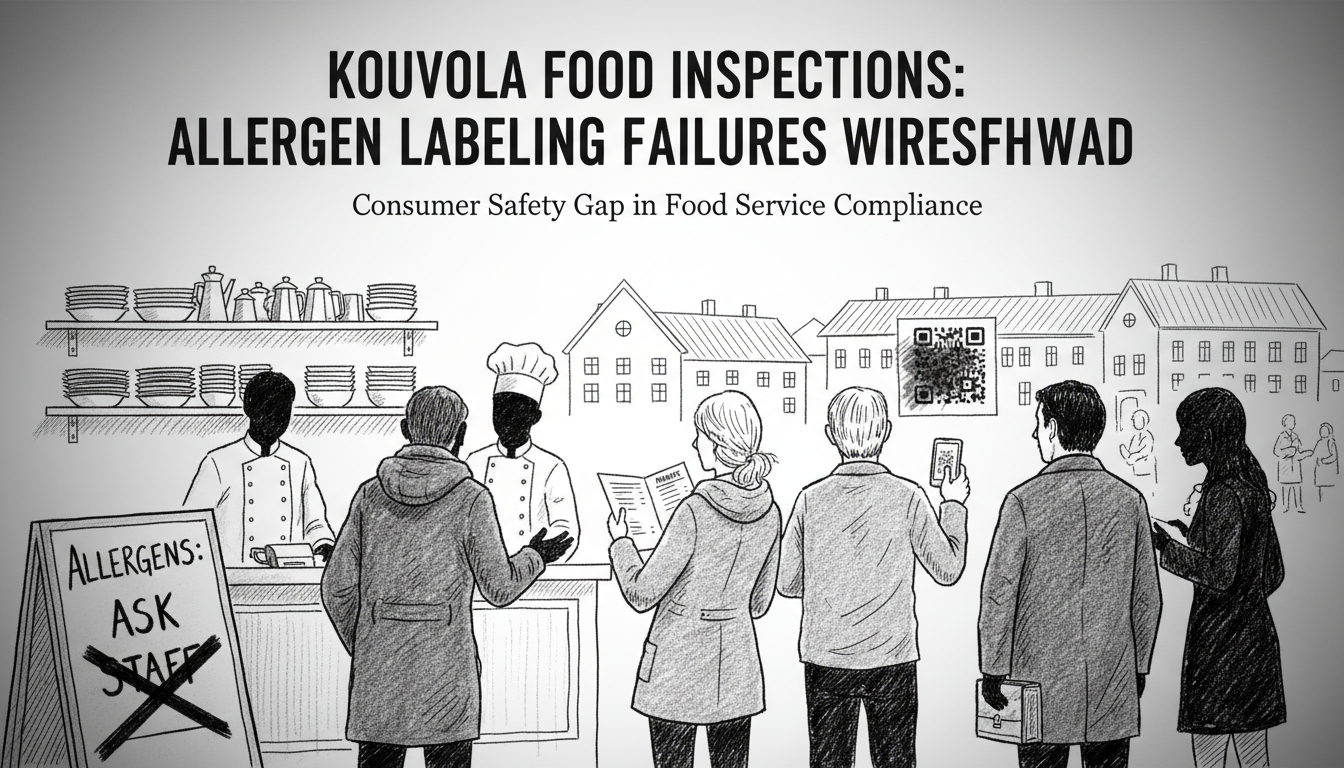
A targeted inspection campaign by Kouvola's municipal food safety authority has revealed systemic failures in allergen information for unpackaged foods sold from display counters. The inspections, conducted over a two-month period, focused on cafes, restaurants, and retail outlets with self-service vitrines. The primary objective was to assess compliance with mandatory consumer information rules, serving conditions, and sales times. The findings point to a significant gap between legal requirements and on-the-ground practice, raising concerns for consumer safety, particularly for those with food allergies or intolerances.
Inspectors carried out 40 unannounced visits to randomly selected food establishments. The most critical deficiency identified was in the labeling of allergens and substances causing intolerances. In not a single cafe were allergen details available in written form for customers to see, for example on a sign. Out of the forty premises, thirty relied on a sign stating that allergen information was available upon request from staff. In ten locations, no information about allergy or intolerance-causing substances was provided at all.
Finnish and EU food law is clear on this point. For unpackaged foods or foods packaged for immediate sale, consumers must be informed in writing of the product name, substances causing allergies or intolerances, and the country of origin for meat. Information can be given orally, but it must be clearly indicated that this is an option. The inspection found only one location where oral information was incomplete when requested. This widespread non-compliance is not merely a bureaucratic oversight. For individuals with severe allergies, unclear or missing information poses a direct health risk.
A related issue involved the use of voluntary abbreviations. Thirty-two establishments used letters like 'L' for lactose-free or 'G' for gluten-free. The meaning of these abbreviations was explained to consumers in only twelve locations. The Finnish Food Authority's guidelines state that consumers cannot be assumed to understand such letter codes, so their meaning should be explained separately, for instance on a menu. This finding highlights a common pitfall where businesses adopt internal shorthand without considering the customer's perspective.
The inspections also evaluated temperature control, a critical factor in preventing foodborne illness. Food served from a display counter must be at a maximum of six degrees Celsius when put out for sale. Temperatures were satisfactory in 24 locations, with one premises exceeding the permitted limit. Products can be displayed for a maximum of four hours if their serving temperature is below 12 degrees Celsius, a condition met in 15 of the inspected sites. Inspectors noted that food kept too warm creates ideal conditions for microbial growth.
Perhaps the most alarming discovery was the sale of easily perishable baked goods, like meat and rice pasties, on the day after they had been displayed at room temperature. This practice is not permitted due to food hygiene risks. During the visits, operators were advised on the mandatory food information that must be provided to consumers and on proper serving conditions. The city's release did not specify whether follow-up inspections or penalties would be issued, leaving the enforcement response unclear.
This case in Kouvola is not an isolated incident but reflects a broader challenge in Finnish food service compliance. It underscores the tension between regulatory frameworks designed for consumer protection and the practical realities of small business operation. The reliance on 'upon request' systems, while legally permissible if clearly signposted, places an unnecessary burden on both staff and customers. It also increases the risk of human error in verbal communication. For international visitors or residents unfamiliar with local practices, this system can be particularly confusing and dangerous. The results suggest a need for clearer, more standardized, and always-visible allergen labeling in the sector, moving beyond minimum legal compliance to best practice that genuinely prioritizes consumer safety.