
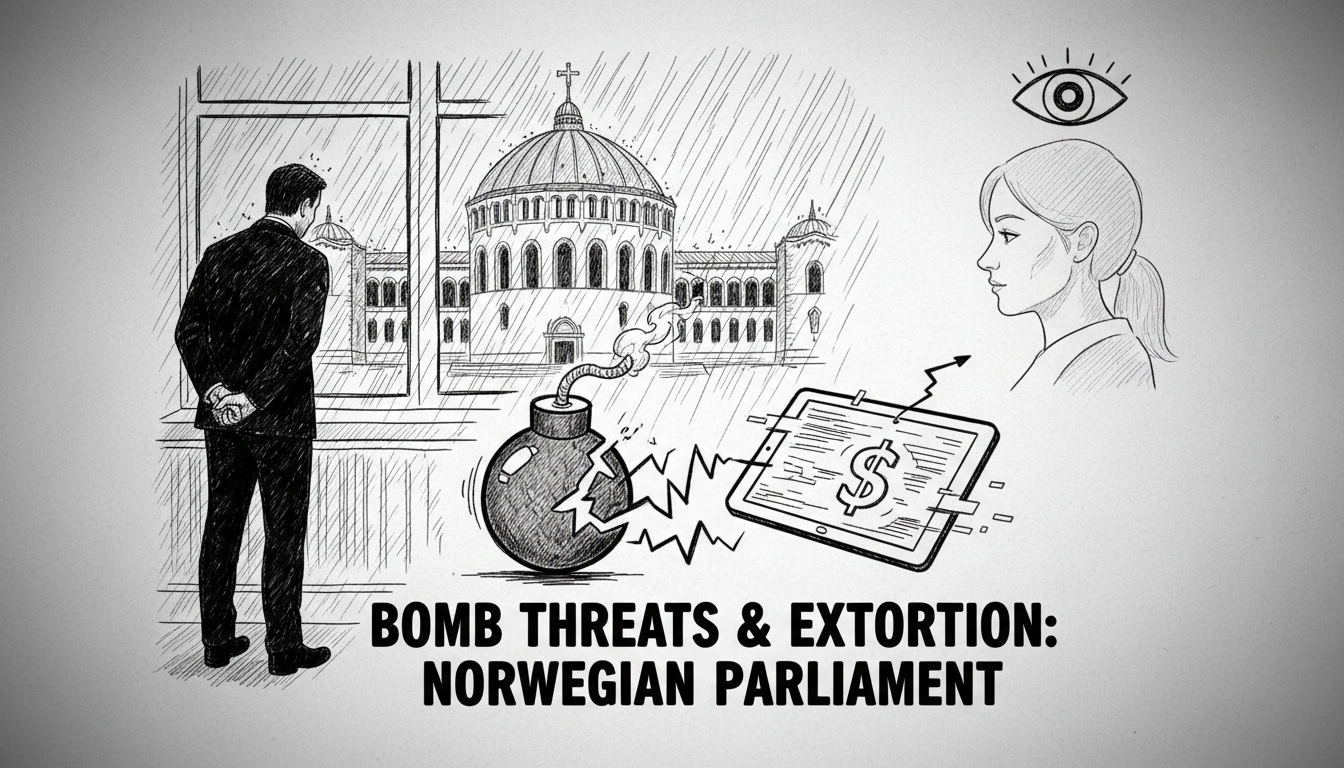
A man in his twenties has confessed to a series of serious crimes in a Norwegian court. The charges include multiple bomb threats against the Storting, Norway's parliament building in Oslo. He also attempted to extort one billion kroner from billionaire industrialist Kjell Inge Røkke. The case involves threats against public figures and institutions, raising questions about security and the impact of such actions on democratic processes.
The defendant, a 27-year-old from Drammen, pleaded guilty to all charges as the trial opened in the Buskerud District Court. The comprehensive indictment was presented by prosecutor Christer Gangsø. The bomb threats against the Storting were sent over a four-month period. The first email went to the Prime Minister's Office. It stated the sender would travel to Oslo and bomb the parliament building to pieces. A later message claimed a bomb was already placed and would detonate at a specific time.
Prosecutors argued these actions were designed to influence the operations of the Storting. This directly targets the heart of Norwegian democracy. The threats occurred during a period of public events, including a children's election event on Eidsvolls Plass in front of the parliament. Such incidents force a reassessment of security protocols for national institutions. They also consume significant police and security service resources.
The extortion attempt targeted Kjell Inge Røkke and his company Aker. The defendant demanded the massive sum be transferred within one week. He warned the company would lose any legal case because he had a murderer on the case. No money was paid. The threats were repeated half a year later. This highlights the vulnerability of high-profile business figures to digital harassment and extortion.
A central part of the case involves threats against Nora Haukland. She is one of the complainants in the separate criminal case against Marius Borg Høiby. The defendant threatened to send a torpedo, meaning a hitman, to Haukland if she did not withdraw her accusations. Her legal counsel, Heidi Reisvang, stated the threats were very frightening and burdensome for Haukland. The timing of these threats, at the start of the investigation into the son of the Crown Princess, adds a layer of complexity and media scrutiny.
The pattern of behavior extended beyond these high-profile targets. The man is charged under penal code paragraph 263 for threats intended to cause serious fear. Over the previous year, he sent 16 such emails to various entities. Recipients included the Tax Administration, Helse Bergen hospital, Drammen municipality, the South-East police district, and the Orkla industrial group. In one message to Orkla, he threatened to kill businessman Stein Erik Hagen with a torpedo, calling himself Norway's most dangerous person.
Forensic psychiatrists assessed the man and diagnosed him with a mild intellectual disability. He was deemed criminally responsible for his actions. The prosecutor stated the defendant had no real plans to carry out the threats. The actions were nonetheless effective in creating genuine fear among the victims. This distinction between intent and impact is crucial in such legal proceedings.
Victim testimony revealed the wider ripple effects of the threats. One woman explained her son was friends with the accused. The defendant had used her son's name in threatening emails to Røkke. The family was shocked to find their son implicated in criminal activity without his knowledge. The woman also received death threats against her own son. When the accused mentioned sending threats to the Royal Palace, she immediately contacted the police. Her son required psychological support following the ordeal.
Another victim, who had been the defendant's guardian, felt so threatened he moved to a secret address. He described being alone at a mountain cabin when police called about threats to set his house on fire. He was terrified for his partner who was at home. This illustrates the profound personal disruption caused by such sustained campaigns of fear.
The trial is scheduled for five days at the Drammen Courthouse. Multiple witnesses are called, including Nora Haukland who will testify about her experience. The case underscores a challenging modern reality. Digital communication allows individuals to launch widespread campaigns of intimidation against state institutions, businesses, and private citizens from a distance. The Norwegian legal system is now tasked with delivering a proportionate response. The outcome will signal how seriously the country treats threats to its core democratic and social structures.