
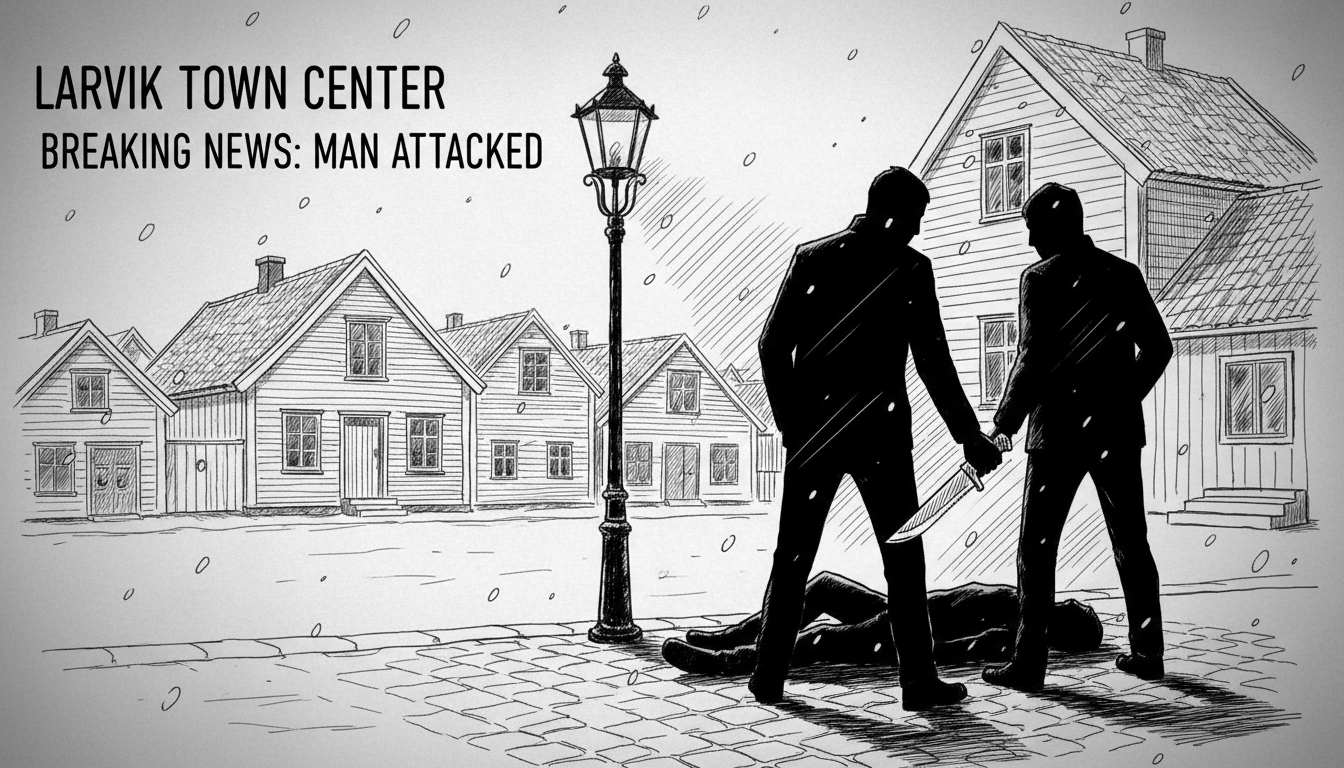
A man in his thirties received emergency medical treatment after a violent attack in Larvik town center on Sunday evening. The victim suffered multiple blows to the head and faced threats from a knife-wielding assailant. Police searched the Øvre Torggate area for two suspects but called off the operation around 8:30 PM. Authorities confirmed all parties involved had previous encounters with law enforcement.
Violent crime in Norwegian towns remains relatively rare compared to other European countries. Norway typically reports low violent crime rates, with most incidents occurring among individuals who already know each other. This pattern appears consistent with the Larvik case, where police identified the parties as previously acquainted.
Larvik, a coastal town in Vestfold county with approximately 25,000 residents, rarely experiences such public violence. The town center location raises concerns about public safety in typically tranquil Norwegian communities. Local businesses and residents often express alarm when violence spills into public spaces.
Norwegian police procedures in such cases typically involve immediate medical response followed by suspect identification. The decision to end the search after approximately two hours suggests investigators had sufficient information to continue the investigation through other means. Law enforcement in Norway generally maintains high clearance rates for violent crimes.
What does this incident reveal about public safety in smaller Norwegian communities? While isolated violent events occur, Norway's comprehensive social welfare system and proactive policing usually prevent escalation. The country's emphasis on rehabilitation over pure punishment often changes how authorities approach crimes between acquaintances.
The immediate medical response demonstrates Norway's robust emergency care system. All residents, including foreign visitors, receive necessary medical treatment regardless of insurance status. This approach reflects the country's commitment to universal healthcare access.
Similar incidents in other Nordic countries show varying patterns. Sweden has reported higher rates of public violence in recent years, while Denmark and Finland maintain profiles closer to Norway's. The Nordic model of social welfare appears to influence crime statistics, though no system completely eliminates violence.
International residents in Norway should understand that while such incidents are concerning, they remain exceptional. The country consistently ranks among the world's safest nations. Visitors and expatriates can generally feel secure in Norwegian towns and cities.
Police investigations typically continue after initial search operations conclude. Norwegian law enforcement often relies on witness statements, CCTV footage, and forensic evidence to build cases. The judicial process emphasizes thorough investigation over rapid arrests.
This incident serves as a reminder that no community remains entirely immune to violence. Yet Norway's systemic approach to public safety and social welfare continues to distinguish it from many other nations. The country's investment in social services and community policing generally contains such events as isolated cases rather than patterns.