
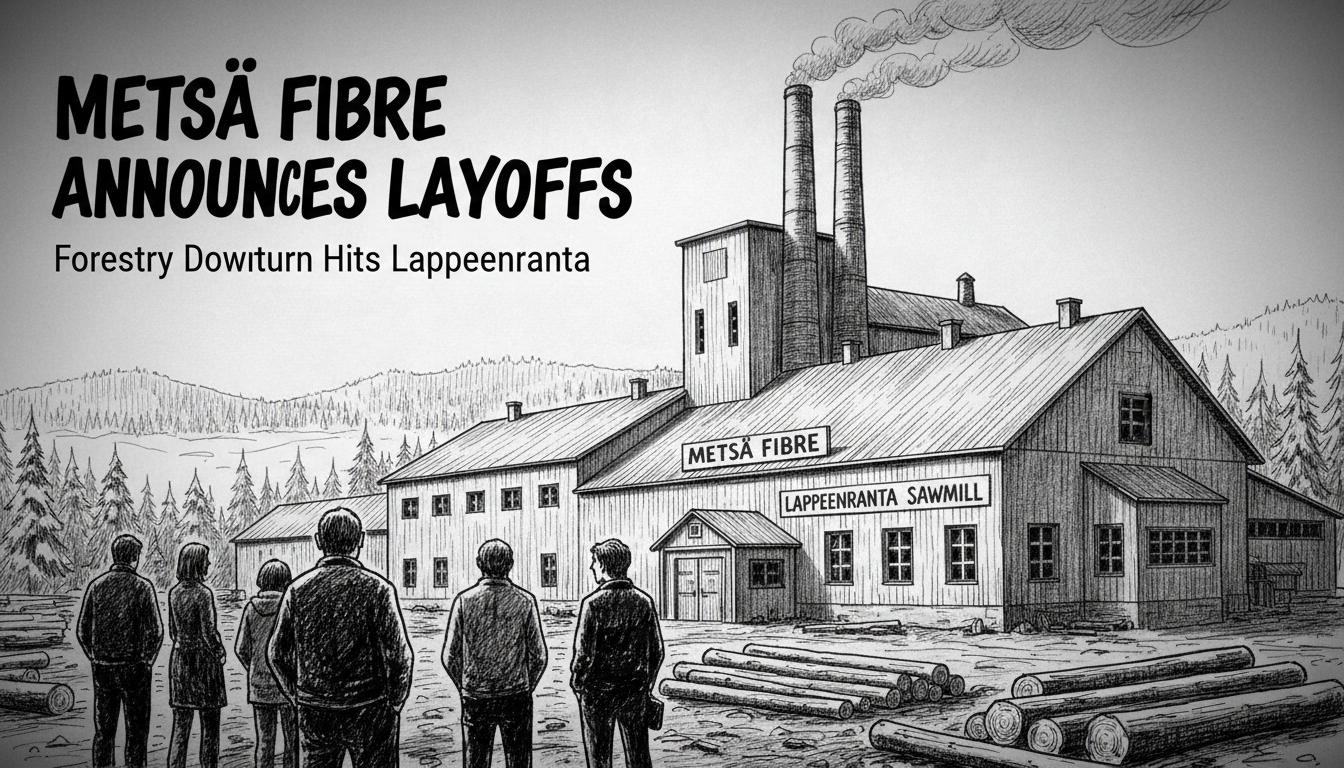
Metsä Fibre, a major Finnish forestry company, has concluded change negotiations at its Lappeenranta sawmill. The company announced it will implement temporary layoffs affecting the entire workforce for up to 90 days between January and June 2026. The decision stems from what the firm describes as a challenging market situation for sawn timber and difficult wood procurement conditions. This move signals deeper issues within Finland's crucial forestry sector, a cornerstone of the national economy located in the southeastern region near the Russian border.
The planned layoffs at the Lappeenranta sawmill reflect a broader European trend affecting the timber industry. High energy costs, reduced construction activity in key markets like Germany, and complex export logistics have created a perfect storm. The Finnish government, currently led by Prime Minister Petteri Orpo's coalition, monitors these developments closely. Forestry remains a vital export industry and a significant employer in rural regions like South Karelia, where Lappeenranta is a key industrial city.
Historical context is important here. The Finnish forestry sector has undergone several restructurings in recent decades, adapting to global competition and digitalization. However, the current combination of economic pressures appears particularly acute. The government's Ministry of Economic Affairs and Employment often engages in tripartite discussions with industry representatives and labor unions like the Industrial Union (Teollisuusliitto) during such periods. These talks aim to balance necessary economic adjustments with social stability.
For international readers and investors, this news highlights the interconnected nature of the Nordic economy. Finland's forestry products are a major export to European and Asian markets. Disruptions in production can ripple through supply chains for construction, packaging, and bioenergy. The temporary nature of the layoffs suggests Metsä Fibre anticipates a market recovery, but the six-month window indicates significant uncertainty. The company's statement did not specify potential support measures for affected workers, a detail that local unions will likely press for in coming weeks.
This development also touches on Finland's green transition policies. The government promotes a bioeconomy strategy where forestry plays a central role. Sustained industrial downturns could impact investments in new, value-added bioproducts. Observers will watch how the state balances immediate support for traditional industry with its long-term climate and innovation goals. The situation in Lappeenranta serves as a real-time test case for Finland's economic resilience in a volatile global market.
The local impact in Lappeenranta will be substantial. As a major employer, Metsä Fibre's decisions directly affect the city's economy and community well-being. Municipal authorities often work with the state's employment services to provide retraining and support during layoff periods. The coming months will reveal whether this is an isolated adjustment or the beginning of a more prolonged contraction for the region's industrial base. The outcome will influence political debates in Helsinki about regional policy and industrial support.