
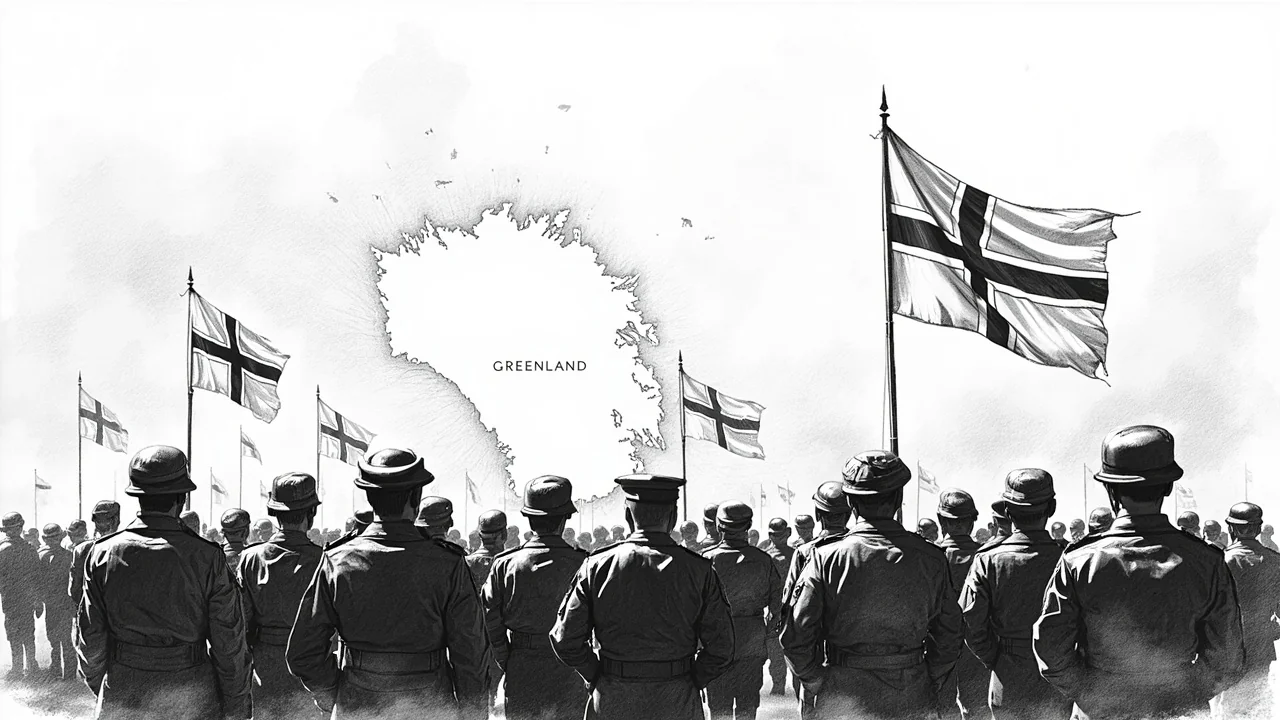
Nordic foreign ministers announced a joint defense pact for Greenland on January 6th, responding directly to recent US threats against the semiautonomous Danish territory. The declaration from Denmark, Finland, Iceland, Norway, and Sweden marks an unprecedented show of regional solidarity. It follows public statements by former US President Donald Trump regarding a potential seizure of the strategically vital Arctic island. "We stand united in our commitment to the territorial integrity and existing constitutional arrangements of the Nordic region," the five ministers said in their joint statement. This formal agreement has gained significant traction in recent days, with initial troop arrivals reported and major international wire services covering escalating Greenland tensions.
A Territorial Threat Revives Old Alliances
The core dilemma addressed by the pact is Denmark's limited capacity to defend Greenland alone. The vast, sparsely populated island falls under the Kingdom of Denmark's realm, with Copenhagen handling its defense and foreign policy. The prospect of a hostile US move under a potential future administration has forced a rapid reassessment of security assumptions across Northern Europe. The Nordic response transforms a bilateral Danish-American issue into a multilateral European security matter. This solidarity wave was explicitly triggered by the US statements, officials confirm, upending decades of stable trans-Atlantic relations in the Arctic.
The Nordic Response: Unity Over Sovereignty
The January 6th statement is a diplomatic instrument but carries concrete military implications. It formalizes a common Nordic position, effectively creating a deterrent based on collective political will. For Norway, with its extensive Arctic experience and shared maritime borders in the Barents Sea, the pact directly links Greenland's security to its own. Finnish and Swedish involvement, despite their own security arrangements, signals a pan-Nordic consensus that transcends individual membership in NATO or the European Union. Iceland's participation underscores the broad geographic concern, covering the North Atlantic sea lanes.
This alignment is not merely symbolic. It involves coordinated planning and intelligence sharing between the five nations' defense ministries. The pact facilitates logistical support and could enable the prepositioning of equipment or personnel. It represents a significant policy shift, moving from loose cooperation to a defined mutual understanding on protecting a specific territory. The ministers framed the move as protective of existing international law and the peaceful development of the Arctic region.
Troops Move North As Rhetoric Heats Up
In the days following the statement's release, reports have confirmed initial troop movements towards the broader Arctic region. While details remain classified, the deployments are seen as a tangible demonstration of the commitment outlined on paper. These actions are a direct reaction to the escalating tensions highlighted in recent Reuters and Associated Press coverage. The situation presents a profound challenge for Denmark, which must balance its role as Greenland's sovereign defender with its deep historical ties to the United States.
The Danish government now operates with the explicit backing of its Nordic neighbors, a factor that strengthens its diplomatic hand. This support is crucial for managing Greenland's own Home Rule government, which holds authority over most domestic affairs. The unified Nordic front aims to provide stability and reassurance to the local population in Nuuk and other settlements. It also sends a clear signal to other global actors observing the increasing competition for Arctic influence and resources.
The Arctic Equation Shifts
The Greenland defense pact fundamentally alters the strategic calculus in the High North. It introduces a new, cohesive bloc focused on regional stability under existing legal frameworks. For Norway, this means its Arctic policy, often focused on the Barents Sea and Svalbard, must now explicitly account for security dynamics west of its coast. The collective move protects critical future shipping lanes and resource exploration areas from unilateral disruption.
Energy security is a subtext, as the Arctic shelf holds significant untapped reserves. A destabilized Greenland could threaten the entire region's investment climate. The Nordic ministers' statement deliberately avoids aggressive posturing, instead emphasizing a commitment to rules-based order. This measured approach aims to de-escalate tensions while firmly drawing a line against territorial adventurism. The success of this strategy depends on sustained unity and the willingness to back diplomatic words with credible capability.
An Uncharted Path Forward
The coming months will test the durability of this Nordic alliance. Its formation marks a historic moment of regional independence in security policy, born from an external shock. The pact places Greenland at the center of a new defense architecture, with implications for every nation with interests north of the Arctic Circle. It raises immediate questions about the future of US-Nordic relations, which have been cornerstone partnerships for generations. Can this united front maintain stability, or will it become a new fault line in a rapidly changing geopolitical landscape? The arrival of troops suggests the five capitals are preparing for the latter, while hoping their unified stance makes such preparations unnecessary.