
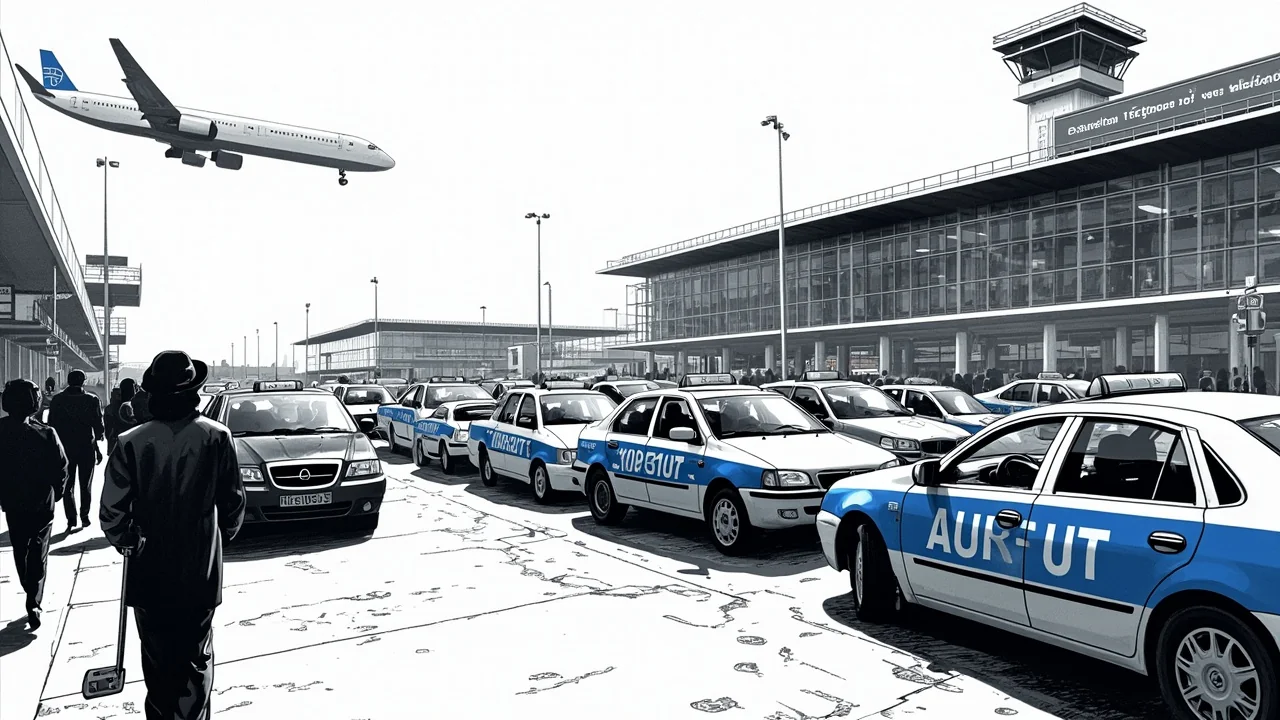
Bergen Airport Flesland faces major travel disruption as a significant group of taxi license holders and drivers began a strike at 09:00 Monday. The drivers announced the action in a press release sent out overnight, citing an 'untenable' situation and a deadlocked conflict with airport operator Avinor over the current taxi arrangement and queue system.
The press release did not specify which companies the strike involves or the number of license holders affected. However, it is understood that the strike does not include Bergen Taxi, which is not part of the automated scheme at the airport. The core of the dispute is the mandatory system drivers must use to get fares from the airport queue.
Drivers Describe 'Untenable' Working Conditions
In their statement, the striking drivers painted a bleak picture of their current working conditions. They reported wait times of up to five to six hours for a single trip and incomes that, in practice, do not cover their costs. They also criticized a forced price war that pushes fares from the airport down to between 300 and 400 kroner.
'Drivers are experiencing wait times of up to 5–6 hours for a single trip, incomes that practically do not cover costs, and a forced price war that pushes prices down towards 300–400 kroner from the airport,' the drivers wrote. They described the situation as now 'completely untenable.'
Grievances Over Fees and Lack of Enforcement
The drivers' complaints extend beyond long waits and low fares. They also highlighted high fees for staying in the queue and a lack of control and enforcement of rules. This, they argue, creates chaotic conditions for both drivers and passengers trying to get a cab from Norway's second-largest airport.
They claim their attempts at dialogue with Avinor over a long period, through meetings and written inquiries, have been futile. The drivers feel Avinor has not taken the situation seriously and that real improvements are lacking. They emphasized that using the system is not a free choice for them.
'It is important to emphasize that taxi drivers are in practice forced to use this system because the airport is one of our most important workplaces. This is not a free choice. The strike is the last resort,' the statement read.
A System Under Fire
The automated taxi scheme at Flesland has been a point of contention for years. It is designed to manage the flow of taxis and ensure fair access to passengers. Drivers take a numbered ticket and wait in a designated holding area until their number is called for the next available passenger at the official taxi rank.
Critics, like the striking drivers, argue the system is poorly managed. They say it leads to excessive, unpaid waiting times and forces them into cut-throat competition on price the moment they pick up a fare. The high fees for participating in the queue further eat into their already thin margins on airport trips.
Impact on Passengers and Travel
The immediate impact of the strike is significant uncertainty for passengers arriving at Flesland. While Bergen Taxi and other operators not participating in the strike will still be available, their capacity will be limited. Passengers can expect longer waits for taxis and should consider alternative transport options like the airport express bus (Flybussen), the light rail (Bybanen), or pre-booking private transfers.
Avinor has not yet issued a detailed public response to the strike announcement. The airport operator typically emphasizes that its systems are designed to ensure orderly and efficient passenger service. They have previously stated that regulations are in place to guarantee fair competition and service quality for travelers.
A Last Resort Action
The drivers framed the strike as a measure of desperation taken only after all other avenues failed. Their statement underscores the economic pressure they face, portraying the airport not as a lucrative hub but as a problematic workplace they are compelled to use due to its importance to their business.
'We have over a long period attempted dialogue with Avinor through meetings and written inquiries. Despite this, we experience that Avinor has not taken the situation seriously, and that real improvements are absent,' they wrote. This language suggests a deep breakdown in trust between the drivers and the airport's management.
Looking for a Resolution
The strike throws a spotlight on the complex ecosystem of ground transport at major airports. It pits the need for airport operators to manage curbside congestion and passenger experience against the economic viability of the drivers who provide an essential service. Similar disputes over queue systems and fees have erupted at other Norwegian airports in the past.
The resolution will likely hinge on Avinor's willingness to re-negotiate aspects of the current scheme. Potential compromises could involve revising the queue fee structure, implementing stricter rules to prevent price undercutting at the rank, or modifying the dispatch system to reduce average wait times for drivers. For now, passengers are caught in the middle of an industrial action that shows no immediate signs of ending.