
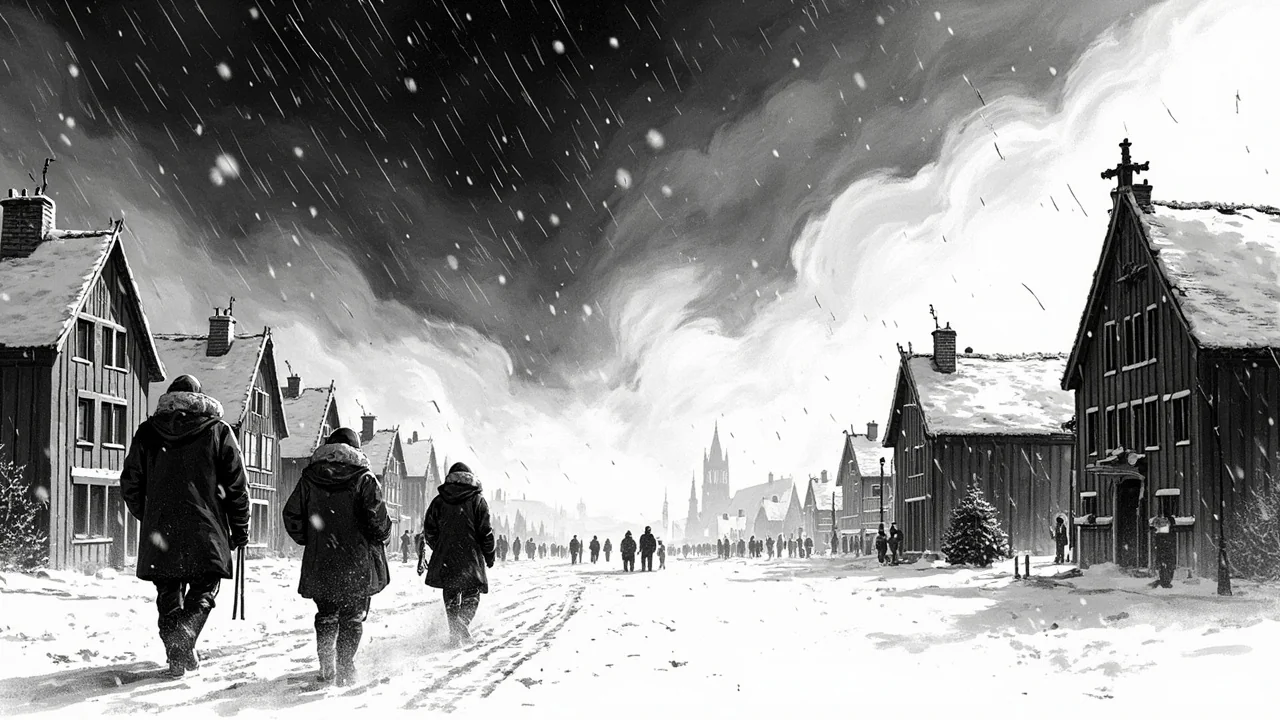
Norway's Meteorological Institute has issued a stark warning for significant disruption across southern and western regions this week, with meteorologists forecasting a chaotic mix of heavy snow, rain, and severe wind. The agency is preparing to issue formal weather warnings for Oslo on Wednesday, where up to 25 centimeters of snow could fall within 24 hours, creating hazardous conditions for the capital's transport and infrastructure.
"It will likely be quite 'baluba' in Oslo," said duty meteorologist Sigrid Auganæs, using a colloquial Norwegian term for chaotic, messy situations. The uncertainty lies in the precise position of the sleet line, which will determine whether the precipitation falls as snow or rain. Current models suggest the downpour will start as snow before gradually turning to rain as temperatures rise throughout Wednesday. Areas further inland may retain snow cover, while central Oslo could see a heavy, wet snowfall.
"Oslo city center is right on the borderline," Auganæs explained. "It might also get a proper top-up of snow. It will be bad regardless." She offered concrete advice to residents: shovel existing snow now before the milder weather arrives. "When the rain comes, the snow will become very heavy to shovel away. If cold weather returns after that, it will turn to solid ice and be very difficult to move." The transition is expected to create extremely slippery road conditions across southern Norway.
A Nationwide Weather Disruption
The impending storm in Oslo is part of a broader pattern of severe weather affecting multiple regions. The Meteorological Institute has already issued a yellow warning for strong wind gusts along the West Coast and parts of Agder and Telemark. More severe orange warnings are in effect for avalanche danger in Hardanger and Voss, and for heavy snow in outer districts of Agder, where snowfall has already begun intensely.
In Agder, meteorologists predict up to 40 centimeters of snow could accumulate during Wednesday alone. The severe conditions have already caused significant travel disruption. At Stavanger Airport, air traffic was completely halted during Monday morning hours due to the weather, with operations severely hampered.
The Economic and Logistical Toll
Such weather events carry a substantial economic cost for Norway, impacting key sectors from transportation and energy to retail and public services. Oslo's role as the nation's administrative and business hub means any major disruption there ripples across the entire country. Delays in road haulage, public transport cancellations, and airport closures disrupt supply chains and workforce mobility.
The energy sector also watches these forecasts closely. While hydropower reservoirs welcome precipitation, the form it takes matters. Heavy, wet snow can damage power lines and distribution infrastructure, leading to outages. The variable conditions—snow turning to rain and potentially freezing again—pose the greatest risk to grid stability in rural and coastal areas already under wind warnings.
From a policy perspective, these repeated severe weather events test municipal preparedness and national coordination. Oslo's municipal government, led by Mayor Eirik Lae Solberg of the Conservative Party, must activate winter response plans, deploying snow-clearing equipment and ensuring emergency services are on high alert. The frequency of such storms fuels ongoing debate in the Storting about infrastructure investment and climate adaptation, particularly for vital road and rail links vulnerable to weather closures.
Expert Analysis on a Warming Climate
While a single storm cannot be directly attributed to climate change, meteorologists note that warming Arctic and North Atlantic temperatures are influencing weather patterns in Scandinavia. "We are observing trends toward more intense precipitation events, even in winter," a climate researcher at the University of Oslo noted recently in a public briefing. "The boundary between snow and rain becomes more volatile, leading to precisely the kind of complex, hazardous conditions we're seeing forecast for Wednesday."
This volatility presents a growing challenge for forecasters and civil authorities. The term "baluba" perfectly captures the unpredictable, messy outcome when multiple weather systems collide. For emergency planners, the worst-case scenario often involves rapid transitions that create multiple hazards: snow loading on roofs, followed by rain adding weight, then a freeze creating widespread ice.
Public Advisory and Preparedness
The consistent advice from the Meteorological Institute and the Norwegian Water Resources and Energy Directorate (NVE) is for the public to take warnings seriously and prepare. This includes securing loose outdoor items ahead of high winds, checking travel plans with transport operators, and ensuring households have necessary supplies if conditions prevent travel.
For motorists, the message is emphatic: expect difficult driving conditions and consider postponing non-essential travel. The combination of snow, potential freezing rain, and strong winds dramatically increases accident risk. Public transport in Oslo, including the T-bane metro and bus networks, often experiences delays and cancellations during such events, prompting commuters to plan for remote work where possible.
Local authorities in Agder and Rogaland are already dealing with the early impacts, focusing on keeping major highways like the E18 and E39 passable. The avalanche warnings for Hardanger and Voss trigger protocols for road closures and increased monitoring in mountainous areas, critical for both local residents and the important tourism industry in those regions.
Looking Beyond the Storm
As Norway braces for this mid-week disruption, the event underscores the nation's ongoing relationship with its formidable weather. The efficient management of such crises is a point of national pride, but also a recurring cost. Each major storm renews discussions about the resilience of modern infrastructure against ancient climatic forces.
The coming days will test systems and preparedness. Will Oslo's snow-clearing fleet manage the wet, heavy load? Can power companies keep lines intact against icing and wind? The answers will be written in the details of response and recovery. For now, the meteorologists' advice is simple: keep a close eye on the updated forecasts, and be ready for a period of classic Norwegian winter 'baluba.' The only certainty is that by Thursday, the conversation will have shifted from forecasts to aftermath, and the inevitable analysis of how well the country weathered the latest blow from the skies.