
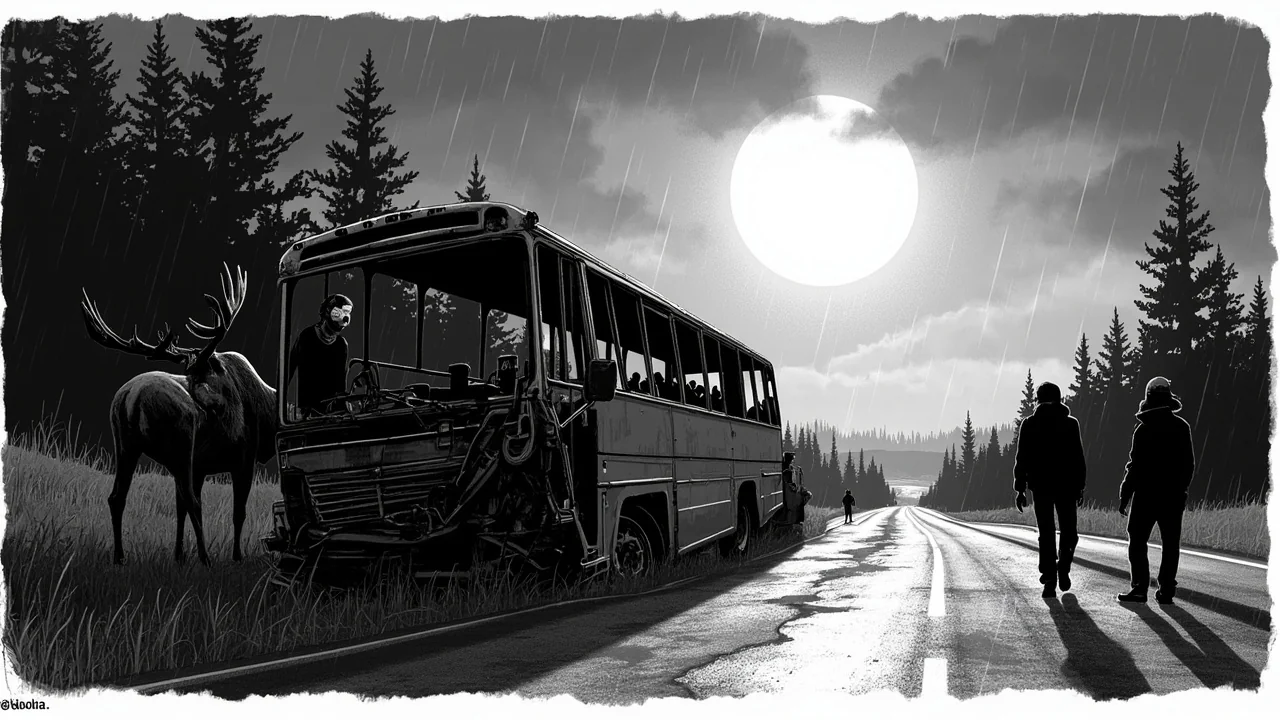
Norway’s E16 highway was the scene of a dramatic collision early Friday when a long-distance bus struck a moose, leaving the vehicle a write-off. The incident occurred between Flå and Nesbyen in the Hallingdal valley. Nobody was hurt, but the moose had to be put down at the scene.
The Moment of Impact
Passenger Dag Venjum was reading when it happened. "I sat and read, and suddenly there was a thud," Venjum said. "The bus stopped at once, and the driver told us it was a moose." According to his account, there were two animals in the road. The bus hit one directly and grazed the other before it ran back into the forest. The driver, following procedure, stopped immediately after the collision. Police and emergency services responded quickly to secure the area and assist the passengers.
Operator Confirms Major Damage
Communications chief Siv Egger Westin for the bus company Vy confirmed the details. "The bus was on its way from Førde to Oslo," Westin said. "Between Flå and Nesbyen, it hit a moose." She emphasized that neither the driver nor any of the passengers were injured. The condition of the bus, however, was severe. "There are major damages to the bus," Westin stated, describing it as totalled. The company arranged for alternative transport to get the stranded travellers to their final destination in Oslo. A replacement bus was dispatched from a nearby depot.
A Recurrent Hazard on Norwegian Roads
This type of accident isn't uncommon in Norway, especially on rural highways like the E16 that cut through dense woodland and mountainous terrain. The moose population is robust, and collisions pose a significant risk year-round. They spike during dawn and dusk in the autumn mating season and in winter when animals move to clearer roads for easier travel and access to roadside salt. Statistics from the Norwegian Public Roads Administration show thousands of such accidents annually, resulting in serious vehicle damage, human injuries, and of course, the death of the animals. The economic cost runs into hundreds of millions of kroner each year when accounting for vehicle repairs, medical costs, and lost property.
Safety Measures and Ongoing Challenges
Authorities have tried to mitigate the risk for decades. Key measures include extensive fencing along high-risk road sections, clearing vegetation back from roadways to improve visibility for drivers, and the construction of wildlife crossings like green bridges and underpasses. Warning signs with reflective moose silhouettes are a familiar sight for Norwegian drivers. But the vast geography makes a comprehensive solution incredibly difficult and expensive. The stretch of E16 where this accident happened is known as a hotspot. Local councils and the national roads administration have debated additional fencing here before, but projects are often delayed by budgeting and environmental considerations.
The Aftermath and Response
For the passengers, the shock was palpable but tempered by relief. The structural integrity of modern coaches, designed with high driver positions and reinforced frames, often prevents catastrophic human injury in such collisions. The bus involved was likely travelling at or near the 80 km/h speed limit common on that highway section. An investigation by police will confirm the exact speed and circumstances. The driver, while unharmed physically, will undergo standard company procedures following a serious incident. This typically includes drug and alcohol testing, a debriefing, and potential leave. Vy stated that driver and passenger welfare was their immediate priority. The wrecked bus was eventually towed to a garage for assessment, but the damage was so extensive it's considered a total loss.
A National Issue with Local Consequences
Every accident like this reignites the debate over wildlife management and road safety in Norway. It’s a complex balance between preserving large animal populations and protecting human life and property. Hunting quotas are a primary tool for population control, but their effectiveness in reducing road accidents is debated by experts. For rural municipalities, a sudden moose collision can block a vital transport artery for hours, disrupting commuters and freight. The clean-up operation itself is a hazardous task for emergency crews who must work close to fast-moving traffic. The remains of the moose are usually processed by local hunters or authorities, as the meat is often salvaged.
Looking Ahead
The fact that everyone walked away is the positive takeaway. But it underscores a persistent, dangerous flaw in Norway’s infrastructure. The government's National Transport Plan periodically allocates funds for more fencing and crossings, yet progress is slow. For now, the onus remains heavily on drivers to be extra vigilant, particularly on roads like the E16 through Hallingdal. They're advised to reduce speed in marked areas, use high beams when possible, and never swerve violently for an animal, which can lead to even worse outcomes. The bus from Førde won’t be making any more trips. Its final run ended with a sudden thud on a dark road, a story repeated far too often across the country.