
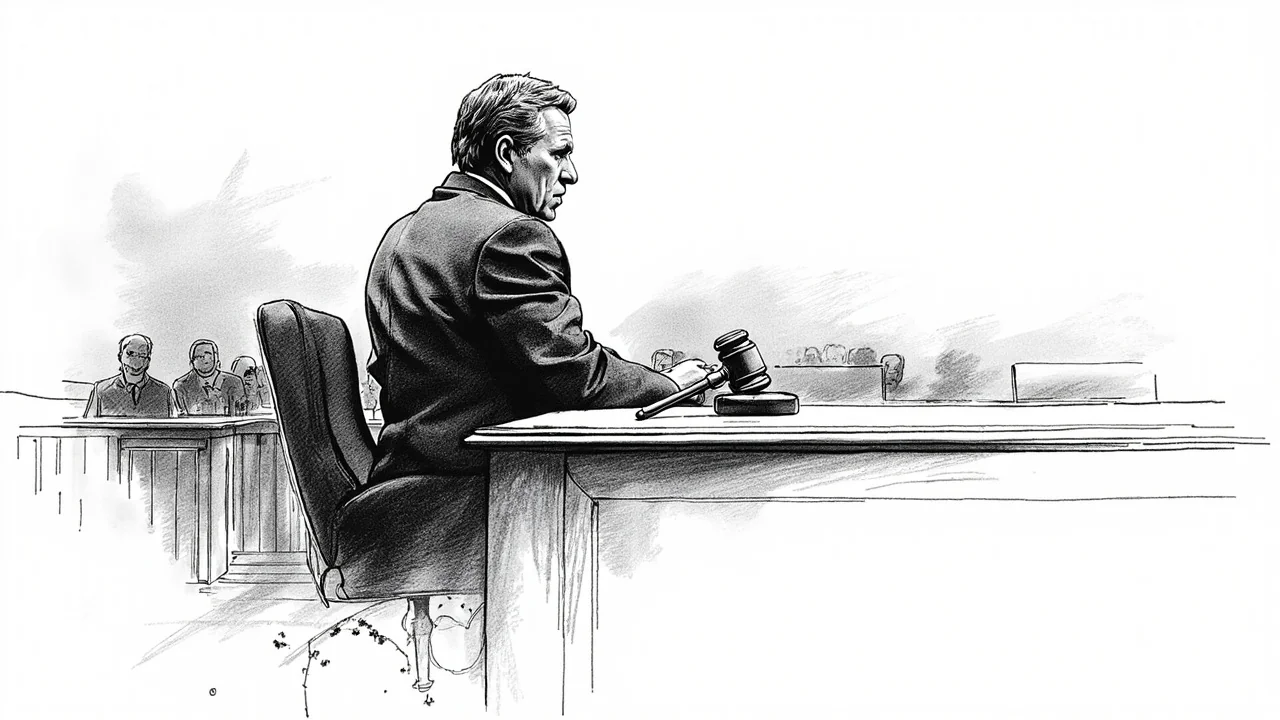
Norway's Oslo District Court has delivered its harshest possible sentence in a landmark terrorism case. Arfan Bhatti was unanimously sentenced to 30 years of preventive detention, with a minimum serving time of 20 years, for his role in planning and facilitating the 2022 Oslo nightlife shooting. The verdict, read on January 16, 2026, concludes that Bhatti acted with terrorist intent, aiming for the Islamic State to claim responsibility for the attack carried out by Zaniar Matapour.
A Courtroom's Heavy Silence
The atmosphere in courtroom 250 was tense before the judgment. Minutes before noon, Bhatti appeared relaxed, smiling and waving to friends and family with his black bubble jacket slung over his shoulders. The gravity of the moment, however, weighed heavily on the rows of attendees. When the court administrator and lay judges entered precisely at 12, the conclusion came immediately. The room fell completely silent upon hearing the sentence. Some of Bhatti's closest relatives bowed their heads, their eyes turning red—a stark reminder that the convicted terrorist is also a father, brother, son, and uncle.
A Path Forged in Early Violence
This sentence marks a potential end to a lifelong criminal career that began when Bhatti was just 13. His initial involvement was with the Young Guns gang, known as a precursor to later notorious groups. Despite his resourceful family's efforts to remove him from the environment, including extended trips to Pakistan, Bhatti continued on a violent path. At only 15 years old, he committed the act that led to his first violent crime conviction. He smashed a soda bottle over a shopkeeper's head, stabbed the man multiple times in the stomach and chest, and then sat on the counter to eat a chocolate bar.
This early crime triggered the first of many psychiatric evaluations. In 1994, court-appointed psychiatrists initially did not find him to have underdeveloped mental faculties. That conclusion was reversed just two years later, following another examination after Bhatti shot a man during a debt collection. The cycle of court hearings and expert assessments would define much of his life.
The Psychological Profile of a Convicted Terrorist
The psychiatric assessments conducted for this terrorism trial presented a severe diagnosis. Bhatti had previously received diagnoses of dissocial personality disorder in 2002 and 2008. In the autumn prior to this verdict, the court-appointed experts diagnosed him with the subcategory of psychopathy. Bhatti achieved a maximal score on the psychopathy test administered by these specialists. Their findings painted a picture of a man with a profound lack of empathy and remorse, factors the court considered in its sentencing rationale.
This detailed psychological history was integral to the court's process. It provided a clinical backdrop to a life of escalating criminality, from teenage gang violence to a central role in a deadly terrorist plot. The unanimous verdict indicates the judges found this evidence compelling and clear, leaving no reasonable doubt about his terrorist intentions and actions.
The Unshakable Verdict and its Foundation
The court expressed no uncertainty in its ruling. It found it proven beyond a reasonable doubt that Zaniar Matapour acted with terrorist intent when he fired wildly outside the Per på hjørnet and London Pub venues on the night of June 25, 2022. Critically, the court was also convinced that Arfan Bhatti, similarly with terrorist intent, participated in planning and facilitating the terrorist act. The intended goal, as established by the court, was for the Islamic State to claim responsibility for the violence.
The location of the attack added a poignant layer to the proceedings. The shootings occurred a mere 100 meters from the courthouse, physically anchoring the tragedy to the place where justice was being delivered years later. This proximity served as a constant, somber reminder of the real-world consequences of the plans Bhatti helped lay.
The Weight of Preventive Detention
The sentence of forvaring, or preventive detention, is Norway's most severe penalty. It is reserved for cases where the court believes the offender poses a significant continued danger to society. Unlike a standard prison sentence with a fixed end date, preventive detention includes a minimum period that must be served—in this case, 20 years. After that minimum, the prisoner can only be released if they are no longer considered a danger. This can, in effect, become a life sentence if the individual is never deemed safe for release.
By imposing this sentence, the court has sent a definitive message about the severity of Bhatti's crimes. It represents a judicial determination that his risk of re-offending with extreme violence remains unacceptably high. The unanimous nature of the decision underscores the strength of the evidence presented against him, from his detailed psychological profile to his established actions in the lead-up to the attack.
The verdict closes a major chapter in Norway's legal reckoning with the 2022 attack. It holds one of the alleged planners criminally responsible to the fullest extent of Norwegian law. For the victims and the nation, the sentence provides a measure of judicial finality. For Arfan Bhatti, it potentially marks the end of a decades-long journey through the criminal justice system, one that began with a soda bottle and a chocolate bar and culminated in a terrorism conviction that will keep him behind bars for decades, if not for life.