
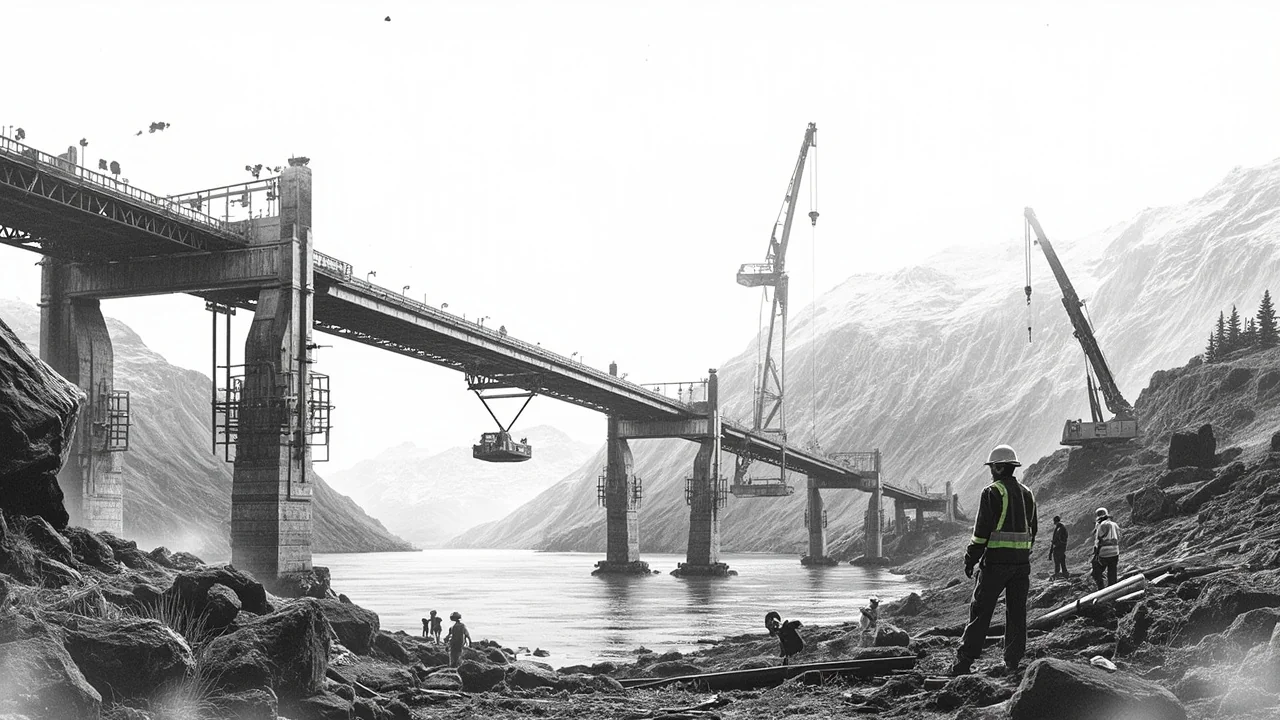
Norway's E18 bridges at Sandvika must be demolished and rebuilt at a cost of 14 billion kroner, new state calculations show, pushing a tunnel alternative into the spotlight for one of the country's busiest highways. The revelation from the Norwegian Public Roads Administration comes as weekend repairs have already snarled traffic around the Oslofjord, hinting at the disruptions ahead for commuters and businesses in Bærum municipality. With the bridges deemed irreparable, the massive price tag for replacement is forcing a reevaluation of the entire E18 expansion plan west of Oslo, balancing colossal infrastructure spending against daily travel chaos.
Traffic Gridlock and a Fiscal Shock
For drivers enduring recent partial closures on the E18 near Sandvika, the new reports confirm their worst fears: the inconvenience is only a precursor. Tom Hedalen, project chief for the E18 development at the Norwegian Public Roads Administration, stated bluntly that maintenance is off the table. 'Here, it is not a question of upkeep or upgrade. The bridges must be demolished and built completely anew,' Hedalen said. He outlined a scenario where rebuilding the bridges would require a temporary structure in the Oslofjord, leading to 'very many disadvantages' for neighbors, Sandvika town center, and traffic management. The 14 billion kroner estimate—a figure that dwarfs many annual municipal budgets—transforms what was a transport upgrade into a fiscal and logistical crisis, directly impacting the tens of thousands who rely on this arterial route into the capital.
The Engineering Reality: Total Replacement
The bridges' poor condition, as detailed in the latest assessments, means that piecemeal fixes are economically and structurally futile. Hedalen emphasized that demolition is the only viable path forward if bridges are to remain the solution. This process would not be a simple overlay but a years-long endeavor involving complex marine construction in the busy fjord waters. The cost breakdown, while not specified in public documents, encompasses the complete removal of existing structures, environmental safeguards for the Oslofjord, and the construction of new, modern bridges capable of handling future traffic loads. The scale immediately raises questions about the opportunity cost, such as whether those billions could be better spent on other transport projects across Akershus county or the national rail network.
Tunnel Alternative Gains Urgent Momentum
Faced with the staggering bridge cost, the Public Roads Administration itself notes that a tunnel under Sandvika now appears 'far more socio-economically rational.' This shift is not merely theoretical, it represents a potential pivot in Norway's long-term infrastructure planning. Bærum's Mayor, Lisbeth Hammer Krog of the Conservative Party, hailed the development as 'fantastic news and a clear breakthrough for a new E18 through Bærum.' Her statement underscores the political dimension, where local leaders have likely advocated for a tunnel to minimize surface disruption and free up land in the dense Sandvika area. The tunnel option, previously perhaps considered too expensive or complex, is now economically competitive, if not superior, when weighed against the combined costs of bridge demolition, new construction, and the immense social cost of prolonged traffic diversions.
The Broader Context: Norway's Infrastructure Crossroads
This decision point for the E18 mirrors larger debates in Norwegian politics about sustainable transport and the lifecycle of post-war infrastructure. The E18 corridor is crucial for freight and commuters linking Oslo to the west, and its state influences national productivity. The 14 billion kroner figure will inevitably be scrutinized by the Storting's transport committee, with implications for how other aging bridges along Norway's coast—from the Bergen area to Trondheimsfjorden—are assessed. Furthermore, the timing is critical: with ongoing climate goals to reduce car dependency, investing in a massive new road bridge versus a tunnel could send different signals about modal shift priorities. The Public Roads Administration's calculations will feed directly into the national transport plan, influencing budget allocations for years.
Navigating the Path Forward
Immediate next steps involve formalizing the updated cost analyses and presenting them to the Ministry of Transport. A full comparative study of the tunnel versus bridge options, detailing not just construction but long-term maintenance, environmental impact, and traffic flow efficiency, will be essential. Public consultations in Bærum and neighboring municipalities will likely intensify, given the direct impact on property and daily life. The ongoing repair work on the bridges, a stopgap measure, serves as a constant reminder of the degrading infrastructure. For now, drivers can expect more weekend closures as authorities manage the existing structures' safety. The final decision, whether for a tunnel or a new bridge complex, will set a precedent for how Norway manages the renewal of its most critical—and costly—transport links in an era of fiscal constraint and environmental scrutiny. The question remains: will this 14 billion kroner revelation finally untangle the decades-old knot of E18 expansion, or will it lead to further delays and cost overruns on a project that Oslo's commuters cannot afford to wait for?