
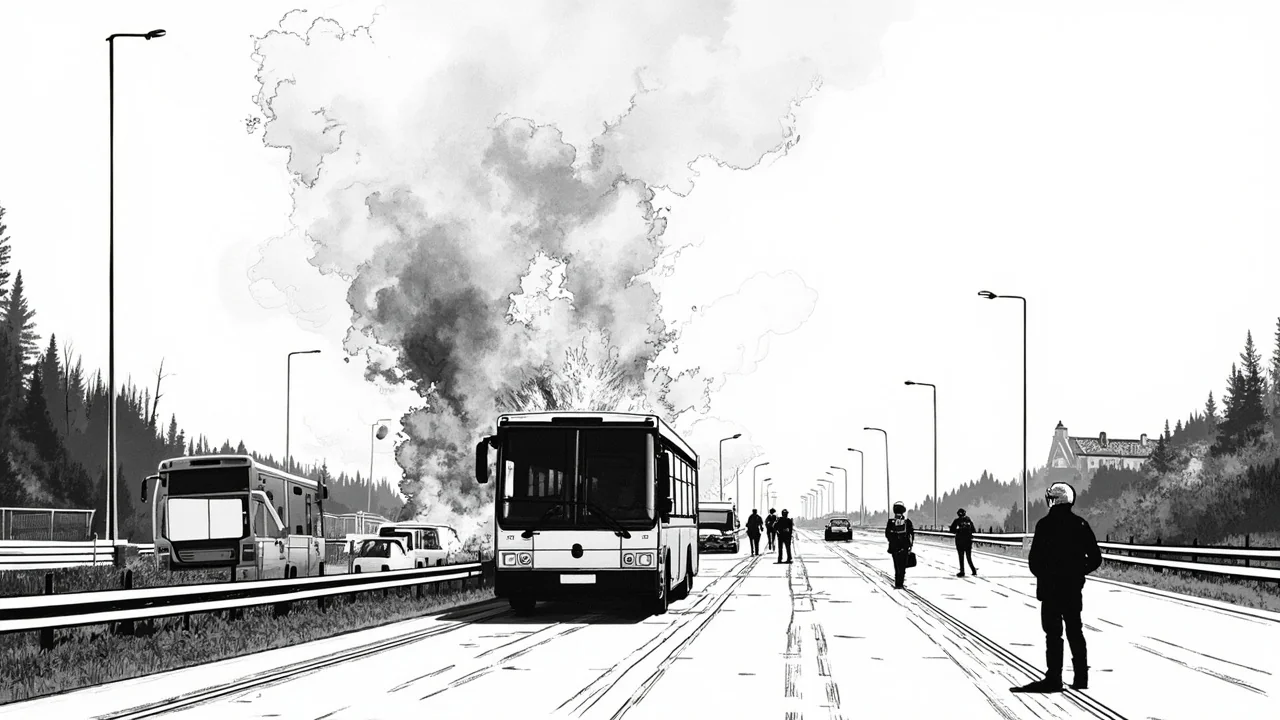
Norway’s E18 motorway faced major disruption Thursday afternoon after a significant fire erupted in an electric bus at Kongshavn in Oslo. Emergency services raced to the scene following reports of a collision between the bus and a passenger car just after 3:00 PM, prompting a full closure of inbound and outbound lanes during the busy pre-rush hour period.
Emergency Response and Immediate Aftermath
Police confirmed the incident at 3:05 PM, noting a collision occurred prior to the blaze. By 3:09 PM, authorities reported 'heavy smoke development and fire in the bus.' The driver of the bus was transported to a medical clinic for evaluation. A critical uncertainty facing the responding Oslo Fire and Rescue Service was the source of the flames. Initial reports indicated it was unclear whether the fire originated in the vehicle's high-voltage battery pack or within its electrical cabling systems. Firefighters worked to extinguish the fire and secure the vehicle for removal. Police confirmed the electric bus was not carrying any passengers at the time of the incident, a fact that likely prevented more serious casualties.
Oslo's Electric Bus Fleet and Safety Context
This incident places a spotlight on Oslo's extensive public transport network, which has aggressively transitioned to zero-emission vehicles. The city’s bus fleet includes numerous electric models, a cornerstone of urban environmental policy. Fires involving lithium-ion batteries, while statistically rare compared to internal combustion engine fires, present unique challenges for emergency services. Such batteries can burn at extremely high temperatures and are prone to reignition, often requiring large amounts of water or specific suppression agents to fully extinguish. The Kongshavn event will inevitably trigger a standard internal review by the bus operator and relevant safety authorities to determine the exact sequence of events, from the initial collision to the ignition of the fire.
Investigating the Cause and Source
Determining the precise cause is a multi-agency effort. The Norwegian Public Roads Administration, alongside police forensic teams and fire investigators, will examine the wreckage. A key focus will be differentiating between fire damage caused by a high-voltage battery thermal runaway event and fire stemming from damaged 12-volt electrical systems or other components ignited in the crash. The investigation will scrutinize the bus's crash sensors and battery management system data, if retrievable, to understand the vehicle's status moments before and after the collision. The findings will contribute to a growing body of data used by transport authorities and manufacturers globally to improve the safety of electric vehicles in crash scenarios.
Transport and Infrastructure Disruption
The closure of a main arterial route like the E18 at Kongshavn created immediate and severe congestion across eastern Oslo. The E18 serves as a critical link for commuters traveling between the city center and municipalities to the east and south. Traffic management systems diverted vehicles onto alternate routes, including RV190 and local streets through neighborhoods like Nordstrand and Lambertseter, which experienced significant spillover traffic. Public transport routes relying on the E18 corridor were also disrupted, with buses rerouted, leading to delays across the network. The Norwegian Public Roads Administration's traffic centers worked to update digital signage and navigation app feeds in real time to mitigate the gridlock.
Standard Procedures and Next Steps
Following the extinguishment of the fire, the priority shifted to clearing the roadway. Specialist recovery vehicles were required to safely handle the damaged electric bus. Due to the potential risk of residual energy in the battery, standard protocol likely involved isolating the high-voltage system and potentially placing the vehicle in a quarantine area for a cooling-off period before transport. The damaged passenger car was also removed from the scene. Once the vehicles were cleared, highway maintenance crews inspected the road surface for damage from heat, fluids, or firefighting foam before the police could reopen the lanes to traffic, a process that took several hours.
A Broader Look at Vehicle Safety
While dramatic, single-vehicle incidents are ultimately addressed through established safety review processes. Every such event provides tangible data for engineers and regulators. For electric vehicles, this includes the performance of battery enclosures during impacts, the effectiveness of automatic high-voltage disconnect systems, and the adequacy of first responder guidelines. Norway, as a world leader in electric vehicle adoption per capita, has a direct interest in pioneering best practices for emergency handling. The findings from this investigation will be shared with the vehicle manufacturer and may inform future technical service bulletins or operational guidelines for fire departments across the country.
Conclusion and Looking Ahead
The fire on the E18 has been contained and the road has reopened, but the procedural aftermath is just beginning. The relevant agencies will now compile their reports. The bus operator will assess its fleet as a standard precaution. For Oslo's commuters, the event was a stark reminder of the fragility of urban mobility infrastructure, where a single incident can ripple across the city. For safety engineers and fire responders, it becomes another case study in the evolving challenge of managing new transportation technologies in real-world conditions. The key question now is what the official investigation will conclude about the interplay between the collision and the subsequent fire in this electric bus.