
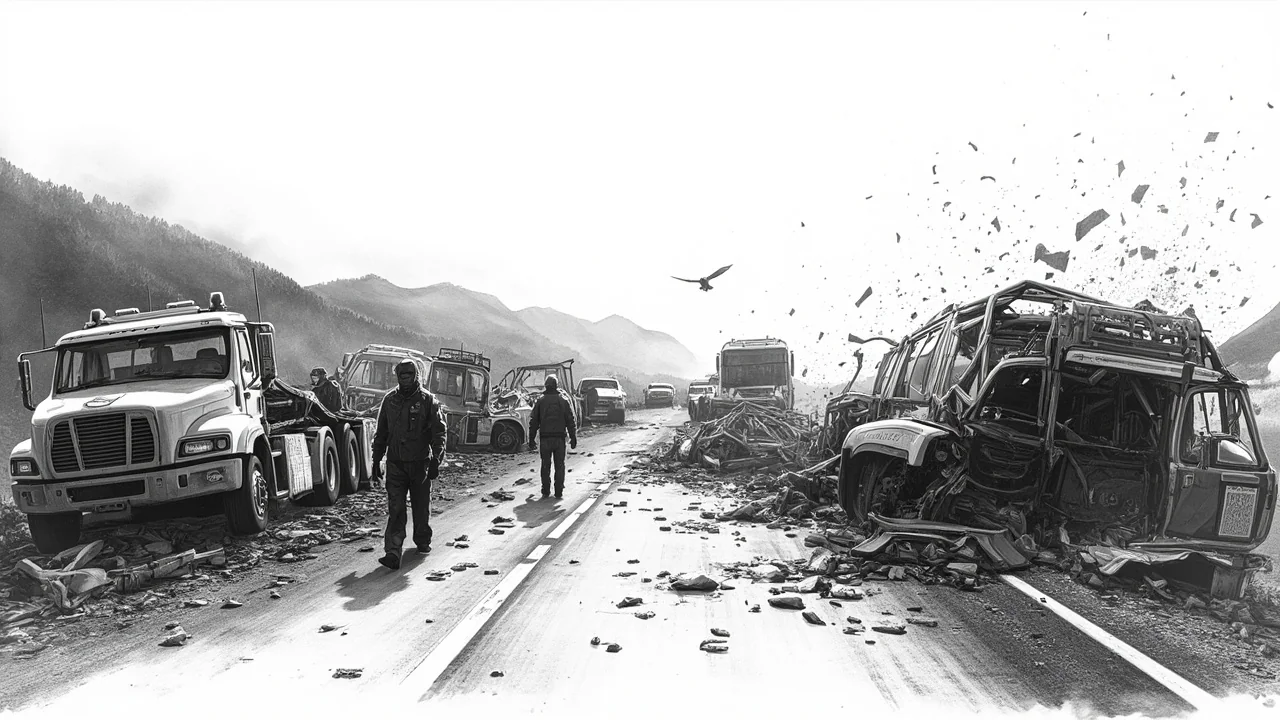
Norway's E6 motorway was the scene of a major chain collision involving eight vehicles near Hvam outside Lillestrøm early Monday morning. The crash occurred at 5:48 AM in slippery conditions, according to police. Initial reports indicated five vehicles were involved, but the number was later revised upward. Emergency services responded to the scene, where three cars required towing. Police confirmed no injuries resulted from the incident, with damage limited to the vehicles involved.
A Close Call on a Major Artery
The E6 is Norway's primary north-south transport corridor, a vital lifeline for commuters and freight moving between Oslo and the northern regions. The collision happened in the right lane of the northbound carriageway during the morning rush hour. Traffic was forced to slow and pass the wreckage carefully, causing significant delays for thousands of commuters heading into the capital region. A video from the scene showed a line of damaged vehicles, their hazard lights flashing in the pre-dawn gloom, as other drivers navigated past cautiously.
Operational commander Ronny Hellerud Samuelsen from the East Police District provided the key update. "No one claims to be injured. Only material damage," he said in a statement. This confirmation likely brought immense relief to both the responders on scene and the families of those involved. The fact that eight vehicles could collide without serious physical harm is noteworthy, pointing to relatively low speeds due to the hazardous conditions.
The Invisible Culprit: Winter Road Conditions
Police explicitly cited slippery conditions at the site as a contributing factor. This time of year presents a persistent challenge for Norwegian drivers, even on major, well-maintained highways like the E6. Morning temperatures near or below freezing can create patches of black ice, particularly on bridges and shaded sections of road. A light dusting of snow, frost, or freezing fog can drastically reduce tire grip without presenting an obviously dangerous visual cue to drivers.
This incident serves as a stark annual reminder. Norway's advanced winter road maintenance, including salting and plowing, cannot eliminate all risk. Driver adaptation—reduced speed, increased following distance, and heightened situational awareness—remains the most critical safety factor. The chain reaction nature of this crash suggests following distances were likely insufficient for the conditions that morning. When one vehicle loses control on ice, it can create an unavoidable obstacle for those following too closely behind.
Analyzing the Aftermath and Response
The logistical impact of such a crash is substantial. Removing three damaged vehicles requires tow trucks and recovery operators, who must work carefully alongside police to clear the lanes. Each minute of lane closure during the morning rush creates a compounding traffic backlog. The economic cost mounts through delayed freight, lost work hours for commuters, and the strain on emergency service resources.
From a traffic safety perspective, the outcome is paradoxically both a success and a warning. The success lies in the vehicle safety systems and structural integrity that apparently protected all occupants from injury. Modern car design aims to create a survivable cocoon during collisions. The warning is the sheer number of vehicles involved. It indicates a systemic failure in the driving chain; multiple drivers were likely caught unprepared for the specific localized condition.
Experts often stress that winter driving is a skill that requires constant recalibration. "Many drivers become acclimatized to winter roads over the season, but the most dangerous moments are often at the start of a new cold snap or during transitional periods in the morning," a senior traffic safety instructor noted in a recent seminar. The Hvam crash, occurring at dawn, fits this pattern perfectly.
The Broader Context of Norwegian Road Safety
Norway consistently ranks among the world's safest countries for road travel, with a steadily declining number of fatalities. This is the result of decades of investment in safer infrastructure, strict vehicle inspections, and a zero-tolerance policy on drunk driving. However, the majority of serious accidents that do occur happen on roads like the E6—high-speed, high-volume routes where the margin for error is slim.
Multi-vehicle pileups, while dramatic, are less common than single-vehicle accidents in Norway. They typically point to a specific, sudden environmental hazard combined with dense traffic. The Public Roads Administration (Statens vegvesen) uses data from such incidents to identify potential trouble spots. They may analyze whether a particular stretch of road has a microclimate that makes it prone to icing or if road geometry contributes to the danger.
Could this lead to infrastructure changes? Possibly. Authorities might review the specific kilometer marker near Hvam for improved drainage, different asphalt mixtures with higher friction, or the installation of automated warning signs that activate when sensors detect icy conditions. However, the primary takeaway for the public remains behavioral.
A Commuter's Dilemma and a National Reality
For the average Norwegian, this story is a familiar winter narrative. It combines relief that no one was hurt with a personal reckoning about one's own driving habits. How many times has a driver tailgated a truck on the E6 on a cold morning, trusting the cleared lane to be safe? This crash is a tangible example of why that trust can be misplaced.
The incident also highlights the resilience of Norway's emergency response protocols. Police, ambulance, and tow services coordinated a swift response that secured the scene, ascertained the lack of injuries, and began clearing operations efficiently. This minimizes both danger and disruption, a routine excellence that is foundational to the country's transportation system.
As the damaged vehicles were towed to garages and the last pieces of debris were swept from the asphalt, traffic on the E6 returned to its normal flow. The physical evidence vanished quickly. The psychological reminder, however, lingers longer. Winter in Norway is a beautiful but demanding season, where respect for nature's power is not just poetic but a practical necessity for safe travel. The eight drivers involved in the Hvam collision experienced a sudden, jarring lesson in that reality. Their undamaged health is the fortunate outcome, but the event itself is a cautionary tale for every motorist facing the first icy commute of the day.
Will this single event change driver behavior broadly? Likely not. But it reinforces the essential, unglamorous tenets of winter driving that save lives: slow down, keep your distance, and never assume the road ahead is as clear as it looks.