
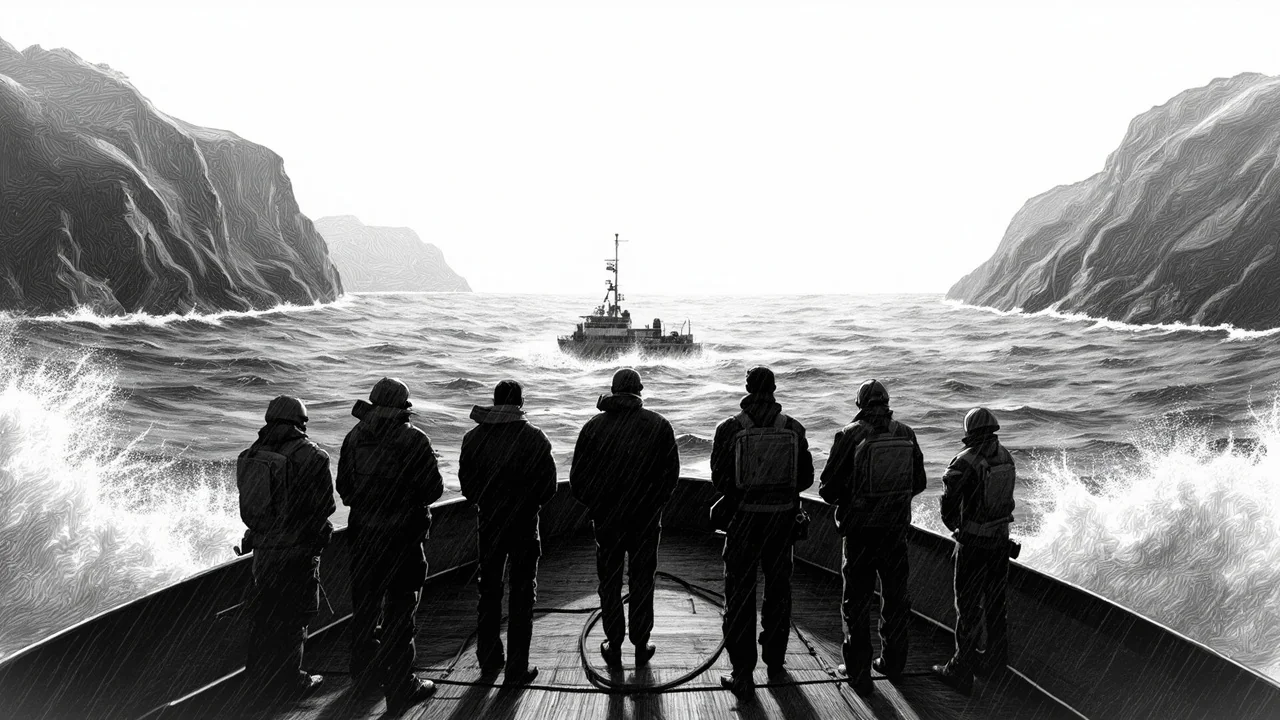
Norway's main rescue center has called off a large-scale search in Trøndelag after a mayday signal vanished, leaving no trace of a vessel or distress. The Joint Rescue Coordination Centre (JRCC) terminated the operation at 1:48 PM Tuesday following a nearly three-hour search involving a rescue cruiser, a fireboat, and a Sea King helicopter. The international distress call was picked up by coastal radio around 12:30 PM, prompting an immediate response along the coast from Trondheim to Steinkjer.
“It was 'mayday, mayday, mayday' that was shouted,” said rescue manager Oddgeir Andersen at the JRCC. He confirmed that attempts were made to respond to the call but received no answer. The search was coordinated from the JRCC’s headquarters at Solberg in Southern Norway, which oversees all major maritime and aeronautical rescue operations. Andersen stated the signal was received through a transmitter in the municipality of Mosvik, in Indre Fosen, but its origin beyond that point remains unknown.
A Signal Without a Source
The core mystery frustrating rescue coordinators is the complete lack of ancillary information. Standard mayday calls include a vessel's position, identity, and nature of distress. This broadcast contained only the repeated distress signal. “We have no information about who, where, or what kind of emergency situation this is about,” Andersen said. This absence of data dramatically widened the search parameters, forcing resources to cover a significant stretch of the Trondheimsfjord and surrounding coastal areas. The fjord, a major shipping and fishing artery, presents complex search challenges with its deep waters, islands, and indented coastline.
Without a specific location, search patterns are based on signal strength estimates and prevailing currents. The resources deployed reflect a standard, rapid response protocol. The rescue cruiser is a fast, capable vessel operated by the Norwegian Society for Sea Rescue, while the Coast Guard's fireboat provides additional search capacity and firefighting capability. The Sea King helicopter from the 330 Squadron offers aerial surveillance, crucial for covering large areas quickly in a low-visibility scenario.
The Challenge of False Alarms
Rescue leaders have not ruled out the possibility of a false alert. “Based on the message, it is impossible to say whether it is real or if someone has tested their equipment incorrectly,” Andersen noted. Accidental mayday transmissions, while rare, do occur. Maritime VHF radios have a dedicated distress button, and misuse—whether through testing, mishandling, or deliberate hoax—triggers the same extensive and costly response. Each mission involves mobilizing crews, burning significant fuel, and incurring operational costs that run into hundreds of thousands of kroner.
Norwegian law treats the deliberate sending of a false distress signal as a criminal offense, punishable by fines or imprisonment. The JRCC maintains sophisticated monitoring to triangulate signals, but a brief, isolated transmission from a mobile source can be exceptionally difficult to pinpoint with the precision needed for a successful rescue. The agency’s decision to call off the search reflects a grim calculus: without a single corroborating piece of evidence—no EPIRB activation, no witness reports, no debris, and no further communication—continuing an active search becomes untenable.
Protocol and the Decision to Stand Down
The conclusion of the search does not mean the case is fully closed. Maritime authorities will typically log the incident and may review radio transmission logs from the area. The JRCC's standard procedure is to remain on a heightened state of alert for a period following such an event, in case new information surfaces. All commercial and large recreational vessels in the search area would have been alerted via NAVTEX and VHF broadcast, asking them to report any unusual sightings.
The Trondheimsfjord region is a busy maritime zone. It services the oil and gas industry, commercial freight, a substantial fishing fleet, and extensive recreational boating. A genuine mayday from a small recreational boat that foundered quickly could theoretically align with the scant facts of this case. However, the total absence of any physical evidence or secondary reports after an intensive search makes this possibility increasingly remote.
The Lingering Question for Maritime Safety
This event underscores a critical vulnerability in maritime distress systems. While technology like the Global Maritime Distress and Safety System (GMDSS) and mandatory EPIRBs on larger vessels has dramatically improved safety, gaps remain. A simple VHF radio call, while immediate, lacks the automated, embedded location data of a satellite beacon. For smaller crafts not required to carry an EPIRB, a VHF mayday is the primary lifeline, but its effectiveness hinges on the operator's ability to communicate details clearly before a crisis escalates.
The JRCC’s response was textbook, swift, and comprehensive. The unresolved outcome is an uncommon but not unprecedented result in search and rescue operations. It leaves a disquieting void for responders and the public alike—a cry for help that echoed across the airwaves and then disappeared into the vastness of the Norwegian coast, a reminder of the sea's inherent unpredictability and the profound responsibility shouldered by those who watch over it. The central question for authorities in Mosvik and Trondheim remains: was this a call that went unanswered, or a signal that never should have been sent?