
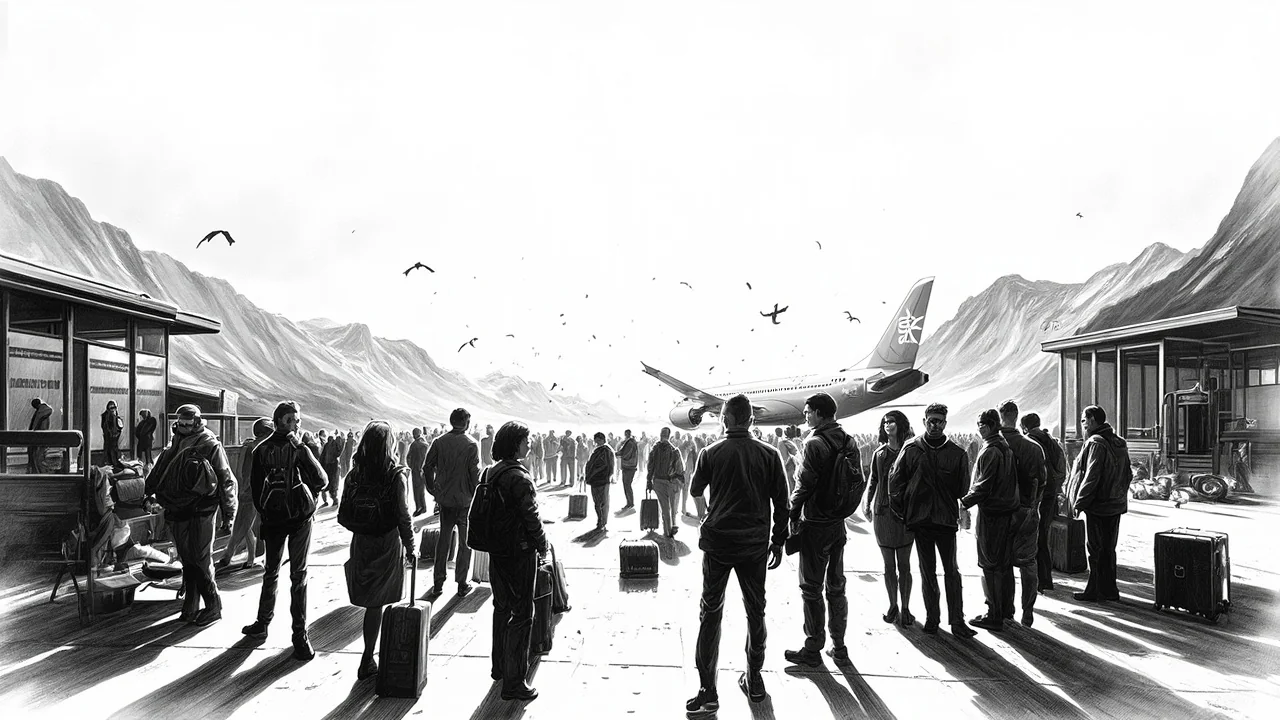
Norwegian Air passengers endured a five-hour ground hold inside a stranded aircraft at Bodø Airport, a rare and severe operational failure the airline called "extremely unusual." The incident on Tuesday, caused by a cascading series of problems including de-icing failures and icy conditions, forced the cancellation of the flight and left travelers exhausted and frustrated.
A Stranded Morning in Bodø
At 10 a.m., passengers boarded the Norwegian flight expecting a routine 90-minute journey. They did not disembark until nearly five hours later, with the plane still stationary at the gate in Bodø. The airline confirmed the flight was ultimately canceled. According to statements from Norwegian, the ordeal began with de-icing issues on the aircraft's wings. When that procedure encountered problems, the plane required an external power source. However, conditions on the apron had become too icy to safely allow passengers to exit the aircraft at that point.
Catharina Solli, Norwegian's press chief, expressed deep regret for the situation. "We are very sorry," Solli said. "Several reasons have caused the passengers to sit for far too long on the plane. This is extremely unusual. It has simply not happened before, according to the operators I have spoken with." She acknowledged the strain on passengers, stating she could imagine they were "tired and fed up, and perhaps sad not to get to their destination."
A Cascade of Failures
Attempts to resolve the situation were repeatedly thwarted. After the initial de-icing and power problems, a decision was made to tow the aircraft back to the terminal for a technical check. Yet again, the icy conditions intervened, making it impossible for a tow truck to reach the plane. This left passengers confined with no viable escape. When asked if there were no other solutions than keeping passengers onboard for so long, Solli responded, "Many other solutions were attempted, but in the end, this is how it turned out. We took them back to the terminal as quickly as we could."
She emphasized that the handling of passengers did not meet the airline's standards. "The press chief strongly apologizes and says this is not how Norwegian wants to treat its passengers," the report noted. Following the cancellation, the airline focused on rebooking stranded travelers and assisting them at the airport.
Broader Disruption at the Airport
The stranded Norwegian flight was not the only service facing significant challenges at Bodø Airport that day. Earlier on Tuesday, another aircraft, fully loaded with football supporters heading to Madrid to cheer for Bodø/Glimt, was delayed for over three hours due to ice on its wings. This separate incident, reported by local media, highlighted the difficult operating conditions.
Despite these two significant disruptions, Avinor, the state-owned company operating Bodø Airport, stated to media that air traffic had otherwise proceeded normally throughout the day. The company explicitly noted the exception was the single Norwegian flight that remained grounded for five hours. "We know nothing about the specific plane. We only know that the rest of the air traffic [was normal]," an Avinor representative said.
Passenger Impact and Airline Accountability
The human impact of the five-hour confinement was immediate and significant. One passenger's husband described the ordeal to media, stating they had finally gotten off the plane after sitting inside for five hours without taking off, and without receiving "either wet or dry"—a Norwegian idiom meaning nothing at all. The statement underscored the lack of service or information during the extended hold.
Norwegian's press chief reiterated the airline's responsibility in the aftermath. The airline's focus shifted to passenger care, including rebooking on alternative flights and providing necessary services at the airport terminal. This incident presents a stark challenge to the airline's operational reliability, particularly during the Nordic winter, where de-icing and ground handling are routine but critical procedures.
Such a prolonged onboard ground hold is rare in European aviation due to strict passenger rights regulations, which typically entitle travelers to compensation and care in cases of long delays and cancellations. The event raises immediate questions about contingency planning and decision-making protocols when multiple technical and environmental problems converge.