
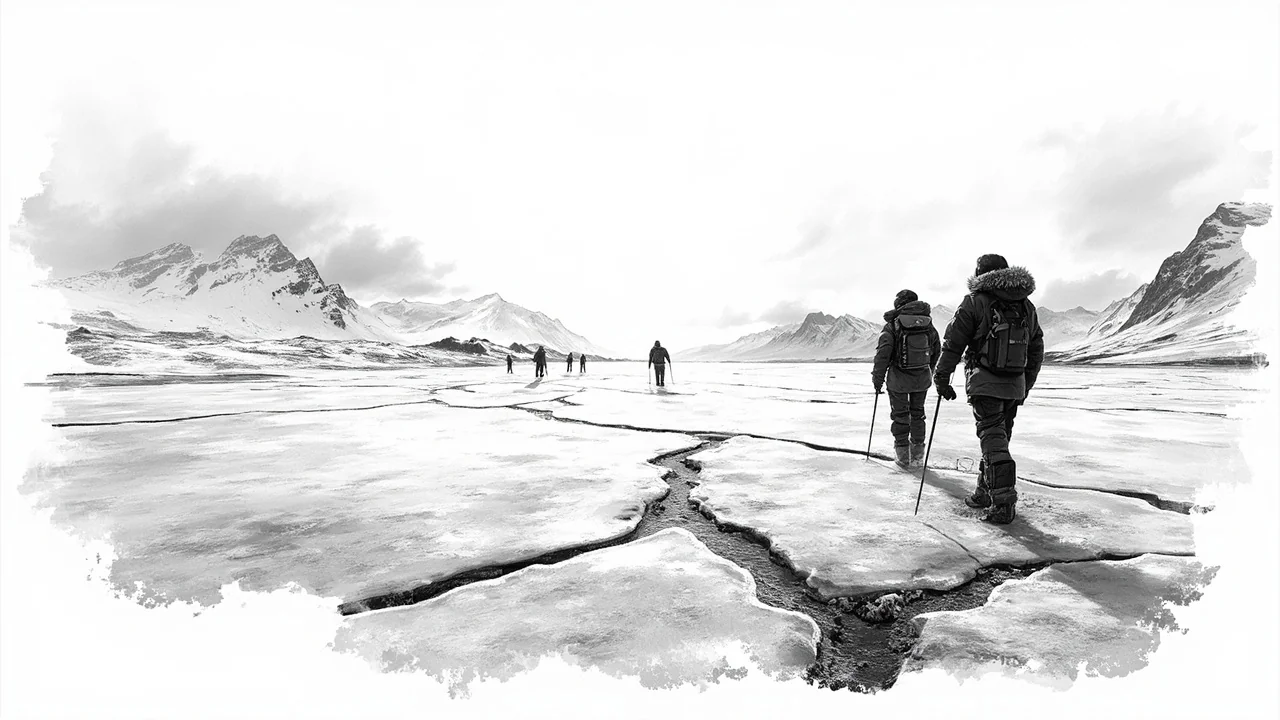
Norway's Red Cross has issued a stark warning to the public to exercise extreme caution and thorough preparation before venturing onto frozen lakes and fjords this winter. The call comes as fluctuating temperatures create unpredictable and potentially dangerous ice conditions across the country. "If you are uncertain, it is absolutely certain that you should not go out on the ice," said Bjørn Hjalmar Andersen, a communications advisor with the Vestfold and Telemark Red Cross, in a clear directive to winter enthusiasts.
Andersen's warning underscores a critical seasonal safety challenge in a nation where ice fishing, skating, and skiing on frozen waterways are deeply ingrained cultural pastimes. The message is not to avoid these activities entirely, but to approach them with a level of preparation and respect that matches the inherent risks. The Red Cross emphasizes that proper gear and knowledge are non-negotiable prerequisites.
The Non-Negotiable Safety Kit
Central to the Red Cross's advice is the imperative to dress appropriately for the cold and, crucially, to carry ice picks. These simple, spiked tools worn around the neck can mean the difference between life and death if a person falls through the ice. "It is important that people dress well and have ice picks with them, so that it becomes easier to get up if you end up in the water," Andersen stated. The shock of cold water immersion can lead to rapid muscle paralysis, making it nearly impossible to pull oneself out without assistance. Ice picks provide the necessary grip to claw back onto solid ice.
Beyond personal flotation devices, which are also recommended, the advice points to a fundamental shift in mindset: from assuming ice is safe to actively verifying its integrity. This represents a key cultural and behavioral change the Red Cross is advocating for. Complacency, born of tradition or local anecdote, is a significant contributor to the dozens of ice-related incidents Norwegian rescue services respond to each year.
The Ten-Centimeter Rule and Proactive Testing
Perhaps the most concrete guidance offered is the "ten-centimeter rule." Andersen advises individuals to use an ice auger or drill to check the thickness themselves before proceeding. "If it is 10 centimeters or more, it starts to help," he noted. This benchmark is a well-established guideline, but experts often caution that it is a minimum for a single person on foot, and that ice strength can vary dramatically due to currents, underwater springs, snow cover, and temperature changes.
Snow, in particular, can be dangerously deceptive. It insulates the ice, slowing its growth, and can hide cracks or thin spots. The Red Cross's push for personal testing with a drill is a call for empirical verification over guesswork. It places the responsibility for initial safety assessment directly on the individual, empowering them with a simple method to make informed decisions. This is especially critical on coastal fjords, where saltwater and tides create weaker, more unstable ice than the frozen freshwater lakes of the interior.
A Norwegian Winter Paradox
This safety campaign highlights a paradox at the heart of Norwegian friluftsliv, or "open-air life." The national identity is deeply connected to engaging with nature in all seasons, embracing challenges, and cultivating self-reliance. Winter activities on ice are a celebrated part of this. Yet, true self-reliance requires acknowledging limits, understanding environmental hazards, and preparing for the worst. The Red Cross message reframes preparedness not as a sign of weakness or excessive caution, but as the very essence of responsible outdoor practice.
The warning also reflects broader environmental trends. Milder winters and more frequent temperature swings around the freezing point, potentially linked to climate change, are leading to less stable ice conditions in many regions. What was considered reliably thick ice by previous generations may no longer hold true. This necessitates an update to traditional knowledge, blending time-honored practices with modern safety protocols and a heightened awareness of changing conditions.
The Role of Community and Technology
While personal responsibility is paramount, community awareness and technology also play vital roles. Local municipalities and the Norwegian Water Resources and Energy Directorate (NVE) often provide ice thickness reports for popular areas. However, these are general guides and cannot account for hyper-local variations. The proliferation of smartphone apps and social media groups where users share real-time condition updates is becoming an increasingly valuable, though informal, tool.
Rescue services, including the Red Cross, the Norwegian Society for Sea Rescue (RS), and local fire departments, repeatedly stress that calling for help early is critical. Carrying a waterproof mobile phone in a sealed bag and informing someone of your planned route and return time are standard safety procedures that cost nothing but can save lives. The national emergency number, 113, should be programmed and accessible. In remote areas, a personal locator beacon (PLB) can be a lifesaving investment.
Analysis: Beyond the Warning
The Red Cross advisory, while focused on practical steps, touches on deeper themes of risk management in a society that encourages outdoor adventure. Norway has one of the world's most skilled and well-equipped voluntary rescue corps, a testament to a collective commitment to safety. Yet, the primary goal is to prevent emergencies from occurring in the first place.
This involves continuous public education, starting in schools where friluftsliv is part of the curriculum. Teaching children not just how to enjoy the ice, but how to read it, test it, and respect its dangers, builds a foundation of safety for life. For adults, the challenge is often unlearning overconfidence. The experienced ice fisherman on his familiar lake is sometimes at greater risk than the novice, due to familiarity breeding contempt for established safety checks.
From a policy perspective, while the state cannot regulate every frozen pond, there is a role for consistent, nationwide safety messaging amplified through media, sports organizations, and outdoor retailers. Ensuring that safety equipment like ice picks and throw lines are readily available and promoted alongside skates and fishing rods is a simple but effective measure.
The Bottom Line for Winter
The final analysis from the Red Cross is unambiguous: uncertainty means stay off. The beauty of a frozen Norwegian landscape is undeniable, offering unique tranquility and recreation. However, that beauty masks a dynamic, potentially hazardous environment. Enjoying it safely is a matter of culture, education, and choice. It requires swapping assumption for verification, and supplementing enthusiasm with a plan. As the light fades early and the cold deepens, this warning serves as an annual, vital reminder that in the Norwegian winter, respect for nature is the most essential piece of equipment anyone can carry. Will this season see a reduction in preventable incidents, or will tradition again override caution? The answer lies with every individual weighing the decision to step onto the ice.