
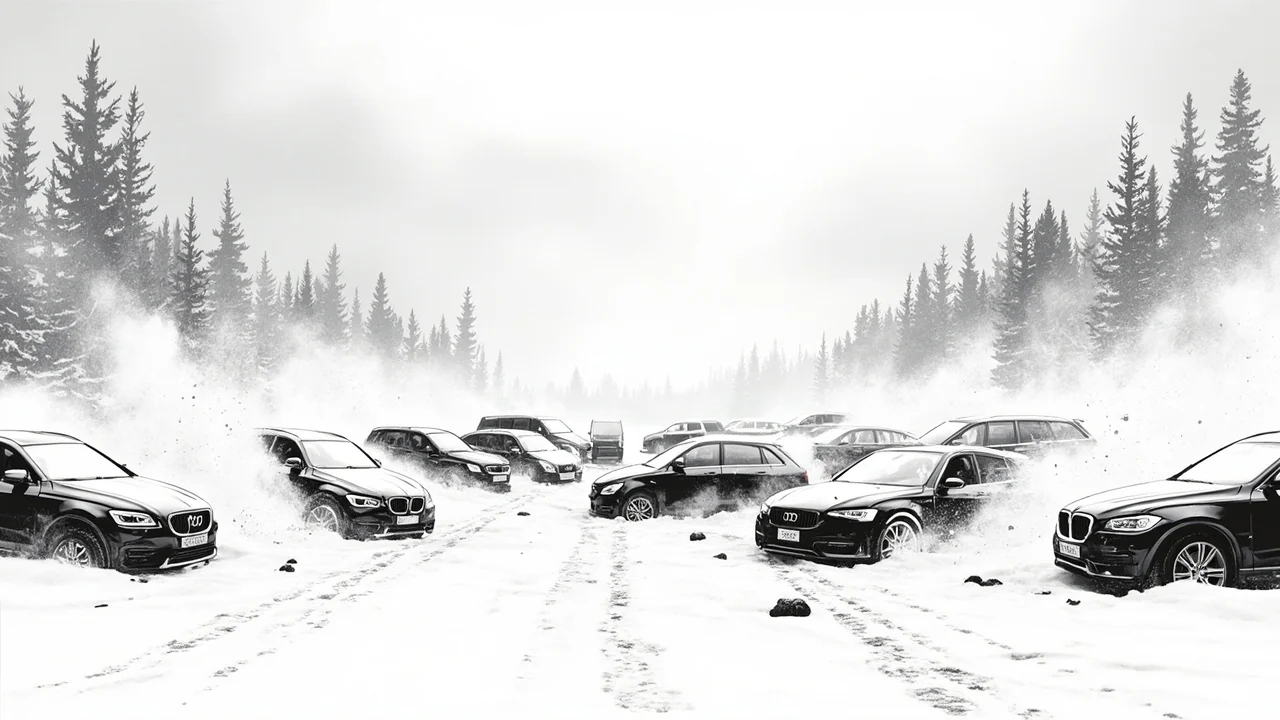
Norway's winter roads proved treacherous again as a sudden ice event caused a major chain-reaction crash involving up to 20 vehicles on a stretch of road in Trøndelag. Police and emergency services reported a scene of widespread disruption with cars in ditches and scattered across the roadway, though no serious injuries were initially reported.
A Scene of Slippery Chaos
The incident occurred Thursday evening at Dalsaunet near Storvatnet in Indre Fosen municipality. According to operations leader Stig Lunde at the regional emergency center, the trouble began with a collision between two cars. "They have driven into the ditch to avoid crashing into the cars that collided. It is mirror-slick there," Lunde said. He described vehicles positioned haphazardly on both sides of the initial crash site, with the damaged area stretching over 150 meters. Operations leader Martin Hammervik Aarhoug from the Trøndelag Police District confirmed the scale at 7:20 PM, stating, "It is reported that up to 20 cars have driven off the road."
Emergency Response in Challenging Conditions
First responders faced the dual challenge of aiding those involved and preventing further accidents. The initial report from emergency services at 6:55 PM noted that two firefighters were the first to arrive on the scene. Their primary task, along with other crews, was to secure the area. "The emergency services on site are working to prevent even more vehicles from going off the road or crashing," Aarhoug stated. The extreme slipperiness remained a persistent hazard. The Norwegian Public Roads Administration dispatched a sander to the location to treat the icy pavement, a critical step in restoring safe passage.
Understanding the 'Speilblankt' Hazard
The Norwegian term "speilblankt," used by responders, translates to "mirror-slick" and describes a specific and dangerous winter road condition. It typically occurs when moisture on the asphalt freezes into a thin, nearly invisible layer of smooth ice. This black ice offers almost no traction for vehicle tires. Such conditions can develop rapidly with subtle shifts in temperature, especially near bodies of water like Storvatnet, catching even experienced drivers off guard. The accident sequence described by officials—where drivers steered into ditches to avoid a collision—is a common, last-resort maneuver on roads with no grip, often causing less damage than a high-speed impact.
The Human Element and Fortunous Outcome
Authorities confirmed that both adults and children were among those involved in the multi-vehicle incident. Despite the alarming number of cars off the road, the outcome was remarkably fortunate. "No serious personal injuries have been reported," Lunde said. This points to relatively low speeds at the time of the incidents, likely due to drivers recognizing the dangerous conditions, and the effectiveness of modern vehicle safety systems. The decision by many to deliberately leave the roadway into soft ditches, while damaging to vehicles, likely prevented more serious, person-to-person collisions. The event underscores a grim annual reality for Norwegian motorists but also highlights how defensive driving choices can mitigate disaster.
A Recurring Challenge for Norwegian Infrastructure
This incident is not an isolated event but part of a recurring pattern each winter across Norway, particularly in coastal and inland regions prone to rapid freeze-thaw cycles. While the country's road authorities have sophisticated weather monitoring and salting regimens, localized microclimates can create unexpected danger zones. Roads near lakes, in shaded forest areas, or on exposed bridges are notoriously susceptible. The response protocol, seen here with the rapid deployment of a sander, is a standard but reactive measure. It raises ongoing questions about proactive solutions, such as improved road surface materials or more localized automated weather stations that can trigger earlier warnings.
The Broader Context of Winter Mobility
For Norwegians, navigating winter roads is a fundamental part of life for several months each year. This crash serves as a stark, early-season reminder of the collective responsibility shared by authorities, who must maintain roads, and drivers, who must equip their vehicles with proper winter tires and adjust their speed to the conditions. The legal requirement for winter tires (M+S or studded) from November to Easter is designed for exactly these scenarios. Incidents like the one at Storvatnet often prompt public service announcements reinforcing these messages, emphasizing that tire technology is only part of the safety equation—driver awareness and behavior are equally critical.