
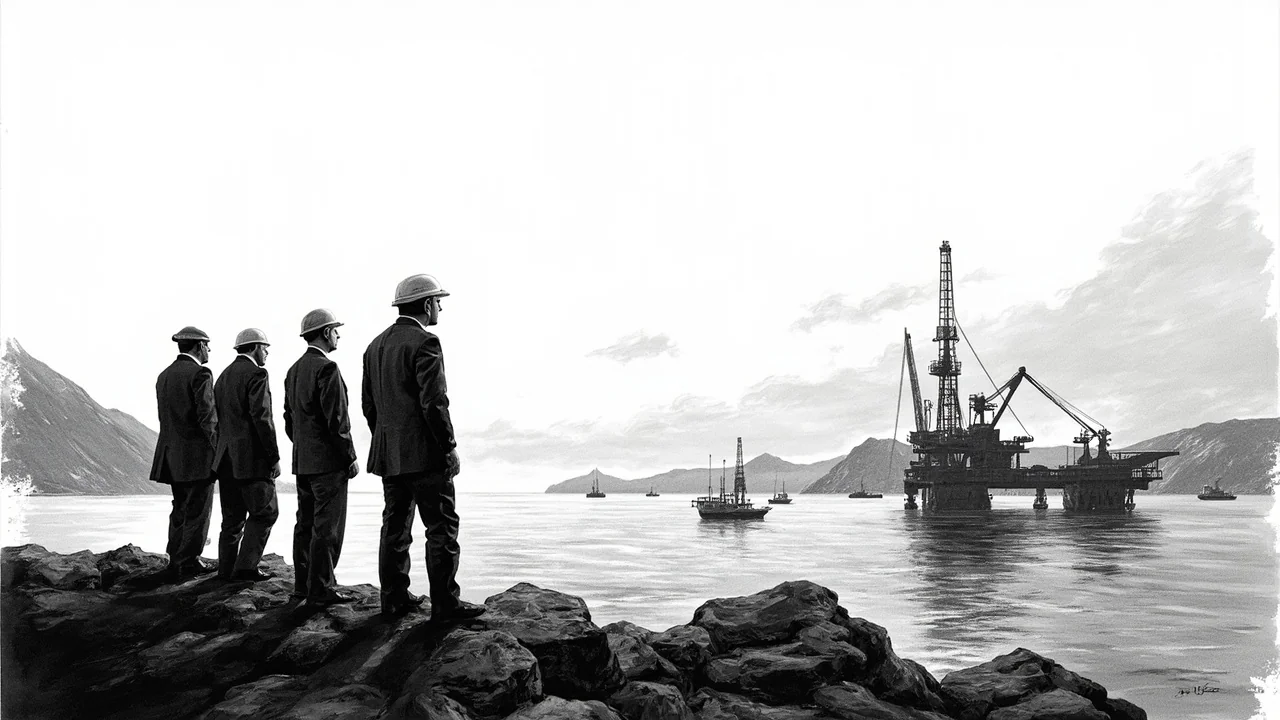
Norway's government has awarded 57 new offshore oil and gas exploration licenses to 19 companies, a significant move aimed at sustaining Europe's largest energy supplier. The announcement, made by Energy Minister Terje Aasland at the annual Sandefjord conference, comes alongside a decision to postpone the major 26th licensing round this year. The licenses were granted under the state's pre-defined area (TFO) scheme, which allows companies to explore in mature areas near existing infrastructure.
A Strategic Pivot for Energy Security
Minister Aasland framed the decision as essential for Norway's economic future and Europe's energy needs. "Norway is Europe's most important energy supplier, but in a few years, production will begin to fall," Aasland said. "Therefore, we need new projects that can slow the decline and provide as much production as possible." The TFO rounds are designed for efficiency. Discoveries in these mature areas can be developed quickly, are often profitable, and pay back investments rapidly. This approach contrasts with the more exploratory and uncertain major licensing rounds.
Of the 57 new permits, 31 are in the North Sea, 21 in the Norwegian Sea, and five in the Barents Sea. The companies receiving the most offers are the state-dominated Equinor, Aker BP, DNO, and Vår Energi. "This is a significant contribution to securing activity in the oil and gas industry," Aasland stated, emphasizing the sector's role in jobs, value creation, and European energy security.
The Postponed Licensing Round and Industry Stability
The simultaneous announcement to delay the 26th ordinary licensing round marks a strategic pause. This major round typically offers access to new, frontier areas and is a bellwether for long-term industry investment. The government stated it will instead focus on developing a new comprehensive petroleum white paper. Aasland expressed a desire for stable, long-term framework conditions and the possibility of a broad parliamentary agreement on the industry's future.
This dual-track approach—pushing ahead with near-term, low-risk exploration while pausing to reconsider the broader long-term strategy—reflects the complex pressures on Norwegian energy policy. The nation is balancing its role as a reliable hydrocarbon supplier to Europe against global climate commitments and the inevitable decline of its existing fields. The TFO awards provide immediate activity for the service industry and hope for new discoveries to plug the production gap.
The Efficiency of Mature Exploration
The TFO scheme's value was highlighted by recent successes. For example, the Lofn and Langemann discoveries were made in a TFO license awarded just in 2022. Located near the Sleipner field, these finds are estimated to hold between 30 and 110 million barrels of oil equivalent. This rapid turnaround from license to discovery underscores the scheme's core purpose: maximizing resource recovery from known basins with existing infrastructure, thereby lowering both economic and environmental costs compared to greenfield projects in new areas.
From the stage in Sandefjord, Aasland addressed the industry directly, acknowledging its scale. "These are enormous dimensions that the industry represents," he said. The government also sent out a proposal for consultation regarding the TFO round for 2026, signaling a commitment to this annual allocation process. "Giving companies access to new and attractive acreage annually is a cornerstone of the government's policy to further develop the industry," Aasland noted.
Analysis: A Calculated Balancing Act
This move is a classic example of Norway's pragmatic energy policy. By awarding TFO licenses, the government stimulates immediate investment and job security in the vital petroleum sector without immediately expanding the geographical footprint of exploration. The delay of the major round offers political breathing room to craft a future-facing policy that addresses climate concerns. It is a hedge, ensuring production continuity for the next decade while the state determines the pathway for the decades beyond.
Industry experts will watch closely to see how the new petroleum white paper shapes up. Will it impose stricter climate conditions on future licenses? Will it chart a clearer path for a managed decline? The broad parliamentary agreement Aasland seeks is elusive but critical for investor confidence. The companies receiving these 57 licenses—primarily large, established players—gain valuable short-term opportunities. However, the postponed major round creates uncertainty for smaller exploration firms and those betting on frontier regions like the Barents Sea.
The Road Ahead for Norwegian Oil
Norway's energy crossroads is now clearly marked. On one path, the efficient exploitation of mature basins to slow production decline and fund the national welfare state. On the other, the urgent global imperative to transition away from fossil fuels. Today's announcement chooses the first path for the immediate future, while pausing at the entrance to the second. The success of this strategy hinges on whether these new TFO licenses yield substantial, cost-effective finds and whether the forthcoming white paper can reconcile Norway's economic dependencies with its environmental aspirations. The world's view of Norway as a stable energy partner is being tested, and its next steps will define its role in Europe's energy landscape for a generation.