
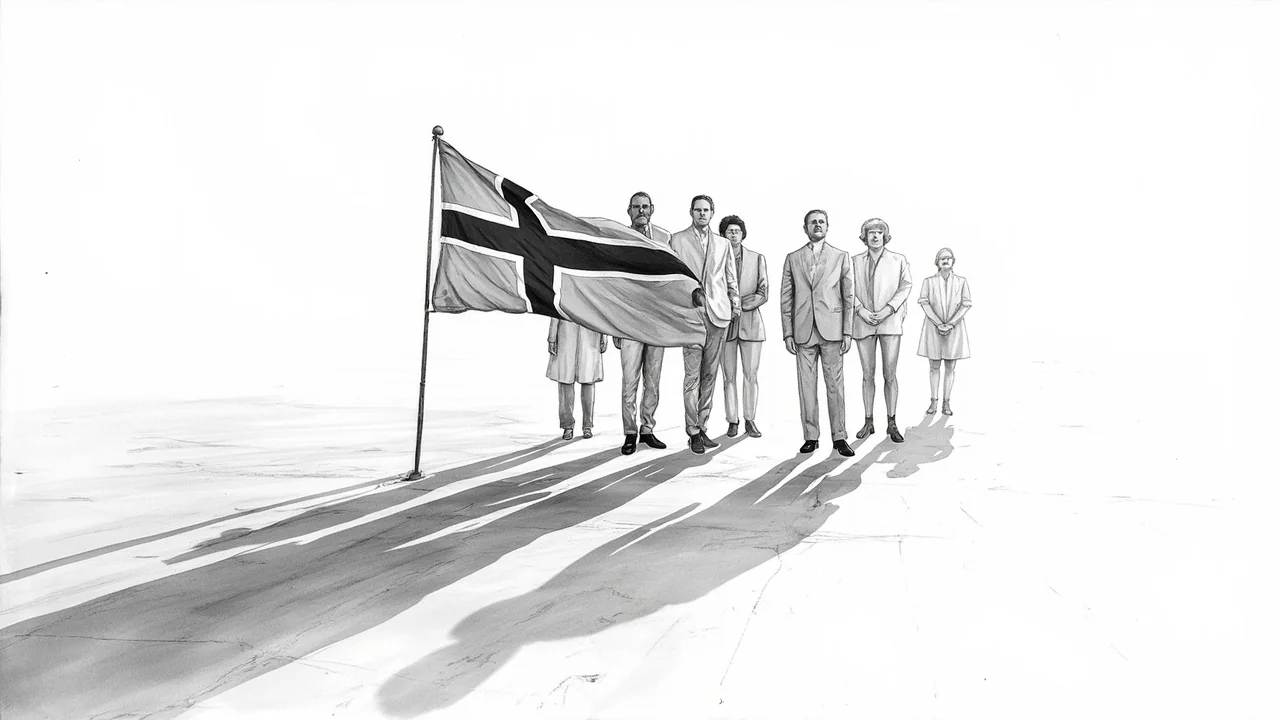
Norway has joined four neighboring Nordic governments to issue a historic declaration supporting Greenland’s right to self-determination, a direct response to reported US territorial threats. The foreign ministers of Denmark, Finland, Iceland, Norway, and Sweden published a joint statement on January 6, 2026, affirming that Greenland's future belongs solely to its people. This coordinated diplomatic move follows a rally of support from European leaders and Canada, and comes amid rising tensions in the Arctic and within the NATO alliance. The statement, published on both Government.se and Regjeringen.no, marks one of the most unified Nordic foreign policy actions in recent memory.
A Unified Nordic Front Emerges
The five-nation statement represents a significant escalation in diplomatic backing for Greenland, an autonomous territory within the Kingdom of Denmark. While the full text of the statement has been published online, its core message is a clear rejection of any external claims over Greenland. The ministers collectively affirmed the principle of self-determination, directly challenging any notion that Greenland could be subject to territorial acquisition or coercion. This action was taken in parallel with shows of support from other European leaders and the Canadian government, creating a broad Western consensus against the reported US position. The timing is critical, as it follows a meeting involving US political figures, which has heightened concerns over Arctic stability.
Norway's Strategic Calculus in the Arctic
For Norway, a founding NATO member with significant Arctic territory and interests, signing this statement involves complex diplomatic balancing. Norway shares a direct maritime border with Greenland in the Arctic Ocean, and both nations have vested interests in the Barents Sea and the broader European Arctic. Norwegian foreign policy has long emphasized international law, orderly resource development, and stability in the High North. This principle is enshrined in Norway's own Svalbard Treaty, which grants sovereignty but with specific international obligations. By aligning with its Nordic neighbors, Oslo is signaling that unilateral actions undermining established sovereignty and self-determination principles in the Arctic are unacceptable, even when they come from its most powerful ally. This stance protects Norway's own precedent-based claims and its managed approach to Arctic oil and gas exploration.
The Historical Weight of Greenland's Status
The Greenland question touches a deep historical nerve in Nordic relations. Greenland achieved home rule from Denmark in 1979 and further self-government in 2009, with the latter agreement formally recognizing the Greenlandic people as a distinct nation with the right to self-determination. Denmark retains control over foreign and defense policy, but the path to full independence remains a legally defined possibility. Any external challenge to this carefully constructed political arrangement is viewed as a threat to the foundational principles of modern Nordic governance. The joint statement explicitly roots its position in this decades-long evolution of Greenland’s political status, defending the integrity of that process against external pressure. It underscores that the future of Greenland, including any discussion of its vast mineral and rare earth element resources, must be decided in Nuuk and Copenhagen, not in foreign capitals.
Implications for NATO and Regional Stability
This diplomatic rift introduces a new and serious strain within the North Atlantic Treaty Organization. The Nordic bloc, which includes NATO members Denmark, Norway, and Iceland, plus newer member Finland, is now in open disagreement with reported US policy. Sweden, another signatory, is also on the cusp of full NATO membership. This creates an unprecedented situation where a core group of European allies is collectively opposing Washington's stance on a territorial and strategic issue. The crisis centers on the Arctic, a region of growing military and economic importance where NATO has sought to present a unified front against Russian expansionism. The Nordic statement risks creating a bifurcated alliance, complicating joint exercises in the Norwegian Sea and coordinated patrols near the strategically vital GIUK Gap. It also raises questions about the future of the US military presence at Thule Air Base in Greenland, a key node in North American aerospace defense.
The Path Forward and Unanswered Questions
The immediate consequence of the joint statement is the formalization of a Nordic-EU-Canadian consensus in support of Greenland. It places a significant diplomatic cost on any further US actions perceived as threatening Greenland’s constitutional status. For Norway, the move reinforces its role as a steadfast defender of international maritime law, a position crucial for its offshore energy sector and fisheries management. However, several critical questions remain unresolved. The statement does not detail what specific measures the Nordic countries might take if tensions escalate further. It also does not address how this disagreement will be managed within NATO's command structure, particularly at the alliance's new regional headquarters in Stavanger, Norway. The coming weeks will test whether this Nordic solidarity can translate into a durable diplomatic solution, or if the Arctic is entering a new period of heightened geopolitical contestation that could redefine alliances forged during the Cold War.