
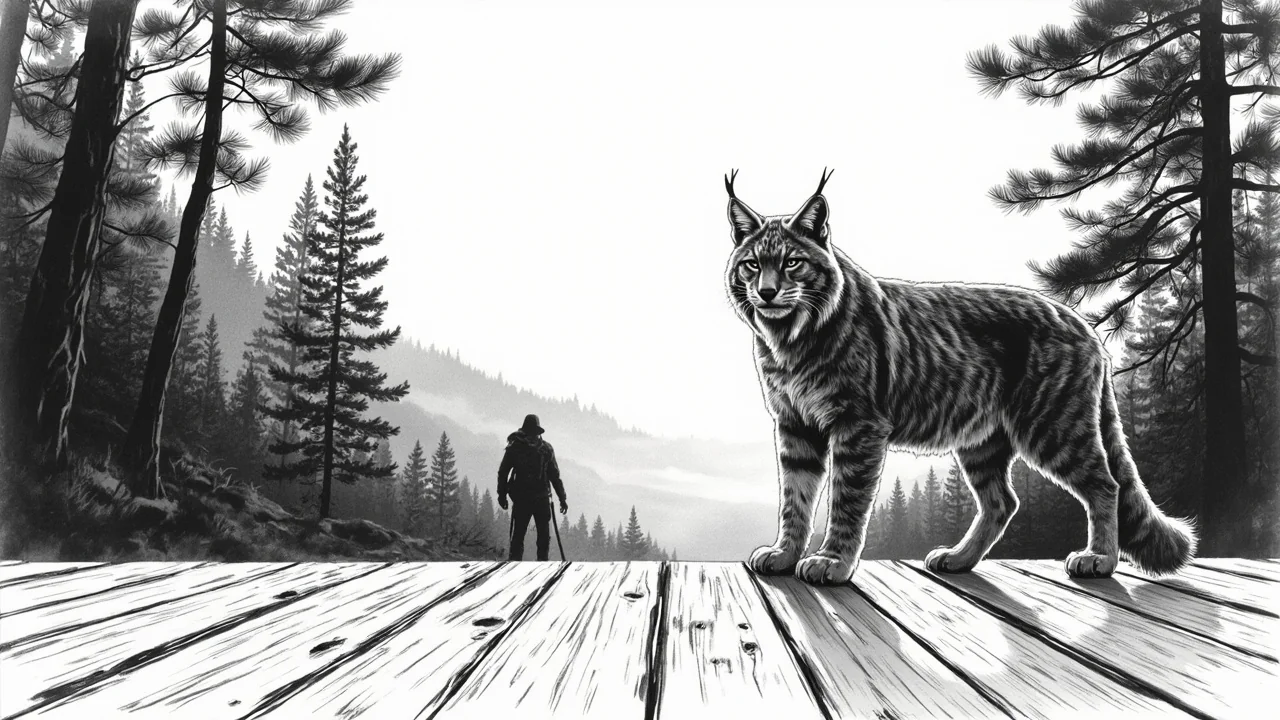
A young Eurasian lynx attacked a dog in a residential area of Darbu, Øvre Eiker, on Saturday morning before returning to settle on a family's terrace for three-quarters of an hour. The incident, described by local authorities as highly unusual behavior, has ignited a tense debate in the community about wildlife management and public safety. The dog suffered injuries to its eye, ear, and face and received immediate veterinary care.
Anders Hals, a member of the municipal search and response team for wildlife incidents, was called to the scene. He found the lynx on another terrace, where he photographed it from a distance of just four to five meters. Hals told local media the animal appeared emaciated and did not flee when approached, a significant departure from typical lynx behavior. "This is not so uncommon, but the rest of its behavior is highly unusual," Hals said. He noted the lynx had been seen peering into house windows and, on Saturday, was observed lying on a terrace sofa.
An Unnerving Display of Fearlessness
Wildlife experts state that lynxes are notoriously shy, elusive predators that actively avoid human contact. Their typical response to encountering people is immediate flight into dense forest. The behavior displayed in Øvre Eiker—lingering in a populated area and showing no fear of humans—is a serious anomaly. Hals theorizes the animal may be a juvenile whose mother was hit by a car weeks earlier, driving it toward human settlements in a desperate search for food. "When animals are starving, they lose their shyness," Hals explained. This loss of natural wariness transforms a normally invisible forest creature into a visible public concern.
The incident has forced a confrontation between Norway's deep-seated conservation ethics and immediate fears for domestic safety. The lynx is a protected species in Norway, with population management governed by strict national and international regulations. However, an animal that attacks pets and loiters in gardens exists in a legal and ethical grey zone. Local police and the wildlife management board were notified, initiating a formal assessment process.
Community Reaction: Fear Versus Protection
Public reaction on local social media channels has been intense, with hundreds of comments. The discourse splits sharply between calls for the animal to be euthanized and strong opposition to such a measure. Some residents express understandable fear, particularly for children and pets. Others argue the lynx is a victim of circumstance, a starving young animal acting out of desperation rather than malice. This divide reflects a broader national conversation about rewilding, predator coexistence, and the limits of tolerance in modern Scandinavia.
Hals, while empathetic to public concern, offered clear advice. "Regardless, do not disturb it is my tip, let it be in peace," he stated. His role was strictly observation and documentation. The decision on the animal's fate rests with higher wildlife authorities, who must weigh the specific risk against conservation status. Possible outcomes include capture for rehabilitation, relocation to a remote area, or, if deemed a continuing threat, euthanasia.
The Policy Framework Governing Predators
This event tests Norway's sophisticated but often contentious wildlife management policies. Large carnivores like lynxes, wolves, bears, and wolverines are managed through regional predator management boards. These boards include representatives from various stakeholders, including environmental organizations, agricultural interests, and local municipalities. Their mandate is to balance species conservation with the needs of livestock owners and public safety.
An incident involving direct conflict, such as an attack on a domestic animal in a residential zone, creates pressure for definitive action. The authorities must determine if this was a one-off event driven by exceptional starvation or the beginning of a pattern of habituation. The latter scenario dramatically increases the likelihood of the lynx being removed from the wild. The process underscores the complex, case-by-case nature of living alongside protected predators in a developed landscape.
A Broader Pattern of Human-Wildlife Interface
The Øvre Eiker incident is not isolated. Across the Nordic region, as forest habitats abut expanding suburbs and recreational use of nature increases, encounters between humans and large wildlife are becoming more frequent. While moose collisions are common, interactions with large predators remain rare but highly charged. Each event becomes a flashpoint, forcing communities to confront their relationship with the natural world. Norway, with its vast wilderness areas and strong environmental laws, often finds itself at the forefront of these difficult discussions.
The story of this young lynx is ultimately a story about boundaries. It highlights the boundary between wilderness and community, between a species' right to exist and the public's right to security, and between fear-driven reaction and science-based management. The animal's 45-minute rest on a human terrace was a silent, unnerving demonstration of how fragile those boundaries can be. As Hals noted, a desperate animal can be unpredictable, and unpredictability in a powerful predator is a legitimate source of alarm.
The coming days will reveal the official response. The decision will be scrutinized as a precedent, signaling how Norway navigates the inevitable, tense moments when its celebrated wild nature steps unexpectedly into its tidy, ordered backyards. Will the response prioritize absolute public safety, or will it seek a solution that accounts for the animal's protected status and exceptional circumstances? The answer will satisfy some and anger others, a testament to the profound challenge of sharing a landscape with creatures that do not recognize our maps and property lines.