
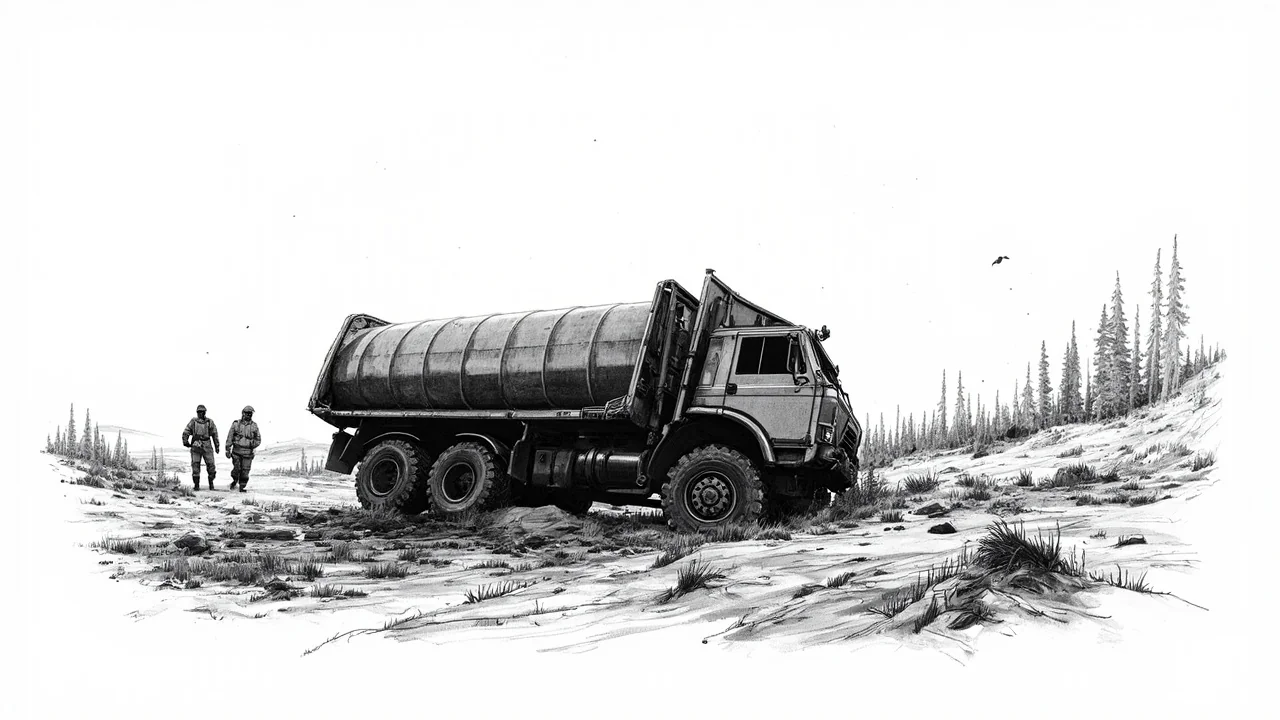
Norway's Defense Forces encountered an operational anomaly when a military truck left the E6 highway in Karasjok Tuesday morning. The vehicle, belonging to Forsvaret, ended up in a roadside ditch. Two personnel were inside but emerged unscathed. Police attended the scene but will not file a report, leaving the military to handle recovery. This minor incident, far from the halls of the Storting in Oslo, opens a window into the logistical challenges of operating in Norway's vast Arctic region.
The Karasjok Incident
At approximately 11 AM local time, a standard logistics truck departed the road near Karasjok in Finnmark county. The E6, Norway's main arterial highway, stretches through this remote terrain. Initial reports confirmed no injuries to the two soldiers present. The police completed their assessment quickly, stating no criminal proceedings were necessary. Forsvaret has dispatched its own recovery team to retrieve the vehicle. Such routine mishaps are seldom news, but in the context of Norway's heightened Arctic focus, they gain significance.
The area surrounding Karasjok is emblematic of Norway's northern frontiers. It is a sparsely populated region where infrastructure faces extreme weather. This truck was likely supporting routine exercises or supply operations. The incident did not disrupt civilian traffic significantly. Yet, the image of a military asset immobilized in a ditch contrasts sharply with official narratives of Arctic readiness.
Arctic Operations and Infrastructure Stress
Norway's defense strategy increasingly prioritizes the High North. This is driven by renewed great power interest and the region's resource wealth. The Norwegian Armed Forces regularly conduct exercises above the Arctic Circle. These operations depend on road networks like the E6, which can be vulnerable. Long distances between population centers and harsh winters test both equipment and personnel.
A single truck in a ditch is not a crisis. However, it points to the daily wear and tear on military logistics in extreme environments. Vehicles face icy roads, poor visibility, and rapid temperature shifts. Maintenance schedules must account for these factors. The Karasjok event suggests a possible need for enhanced driver training or vehicle adaptations for northern routes.
Defense Logistics and National Policy
This incident touches on broader defense procurement and infrastructure debates in Oslo. The Storting recently approved increased spending for military mobility and Arctic capabilities. Projects include new ice-class vessels and improved surveillance. Ground logistics, however, rely on existing public roads. The national transport plan allocates funds for northern road upgrades, but progress can be slow.
Forsvaret's operational footprint in the north is expanding. This includes the presence near crucial energy installations like the Snowhammer gas field. Secure supply lines are vital for national security and for protecting Norway's oil and gas interests. A stuck truck, while minor, highlights the dependency on reliable transportation. Any systematic weakness could have implications for rapid deployment or crisis response.
Expert Perspective: Reading the Signals
I spoke with defense analyst Kari Nystad, a former officer with experience in northern operations. "We must avoid over-interpreting a single accident," Nystad cautioned. "But in aggregate, such incidents feed into a necessary conversation. Our forces are training more often in the Arctic. Equipment failure rates, transportation delays, and infrastructure gaps need continuous monitoring."
Nystad emphasized the human factor. "Soldiers driving these routes are not just truckers. They are part of a complex deterrence posture. Fatigue, familiarity with conditions, and vehicle suitability are all part of the equation. This is not just about a ditch in Finnmark; it's about ensuring our logistical chain is resilient from Oslo to the Russian border."
Her analysis connects to parliamentary discussions. The Standing Committee on Foreign Affairs and Defense frequently reviews readiness reports. Data on non-combat incidents like this one contributes to assessments of material condition and training adequacy.
The Energy Security Dimension
Norway's Arctic policy is inextricably linked to its energy sector. The Barents Sea holds significant hydrocarbon reserves. Defense forces play a role in securing offshore platforms and related infrastructure. Land-based logistics support this maritime domain awareness. A truck carrying supplies for a coastal radar station, for instance, is a small cog in a larger system.
If military logistics face routine difficulties, it could indirectly affect the security perception for energy companies. Stable operations in the north reassure investors and partners. The Norwegian government balances economic interests from the oil fields of the North Sea with sovereignty assertions in the Arctic. Smooth military transportation, even for routine matters, underpins that balance.
Looking North: A Routine Event with Resonance
The Karasjok truck recovery will conclude without fanfare. The soldiers involved will return to duty. For the local community, it was a brief curiosity on the E6. Yet, for policymakers in Oslo, each such event is a data point. It informs budgeting for all-terrain vehicles, road maintenance agreements with the Norwegian Public Roads Administration, and winter warfare training programs.
Norway's ambition as a stable Arctic nation requires attention to granular details. This includes the performance of a single truck on a lonely northern highway. As the climate changes and economic activity shifts northward, the strain on infrastructure will grow. Both civilian and military planners must anticipate these pressures.
The incident serves as a humble reminder. Even the most advanced defense strategies can encounter a patch of black ice or a moment of distraction. Norway's challenge is to ensure that its systems are robust enough that such events remain mere anecdotes, not symptoms of a larger vulnerability. The true test is not avoiding every ditch, but building a framework where recovery is swift and lessons are integrated into future planning.