
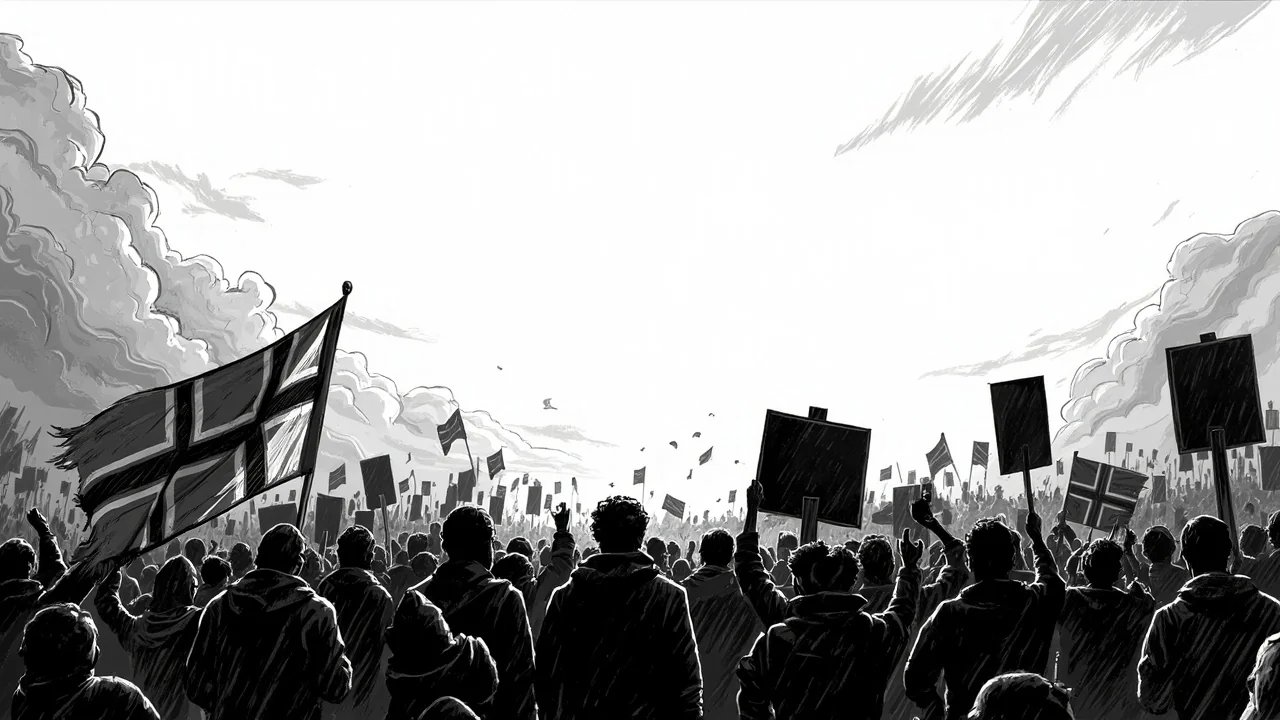
Norway’s influential annual oil and energy policy seminar opened under police escort in Sandefjord this morning, as officers moved more than fifty demonstrators blocking the hotel entrance. The protesters oppose the nation’s petroleum policy as Energy Minister Terje Aasland arrived to address industry leaders. This clash at the so-called Sandefjord Conference highlights the deepening national conflict between Norway’s economic engine and its climate ambitions.
Scuffles were brief but tense. Police formed a cordon to allow conference delegates, including top executives from Equinor, Aker BP, and Vår Energi, to enter the venue. The demonstrators, representing environmental groups including Natur og Ungdom and Greenpeace Norway, held banners reading “Stop Drilling” and “Planet Over Profit.” Their chants echoed across the square, a direct challenge to the government’s tradition of awarding new exploration licenses during this event.
A Ritual of Power and Protest
The Sandefjord Conference, organized by the Norwegian Oil and Gas Association (Norsk Petroleumsforening), is a cornerstone of the country’s energy calendar. For decades, it has served as the informal launchpad for the year’s petroleum policy. The presence of the sitting energy minister is a given. So too, increasingly, is the presence of activists. This duality defines modern Norway: a global green champion funding its transition with fossil fuel wealth.
“This is where the real decisions are toasted, far from the debating chambers of the Storting in Oslo,” said political analyst Kari Nessa Nordtun. “The conference symbolizes the industry’s deep-seated political access. The protests symbolize a growing portion of the electorate that finds this access morally and environmentally bankrupt.” The government, led by Prime Minister Jonas Gahr Støre, walks a tightrope. It is committed to the Paris Agreement but also to managing the decline, not the immediate cessation, of Norway’s oil and gas sector.
The Economic Engine Room
To understand the stakes, one must look at the numbers. Norway is Western Europe's largest oil and gas producer. The petroleum sector accounts for approximately 24% of the country’s GDP, 52% of its export value, and directly employs over 200,000 people. Revenues from the sector fill the world’s largest sovereign wealth fund, now valued at over $1.6 trillion. This fund pays for Norwegian welfare, green technology investments, and buffers the economy.
New licenses are the lifeblood of this system. They promise future revenues and jobs, particularly in coastal communities like Sandefjord, Stavanger, and Bergen. The ministry argues managed exploration in mature areas like the North Sea is less carbon-intensive than importing gas from other regions. “Our production has among the lowest operational emissions in the world,” Energy Minister Aasland stated in his keynote address. “Norwegian gas is crucial for European energy security.”
The Voices from the Square
The protesters reject this logic of gradual transition. “Every new license is a death sentence for our climate targets,” said Sigrid Jensen, a 24-year-old geology student protesting outside. “We can’t drill our way to a green future. The government is betting on carbon capture technology that doesn’t exist at scale, just to justify more extraction.” Her sentiment reflects a generational shift. Polls show younger Norwegians are significantly more likely to support a rapid phase-out of oil activities.
Their demands are specific: an immediate halt to new exploration, a binding phase-out plan for existing fields before 2035, and a massive redirection of fossil fuel subsidies and expertise towards renewable energy, particularly offshore wind. “Norway has the engineering skills, capital, and maritime tradition to lead in renewables,” Jensen argued. “We’re choosing not to.”
Political Fault Lines Exposed
The protest in Sandefjord exposes raw political fractures. The government coalition relies on the support of the Socialist Left Party (SV), which advocates for a faster oil exit. SV leaders have criticized the license announcements expected at the conference. Meanwhile, the Conservative Party (Høyre) and the Progress Party (FrP) argue for maximizing resource extraction to fund the transition and ensure national wealth.
This leaves Prime Minister Støre’s Labour Party in a difficult middle ground. “Støre is trying to please both the unions in the oil sector and the climate-conscious urban voters,” Nordtun analyzed. “Events like today show that balance is becoming impossible to maintain. The physical confrontation at the hotel door mirrors the political confrontation within his own base.” The police intervention, while routine, becomes a potent visual metaphor for the state protecting the industry’s policy pathway.
Beyond the Barricades: The Global Context
Norway’s dilemma is unique in scale but not in kind. The country faces the ultimate test of its oft-stated values. It lectures other nations on forest preservation and human rights while its wealth is built on a product that exacerbates global instability. The war in Ukraine and subsequent European energy crisis, however, gave Norway’s gas exports a new geopolitical legitimacy. The industry and government frame Norway as a reliable, clean supplier replacing Russian gas.
Environmentalists call this a dangerous pretext for locking in decades of new development. They point to the International Energy Agency’s 2021 statement that no new oil and gas fields can be developed if the world is to reach net-zero by 2050. “Norway cannot be a climate leader and an expanding oil state,” said a Greenpeace Norway spokesperson at the protest. “The choice is binary.”
The Road from Sandefjord
As the seminar continued behind closed doors, protesters regrouped for planned demonstrations throughout the day. The new exploration blocks, expected to be in mature areas of the North Sea, will be announced quietly via official bulletin. The cycle continues. Yet the pressure is building. Litigation against the state, led by environmental groups, challenges the legality of new licenses under Norway’s constitution and human rights commitments. Electoral politics are shifting.
The scene in Sandefjord is more than a yearly ritual. It is a pressure gauge for the nation’s soul. Can the architect of the electric car revolution, the hydropower giant, and the green investment fund truly begin to dismantle its own founding industry? The police cleared the hotel entrance today, but they cannot clear away the fundamental question now echoing through Norwegian politics: How long can a nation finance its future by selling the past?