
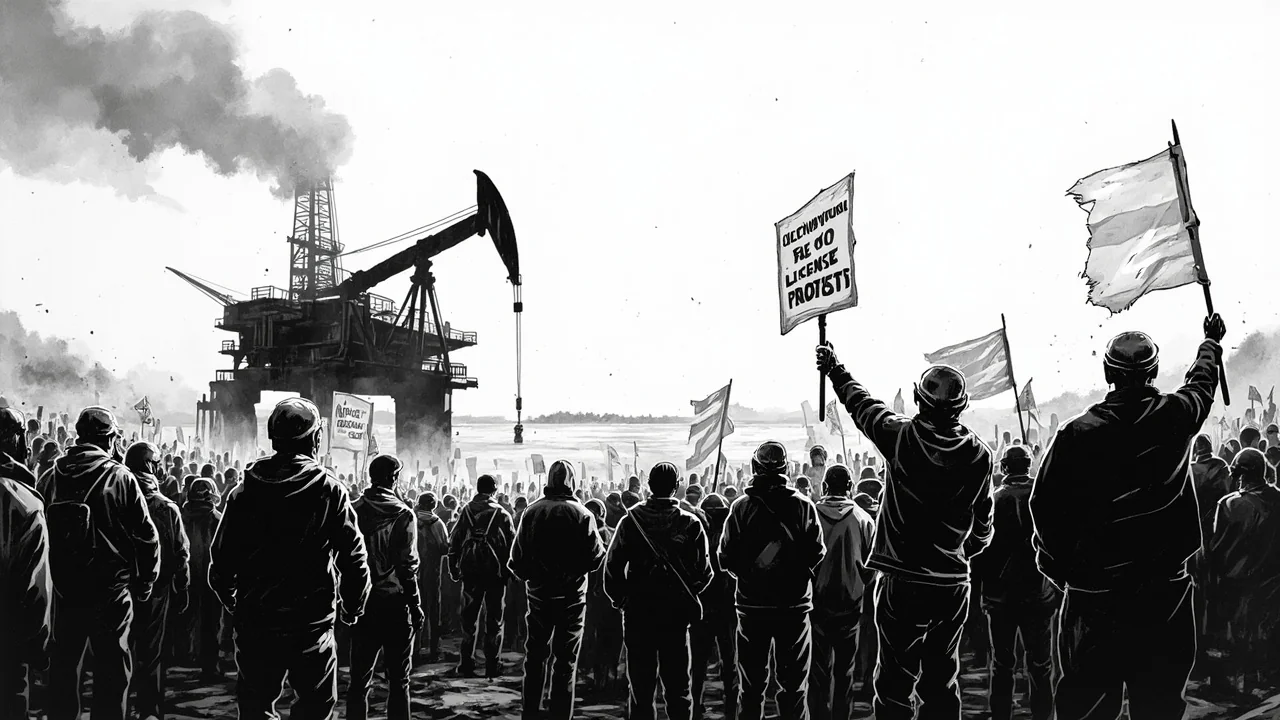
Norway's annual oil licensing round faced direct public dissent as demonstrators gathered outside a key industry seminar in Sandefjord. The protest targeted the Norwegian Petroleum Association's annual event, a traditional platform where the government announces new exploration licenses. This confrontation highlights the growing domestic pressure on Norway's central economic engine as it balances climate commitments against energy security demands.
Protesters assembled at the entrance to the conference venue in the coastal city, a historical hub for Norway's maritime and offshore industries. The demonstration, planned to continue throughout the day, represents a visible challenge to the long-standing political consensus surrounding oil and gas development. Sandefjord's location in Vestfold county, near major offshore operations in the North Sea, made the symbolism particularly potent.
A Clash of Visions for Norway's Future
The protest underscores a fundamental national debate about Norway's future. On one side stands the oil and gas industry, which has built the world's largest sovereign wealth fund, now valued at over $1.6 trillion. On the other, climate activists and a growing segment of the public argue the country must accelerate its transition away from fossil fuels. The demonstrators in Sandefjord aimed to disrupt the routine of license allocations, challenging what they see as business-as-usual in a climate crisis.
This annual seminar is more than a conference; it is a ritual. It is where the Ministry of Petroleum and Energy has historically presented the numbered licensing rounds, offering blocks in mature areas like the North Sea or the emerging Arctic frontier in the Barents Sea. The presence of protesters at the gates signals that this ritual is no longer insulated from public scrutiny. The very act of awarding new licenses, a technical process for the industry, has become a flashpoint for national identity.
The Political Calculus in Oslo
The protest places the minority coalition government, led by Prime Minister Jonas Gahr Støre, in a difficult position. His Labour Party relies on support from the Socialist Left Party, which advocates for a faster end to oil exploration. Meanwhile, the government faces pressure from industry and unions to maintain activity and protect tens of thousands of jobs. Every new license round is now a delicate political operation, scrutinized by both its supporters and its detractors.
Energy Minister Terje Aasland, who would typically headline the Sandefjord event, must navigate these conflicting demands. The government's official policy is to continue exploration while investing heavily in renewables like offshore wind and green hydrogen. Critics call this a contradictory stance. "We cannot drill our way to a low-carbon future," said one protester at the scene, capturing the essence of the opposition's argument. The demonstration serves as a physical reminder to ministers inside the seminar hall that their decisions are being watched.
Industry Confidence Meets Investor Uncertainty
For the Norwegian Petroleum Association and its members, the seminar is a vital forum for discussing policy, technology, and market outlooks. The industry argues that Norwegian gas is crucial for European energy security, especially following the war in Ukraine, and that its production has a lower carbon footprint than other global suppliers. They point to ongoing projects like the development of the Wisting field in the Barents Sea or the continued investment in the giant Johan Sverdrup field as evidence of a stable, long-term future.
However, the protests reflect broader investor concerns. Environmental, social, and governance (ESG) criteria are increasingly influencing capital allocation. Major Norwegian oil companies like Equinor are publicly committing to net-zero emissions, even as they apply for new exploration licenses. This duality creates a tension that the Sandefjord demonstrators sought to expose. The risk for the industry is not just activist pressure, but a potential shift in the political and financial landscape that could make new projects harder to sanction.
The Local Impact in an Oil-Dependent Region
The choice of Sandefjord as the protest location is significant. The city and the wider region have prospered from the offshore sector for fifty years. Supply vessels, engineering firms, and maritime services provide high-skilled employment. Many local families have direct ties to the industry. The protesters, therefore, are not just challenging a distant government in Oslo; they are engaging with a local community whose economy is intertwined with oil.
This creates a complex dynamic. While national polls show growing support for stricter climate policies, local support for the industry remains strong in regions like Rogaland and Vestfold. The demonstrators' message must resonate in a place where the benefits of oil are tangible and immediate. Their presence asks a difficult question of their neighbors: how does a community built by oil prepare for a future that requires less of it?
The Road Ahead for Norwegian Energy Policy
The Sandefjord protest is unlikely to halt the current licensing round, known as the Awards in Predefined Areas. The process is legally established and bids from companies are already under review. Yet, the demonstration is a clear signal that the social license for oil exploration is fraying. Future rounds, particularly those involving sensitive Arctic areas, will face even greater opposition and legal challenges from environmental groups.
The government's next move will be closely analyzed. Will it scale back the number of blocks offered? Will it impose stricter environmental conditions on new licenses? The political compromise may involve continuing exploration in the mature, near-shore North Sea while restricting or slowing development in the remote Barents Sea. Each decision will be measured against Norway's international climate pledges and its commitment to the Paris Agreement.
Ultimately, the scene in Sandefjord represents Norway at a crossroads. The nation is caught between its historical role as a reliable energy exporter and its desired future as a green industrial leader. The protesters outside the seminar hall are demanding that the country choose a path. As the government officials inside proceed with the ceremony of license allocation, the noise from the street serves as an insistent reminder that the era of quiet consensus on oil is over. The debate over Norway's next chapter is now happening not just in the Storting in Oslo, but at the very doors of the industry's most important gatherings.