
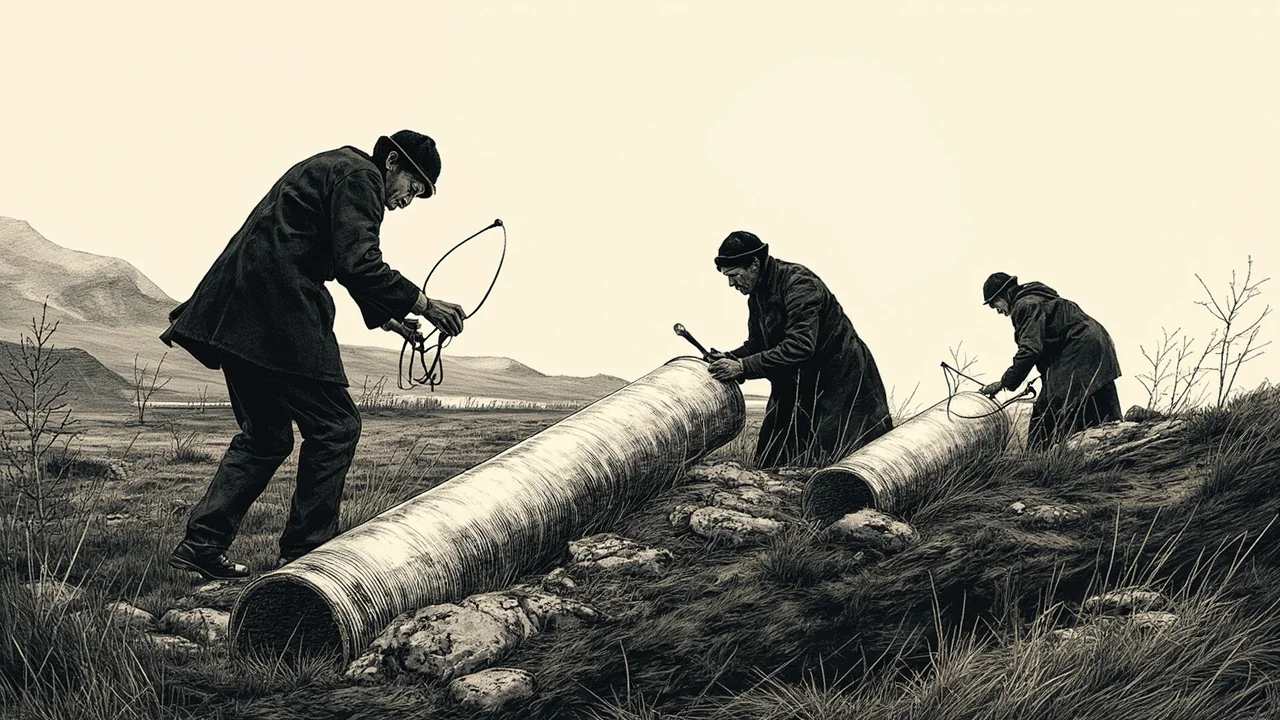
Norway's oldest folk music recordings have been rediscovered on wax cylinders from 1904. The unique find was made in a small wooden box on the Berge farm in Tinn, Telemark, where the wax rolls had sat forgotten for many years. The 20 cylinders contained audio recordings from the Jørisdal farm in the same municipality, preserved by Aaste Kveseth's family who knew they were old but not what they held. This discovery represents one of the earliest documented audio captures of Norwegian folk music, a rare window into a soundscape that has largely faded.
A Forgotten Box on a Farm
For decades, the unassuming wooden box held its secret. The wax cylinders inside, fragile and aged, were passed down through Aaste Kveseth's family without their contents being fully understood. The family's knowledge was limited to their age, the specific recordings and their immense historical value remained locked in the grooves of the wax. It was not until Kveseth, alongside journalist and folk musician John Ole Morken, began to investigate the rolls that their true significance came to light. Their investigation forms the basis of the podcast '1904 Tidskapselens hemmelighet' ('The 1904 Time Capsule's Secret'), detailing the process of uncovering this acoustic treasure.
The 1904 Time Capsule
Two of the cylinder labels are dated 1904, placing the recordings among the oldest known audio documents of Norwegian folk music. 'It is like Christmas Eve for me to come across something like this,' said John Ole Morken, a hardingfele player and host of the Folkemusikktimen on national radio. The recordings feature private, local performances of traditional tunes on the hardingfele (Hardanger fiddle) and songs, offering an intimate and authentic snapshot of musical life at the turn of the 20th century. Research librarian and musicologist Hans-Hinrich Thedens at the National Library confirmed the rarity and age of the music, noting the institution had previously received similar wax rolls with fiddle music from collector Tom Valle.
Preserving the Unplayable
The physical playback of the cylinders presented a significant technical challenge. The phonograph apparatus required to play them has long been out of production. To access the sounds hidden in the wax, Kveseth and Morken had to work with specialists at the National Library. Thedens suggested that photographer and folk musician Narve Skarpmoen from Numedal in Buskerud was likely behind the recordings, possibly made in Oslo in 1904 before some found their way to Tinn. 'It is fantastic that more recordings like this are appearing,' Thedens remarked, highlighting the importance of such private collections for national cultural heritage.
A Cracked Cylinder's Reveal
One of the most dramatic moments in the recovery process involved a cylinder dated June 11, 1904, which had a large crack. Despite the damage and significant background noise, the familiar local tune 'Rjukanfossen,' a springar dance melody, emerged from the speaker. The researchers identified the performer as the local folk musician Ola Bernås Gvåle on the hardingfele. 'Finding such folk music recordings is so rare. It is like finding a needle in a haystack,' Morken said, underscoring the sheer luck and persistence involved in the project. The successful playback of a damaged cylinder demonstrates both the fragility of these historical media and the resilience of the information they store.
The Significance of Sound
This discovery does more than just add old songs to an archive. It provides an irreplaceable acoustic fingerprint of a specific time and place in Norwegian history. Before the widespread adoption of recording technology, folk music traditions were passed down aurally, with variations emerging between regions and musicians. These wax cylinders capture the specific bowing techniques, ornamentation, and rhythmic feel of a musician from Telemark in 1904. They serve as a primary source for musicologists and musicians seeking to understand the evolution of Norwegian folk styles, offering a level of detail that written musical notation cannot convey.
From Farm to National Heritage
The journey of these cylinders—from a farm in Tinn, likely via Oslo, to a family's keepsake box, and finally to the National Library—mirrors a broader story about cultural preservation. Privately held artifacts often contain pieces of history unknown to public institutions. This find emphasizes the role of individuals and families in safeguarding national heritage, sometimes without even knowing the full value of what they possess. The collaboration between the family, independent researchers, and the National Library was essential to bringing this music back to life, creating a model for how other similar discoveries might be handled.
A Legacy Restored
The unearthing of the 1904 wax cylinders is not an endpoint but a new beginning. The digitized recordings now belong to the public, accessible for future generations to study and enjoy. They correct the historical record, proving the vitality and sophistication of folk music in rural Norway at the dawn of the recording age. For musicians today, they offer a direct link to the past, a chance to hear the phrasings and rhythms that might have otherwise been lost. In a quiet farmhouse box, a piece of Norway's sonic soul was patiently waiting, and its rediscovery adds a profound new layer to the understanding of the nation's cultural soundtrack. What other forgotten treasures might still be hidden, waiting for the right moment to speak again?