
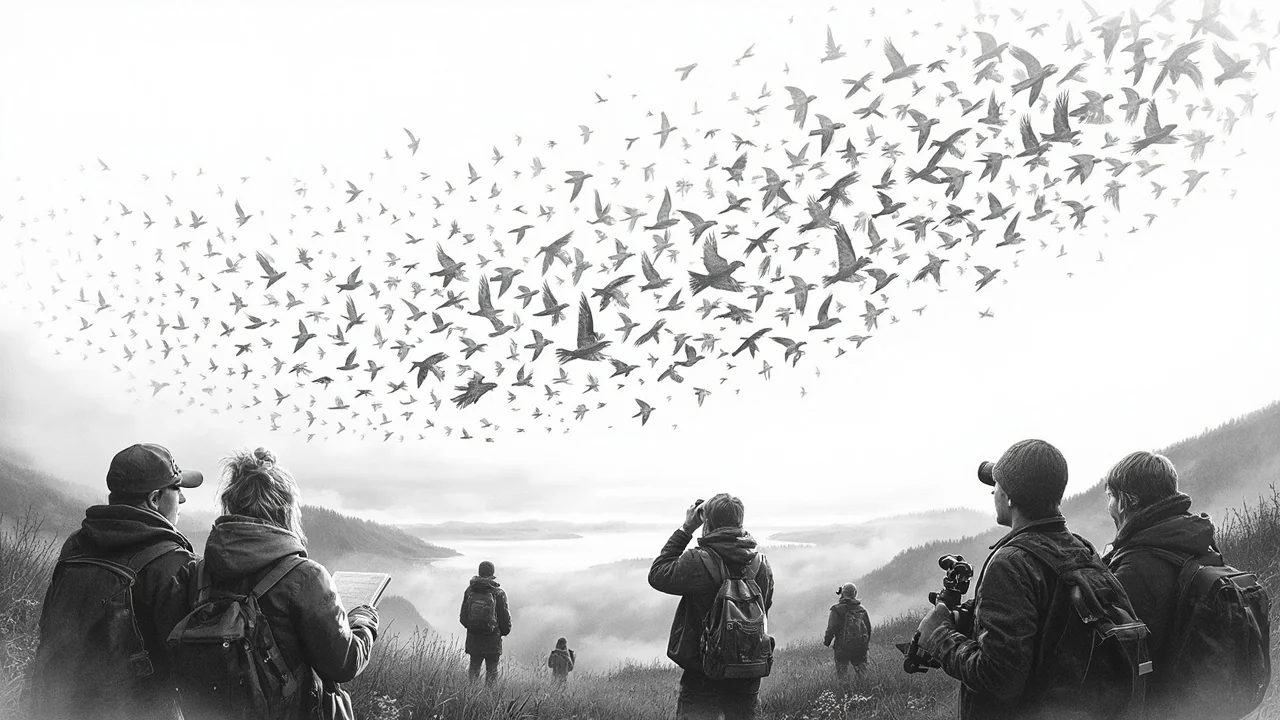
Norway's annual garden bird count has recorded over 53,900 individual bird sightings this weekend in one of the country's largest citizen science events. The national count, organized by BirdLife Norway, invites everyone to log the birds visiting their gardens, balconies, and feeders. The data provides crucial knowledge about winter bird populations across the nation. For the Bru-Kammler family, participation is a weekend tradition. Parents Mirjam and Teodor, along with their three-year-old daughter Maiken, share a deep interest in birds. Their observation this year, however, highlights a concerning trend many participants are noting.
A Family's Feathery Focus
Teodor Bru-Kammler's passion for birds even led him to study biology. The family previously lived in a city center location where they didn't expect to see many birds, but were surprised by what they found. They have since moved to a home near the Østmarka forest, expecting more avian visitors. Their expectations were not met. "Is there less birds now than before? Yes, there is," Teodor stated during the count. He referenced the biological concept of 'shifting baseline syndrome,' where each generation accepts the current state of nature as normal. "If you placed random people from the past into our row house now, they would be very surprised by how few birds there are," he explained. During a recent observation period, they saw no birds at all.
A National Weekend for Wings
The annual Garden Bird Count is a key event for BirdLife Norway, an organization founded in 1957. It relies on volunteers across the country to submit their observations through the Fuglevennen.no website. This massive data collection effort would be impossible without public participation. The aggregated results are processed with the help of artificial intelligence, with quality assurance performed by journalists, to identify broad population trends. The long-term dataset is invaluable, showing how various species' winter ranges are changing over time. It turns every garden and park into a temporary research station, contributing to a clearer picture of Norway's biodiversity.
Winners, Losers, and the Red List
Data from previous years has revealed clear trends for different species. Some birds have successfully expanded their winter range in Norway. These include the coal tit, the brambling, the chaffinch, and the Eurasian siskin. Other familiar species are in decline. The greenfinch, the yellowhammer, and several tit species are being seen less frequently. The popular house sparrow is also among the birds showing a decreasing trend. These declines contribute to official conservation statuses. The Norwegian Red List for species catalogues those at risk of disappearing from the country. For birds, being red-listed can be due to a very small remaining population or a significant reduction in population size over the last three generations. Currently, 93 of 234 assessed species on the mainland are on this list.
The Silent Spring in Suburbia?
The experience of the Bru-Kammler family points to a wider, quieter change in suburban and urban environments. While year-to-year fluctuations are normal, the long-term datasets built by counts like this one provide evidence of broader shifts. The decline of common species is particularly insidious, as it happens gradually, often unnoticed from one year to the next. Events like the Garden Bird Count make this change visible by aggregating thousands of individual observations. It creates a national snapshot that helps scientists distinguish between local variation and genuine population trends. For participants, it transforms a casual interest into meaningful contribution.
From Hobby to Hard Data
The transition from a personal hobby to systemic data is the core strength of the bird count. Teodor Bru-Kammler's academic perspective underscores the value. His favorite bird, the puffin, won't visit his garden, but his counting helps protect the habitats of all species. The over 53,900 birds registered this weekend represent tens of thousands of data points. Each recorded house sparrow or coal tit adds to the understanding of migration patterns, food availability, and the impact of climate change on local ecosystems. This public engagement is vital for environmental monitoring in a country as vast as Norway, where professional scientists cannot be everywhere.
The Future of Feathered Friends
The ultimate goal of the count is to inform conservation efforts. By identifying which species are declining, organizations and authorities can target protective measures more effectively. The reasons for decline are varied, including habitat loss, climate change, and changes in agriculture. The Red List is a direct tool stemming from this kind of monitoring. For now, the annual count continues to be a weekend where Norwegians look out their windows with a purpose. The Bru-Kammler family will likely be counting again next year, hoping their log will contribute to a future where the baseline is not so quiet. As the data is finalized, it will add another critical layer to the story of Norway's birds, a story written not just by scientists, but by thousands of citizens looking into their own gardens.