
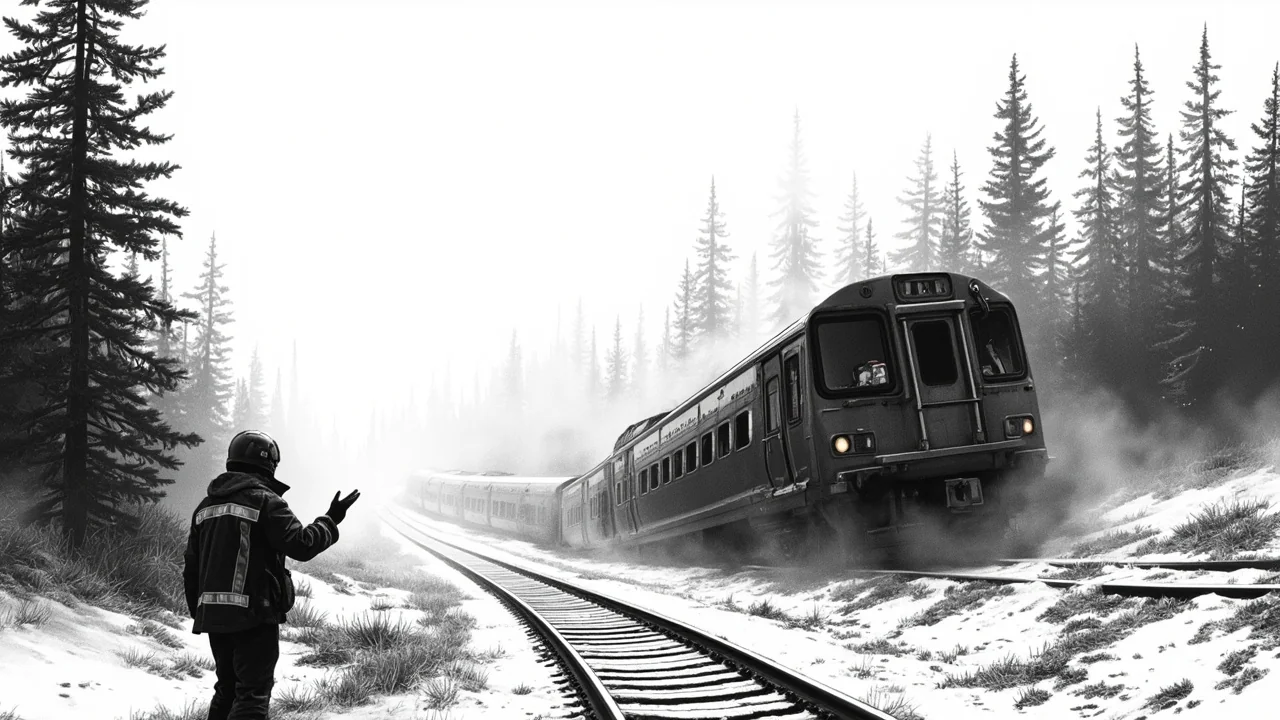
Norway's vital Gjøvik Line carries over 7,000 daily passengers, a crucial regional link now severed after a train derailment caused a full service halt. Railway operator Bane Nor reported a complete traffic stop between Jaren and Gjøvik on Thursday afternoon, leaving commuters stranded and supply chains disrupted along the 123-kilometer route. Emergency services rushed to the scene as officials began the complex process of assessing damage, recovering the train, and determining a cause. The incident underscores persistent vulnerabilities in Norway's aging northern rail infrastructure.
Immediate Chaos and Passenger Ordeal
Passengers onboard experienced sudden braking and were evacuated safely, according to initial reports. No serious injuries were reported, but the disruption caused immediate logistical chaos. Replacement bus services were hastily organized, but faced significant delays due to the rural nature of the line that cuts through the picturesque valleys of Oppland county. For the towns of Raufoss, Reinsvoll, and other communities along the route, the rail line is their primary efficient connection to Oslo and the larger national network. The derailment effectively isolates these areas, halting the daily flow of workers, students, and goods. Local businesses reliant on just-in-time deliveries, particularly in the industrial hub of Raufoss, faced immediate operational challenges. 'This isn't just an inconvenience; it's a total standstill for our economic mobility,' remarked one frustrated commuter trying to arrange alternative transport.
The Technical and Investigative Challenge
The derailment presents a significant technical challenge for Bane Nor's maintenance crews. Recovery operations for a derailed train are delicate, requiring specialized equipment to lift heavy carriages back onto the tracks without causing further damage to the rail bed or overhead electrical systems. Investigators from the Norwegian Safety Investigation Authority will likely be dispatched to the site. Their probe will focus on several critical factors: the condition of the track at the derailment point, the mechanical state of the train's wheelsets and bogies, and data from the train's onboard recording systems. Historical data shows that the majority of derailments in Norway are caused by track geometry defects or failing rail components, often exacerbated by seasonal temperature fluctuations that stress the steel. The Gjøvik Line, parts of which date back over a century, has undergone significant modernization but remains a challenging route with sharp curves and steep gradients, particularly in the northern section approaching Gjøvik itself.
A Recurring Strain on Regional Resilience
This disruption is not an isolated event for Norway's regional rail network. Similar incidents on the Gjøvik, Bergen, and Nordland lines in recent years have repeatedly highlighted the tension between maintenance needs, budget constraints, and increasing passenger demand. Each major stoppage triggers a costly emergency response, compensation payouts to affected businesses and passengers, and a loss of public confidence. The economic cost extends beyond immediate logistics. Consistent reliability is key for regional development, influencing corporate location decisions and property values. When the primary rail artery is prone to failure, it discourages investment in the very areas the government aims to support through decentralized growth policies. This derailment will inevitably renew debates in the Storting about the pace and funding of the National Transport Plan, particularly its rail maintenance and renewal segments.
Political Reactions and Infrastructure Debates
Politicians from the affected regions, including MPs from the Opposition Labour Party and the governing Conservative Party, quickly called for swift action and transparent communication from Bane Nor and the Ministry of Transport. Transport Minister Jon-Ivar Nygård is expected to face questions in parliament regarding the state of rail asset management. 'This is a stark reminder that our infrastructure backbone needs constant, diligent care,' said a spokesperson for the Standing Committee on Transport. The incident provides ammunition for those advocating for accelerated investment in rail digitalization and predictive maintenance technologies. Conversely, it also fuels arguments from fiscal conservatives who question the cost-effectiveness of maintaining low-density regional lines versus bolstering road networks. The derailment occurs against a backdrop of Norway's ambitious climate goals, which heavily rely on shifting freight and passenger traffic from road to electrified rail, making reliability a climate policy issue, not just a transport one.
Comparative Context: Nordic Rail Reliability
While serious, Norway's rail safety record remains strong by international standards. The Nordic model of a state-owned, single infrastructure manager like Bane Nor generally promotes high safety protocols. However, operational reliability—measured by punctuality and cancellations—often lags behind neighbors like Sweden and Denmark, particularly on branch lines. These countries face similar geographical and climatic challenges but have invested differently in dual-track expansions and advanced signaling systems. The Gjøvik Line incident will likely be benchmarked against recent performance data from across Scandinavia. Analysts often note that Norway's rugged terrain and lower population density outside the Oslo area make rail investment per passenger significantly higher, creating a persistent political and economic challenge for justifying the massive capital expenditures required for foolproof reliability.
The Road to Restoration and Long-Term Implications
Bane Nor's priority is restoring service, but the timeline remains uncertain. After securing the site and completing the initial investigation, crews must repair any damaged track, conduct thorough integrity checks on a long section of line, and finally reintroduce services cautiously. This process could take days, if not longer. The long-term implications are more profound. Each major failure acts as a stress test, revealing weaknesses in contingency planning, communication between operator and passengers, and the resilience of regional transport ecosystems. It will pressure Bane Nor to review its inspection frequencies on key regional corridors and may accelerate planned renewals. For the public, the derailment is a tangible, frustrating manifestation of the abstract infrastructure statistics debated in Oslo. The sight of a train off its tracks near Jaren is a powerful image that will resonate far longer than the service interruption itself, shaping the public's trust in Norway's ability to maintain its essential connections in an era of climate and economic uncertainty. The ultimate question for authorities is not just when the trains will run again, but what systemic changes will prevent the next derailment from halting an entire region.