
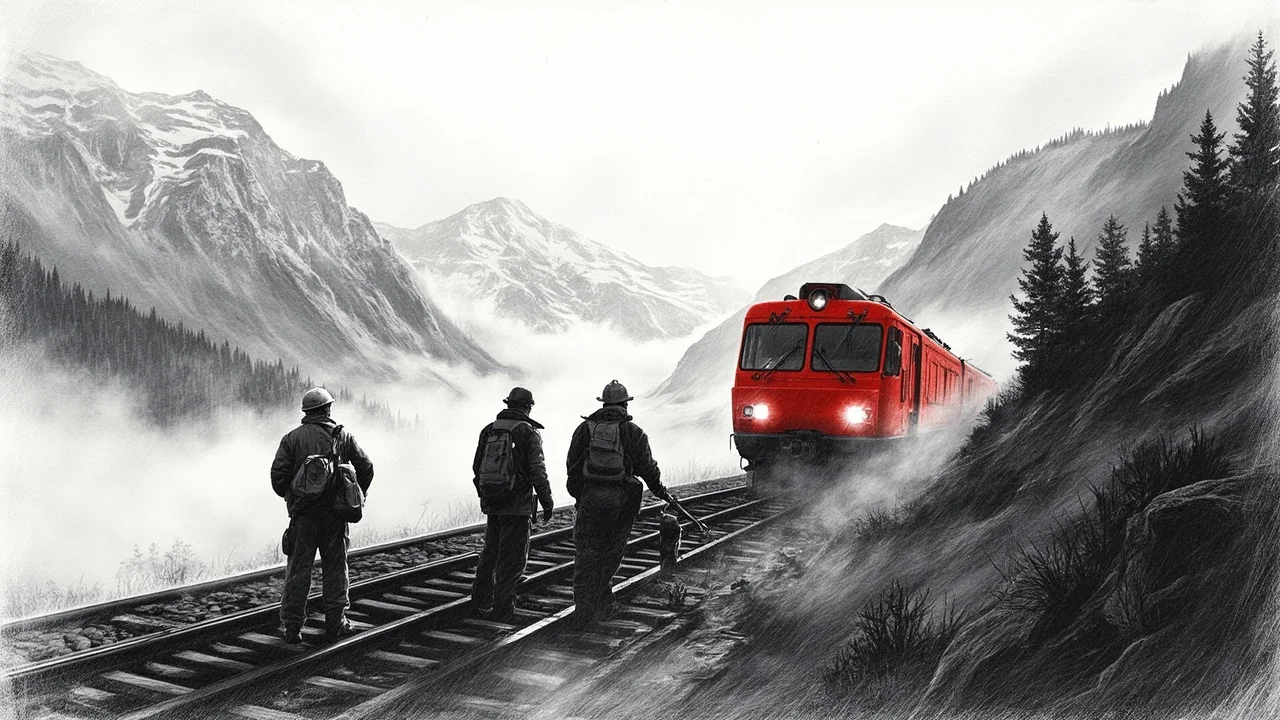
Norway's critical Nordland Railway line between Fauske and Bodø reopened Tuesday night following a dramatic 24-hour repair operation. The line resumed service at approximately 9:00 PM with trains operating at reduced speeds for safety, after a derailment on Monday brought all traffic to a halt. The swift restoration, beating initial Wednesday estimates, highlights the strategic importance of this Arctic transport artery.
"There is some urgent repair work that must be done immediately, which will continue going forward," said press officer Harry Korslund of Bane Nor, the state railway infrastructure manager. "But as it looks at the moment, we are heading towards reopening the section between Fauske and Bodø during the evening." The incident caused damage to sleepers and the fastening system connecting rails to sleepers, requiring both immediate and longer-term repairs.
A Race Against Time in the Arctic
The derailment, occurring on the northernmost stretch of Norway's extensive railway network, triggered a complex logistical challenge. Engineers and repair crews worked through Monday night and all day Tuesday to clear the derailed train, which was removed from the tracks by 2:30 PM Tuesday. The remote location, just south of Bodø near the Arctic Circle, complicates the mobilization of heavy equipment and personnel. Bane Nor's initial assessment pointed to a Wednesday reopening at the earliest, making the Tuesday night restoration a significant operational achievement.
This section of the Nordland Line is not merely a regional route; it is the final leg of a 729-kilometer line connecting Trondheim to Bodø. It serves as a vital passenger and freight corridor for Nordland county. The closure severed the rail connection to Bodø, a key city for regional administration, defense, and as a gateway to the Lofoten Islands. For over a day, alternative transport by road was the only option, a difficult proposition given Norway's long distances and mountainous terrain.
Economic and Strategic Implications
The rapid response underscores the line's economic importance. Bodø is a hub for fisheries, offshore supply services, and is designated as a European Capital of Culture for 2024, expecting increased visitor traffic. Reliable rail transport is crucial for moving goods like fresh fish south to markets and for supporting the region's tourism industry. A prolonged closure would have disrupted supply chains and travel plans, with financial consequences for local businesses.
From a strategic perspective, the Nordland Line holds national security relevance. Bodø hosts a major air force base, and the railway is part of broader infrastructure considerations for national defense and resilience in the High North. The efficiency of the repair operation reflects the priority placed on maintaining connectivity in this strategically sensitive region. The incident will likely prompt internal reviews at Bane Nor regarding track maintenance schedules and derailment response protocols on northern lines.
The Challenge of Permanent Repairs
While service has resumed, the work is not complete. Korslund noted that "some more permanent measures must be carried out," though he could not immediately specify how long these subsequent repairs would take. Trains are operating at reduced speeds as a precaution while this work continues. This phased approach is standard: first restore mobility, then conduct more thorough, lasting repairs, often requiring coordinated track possession windows that minimize further disruption to schedules.
The nature of the damage—to sleepers and rail fastenings—points to significant physical forces during the derailment. These components are fundamental to track integrity, ensuring the correct gauge and alignment. Their failure can lead to further safety risks if not properly addressed. Bane Nor will be under pressure to complete these permanent fixes promptly while maintaining safe operations, a balancing act that will test their engineering and planning capabilities in the weeks ahead.
A Test of National Infrastructure Resilience
This event serves as a microcosm of the broader challenges facing Norway's transport infrastructure. An aging network, particularly in remote areas, faces constant pressure from harsh weather and increasing demand. The Norwegian National Transport Plan consistently debates investment priorities between new projects, like the proposed Nordland Line extension to Tromsø, and the maintenance of existing assets. Incidents like this derailment strengthen the argument for robust maintenance budgets to ensure reliability.
For passengers and freight operators, the swift reopening provides relief but also a reminder of vulnerability. Norway's geography makes its rail network a series of critical chokepoints. The performance of Bane Nor in crisis management is therefore closely watched by politicians in the Storting and by regional authorities. The coordination between recovery crews, communication teams, and operational planners during this 24-hour period will be analyzed for lessons that can be applied across the national rail system.
Looking North: Transport in the Arctic Future
The Nordland Line derailment occurs amid a national focus on Arctic development. As activity increases in the north—from tourism to shipping to potential mineral extraction—the reliability of ground transport becomes ever more critical. Rail is viewed as a sustainable alternative to road and air for long-haul freight, reducing carbon emissions. This incident highlights the operational reality behind that policy ambition: infrastructure must be resilient.
Future investments, such as the proposed electrification of remaining diesel-operated sections of the line, depend on demonstrating that the core infrastructure is sound and reliably managed. The government's commitment to northern regions is often measured in concrete terms like transport links. The efficient handling of this disruption likely prevents a larger political debate about neglect, but it also focuses attention on the need for continued, predictable investment in maintenance.
The trains are moving again between Fauske and Bodø, a testament to effective crisis response. However, the sight of a derailed train on this iconic line raises a persistent question for Norwegian authorities: is the nation investing enough to prevent the next one, or merely to fix it faster? The answer will shape the future of connectivity in the Arctic north for decades to come.