
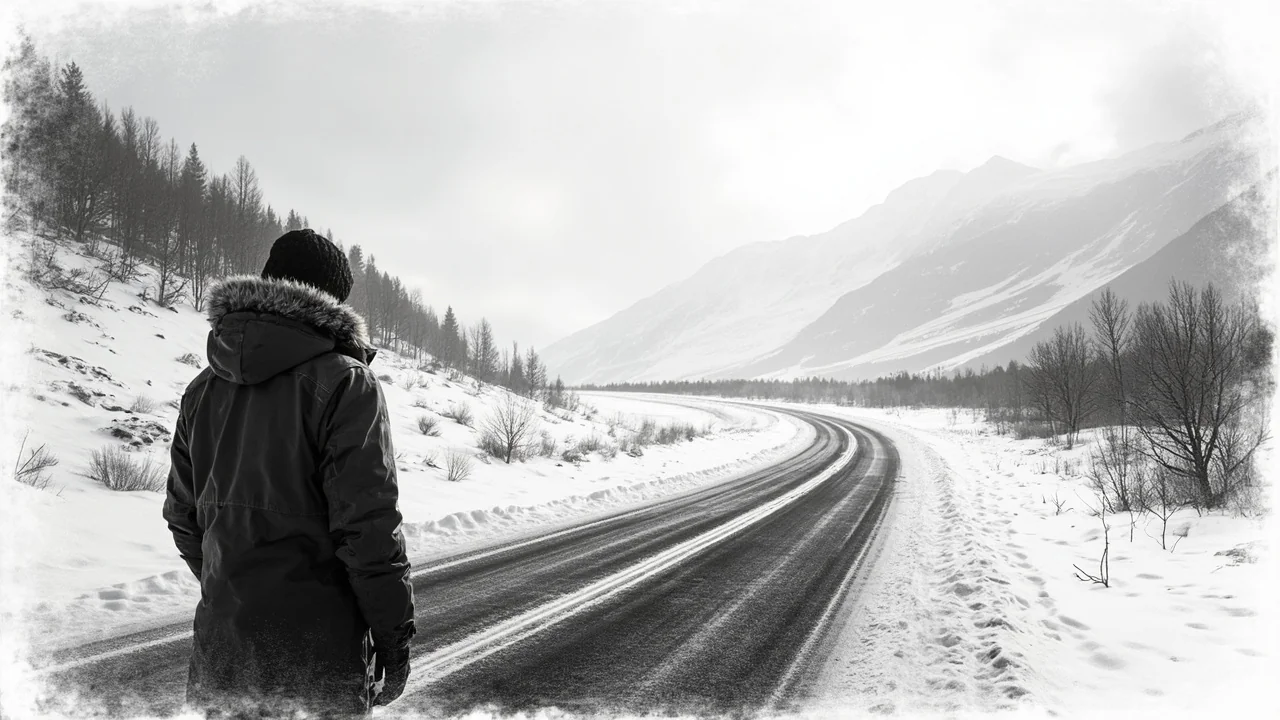
Norway’s winter roads in the south pose a far greater challenge than the famed Arctic highways up north. That’s the controversial claim from a senior road engineer who should know—he’s a northerner himself. The statement has kicked off a classic Norwegian regional spat, pitting deep winter experience against volatile coastal conditions.
Rudi Malmo, a senior engineer with the state roads authority, moved from Lofoten to southern Norway in 2013. He’s got a unique perspective. "The winter weather on the south coast is considerably more challenging than up north," Malmo said. He argues the real problem isn't snow volume, but instability. Temperatures dance around freezing, he said, shifting rapidly between plus and minus degrees.
The Slush Factor
When snow falls in the south, it’s often heavy and wet. "We get snow, then it's heavy snow and slush. It's the most challenging thing we can have, both for the plowing crews and for drivers," Malmo explained. Up north, roads are more stable. It stays below zero for weeks on end. "When you drive on stable winter roads that have had freezing temperatures for a long time, they can almost be compared to bare roads," he said. Plus, northerners have the experience. Southern roads, by contrast, become unpredictable skating rinks coated in treacherous, icy sludge.
Malmo was quick to defend southern drivers. It’s not about skill. "No, on the contrary, I would say. Southerners are generally good at driving in challenging conditions." The bigger issue is scale. The consequences of a stoppage are massive. On the E39 near Kristiansand, a traffic halt can mean 4,000 cars backed up. Emergency services and plows get stuck too. "If you get a blockage further north in the country, then we're talking about 50 cars at best," he noted. The sheer volume of traffic on southern corridors turns minor incidents into major crises.
Northern Backlash
The reaction from the north was swift and proud. After Malmo shared his views, he received dozens of messages from displeased northerners. "It's not to be hidden that some were a bit offended," he laughed. Rune Ytreberg, editor of a Tromsø-based newspaper, was blunt. "It's just nonsense. The mild breeze on wide south coast roads cannot be compared to the north," Ytreberg said. He argued northerners are used to driving narrow roads in ground blizzards, snowstorms, and polar lows. "And we are much better at plowing. We plow around the clock."
This debate touches a nerve. It’s about regional identity and a deep-seated belief in northern toughness. For many in the Arctic, mastering winter is a fundamental part of life. The suggestion that the gentler south has it harder can feel like an insult to that heritage. Yet, Malmo’s point is technical, not cultural. He’s looking at the engineering and logistics, not the driver’s mettle.
A Question of Stability
The core of the argument isn't about who is tougher. It's about physics. Stable, cold conditions are predictable. Roads stay consistently icy or snow-packed. Drivers adjust tire pressure, fit studs, and settle in for the long haul. The southern coast faces a meteorological rollercoaster. A daytime thaw turns snow to water. Overnight, it refreezes into black ice. Then it rains. Then it snows again. The road surface changes by the hour. That demands constant adaptation from both maintenance crews and drivers. One isn't necessarily harder than the other—they're different kinds of hard.
Plowing strategies differ, too. In the north, the goal is often to keep roads clear of accumulating snowdrifts. In the south, the battle is against ice formation and managing wet, heavy snow that falls on warmer asphalt. Brine solutions and salt are used more aggressively in the south, but they lose effectiveness when temperatures plunge too low, a problem less common on the coast. It's a constant balancing act with nature's thermostat.
Beyond the Banter
Underneath the friendly rivalry lies a serious point about national infrastructure. Malmo’s comments highlight how winter preparedness must be region-specific. A one-size-fits-all approach won't work for a country stretching from 58 to 71 degrees north. The resources and tactics needed for the E6 through Finnmark are different from those for the E18 along the Skagerrak coast. Investment, training, and public awareness campaigns all need this nuanced understanding.
So far this season, despite warnings, the weather hasn’t created major problems on southern roads. But the potential is always there. A single wrong forecast, a rapid temperature drop, and the main arteries connecting Oslo to Stavanger and Kristiansand could seize up. The economic impact would be immediate. For northern communities, isolation during a storm is an accepted part of winter. For the densely populated south, it’s an economic emergency.
This isn't just a war of words. It's a discussion about resource allocation and risk assessment. Should more winter maintenance funding go to the unpredictable south, where the cost of failure is so high? Or does the extreme, prolonged Arctic winter justify its own significant share? The debate between Malmo and Ytreberg frames that exact policy question. It's a conversation happening in municipal public works departments and the national transport ministry right now.
In the end, both men are right in their own way. Ytreberg defends a legitimate culture of Arctic competence. Malmo points out a less visible, more chaotic form of winter adversity. Perhaps the only true consensus is that Norwegian winters, from the fjords to the tundra, demand respect. The rest is just healthy, regional pride playing out in the open—a national pastime as predictable as snow in January.