
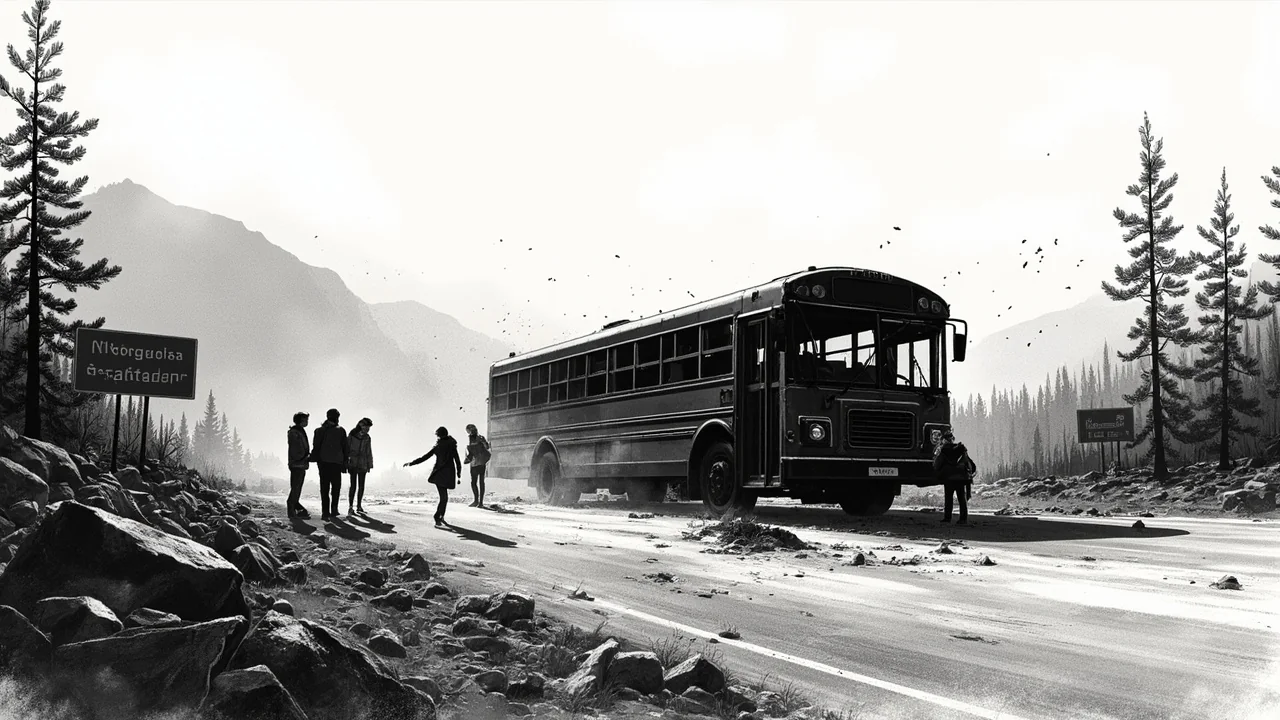
Norway's E10 highway in Flakstad, Lofoten, was the scene of a school bus accident Tuesday morning, leaving six to seven teenagers with minor injuries. The bus veered off the road and into a ditch, with initial reports indicating the vehicle's door was difficult to open, complicating the evacuation. Emergency services from Nordland Police District confirmed the evacuation was underway minutes after the first unit arrived on the scene.
This incident on a major Arctic coastal route immediately raises questions about winter road safety in remote regions. The E10 is a critical transport artery connecting the Lofoten archipelago, used by tourists, freight, and local residents daily. A bus carrying students leaving the roadway highlights the persistent risks faced by communities in Norway's far north, where dramatic weather and challenging geography are constant factors.
The Immediate Response and Evacuation
Operational leaders at Nordland Police District confirmed the number of youths on board. The first police unit to arrive assessed the situation, reporting initially that those on board had sustained only light injuries. However, their ability to exit the vehicle was immediately hampered. "The bus door was initially difficult to get open," a police operations leader said in a statement. This brief delay underscores how even minor technical issues can escalate tension during an emergency evacuation.
Within minutes, responders on the ground managed to resolve the issue. The operations leader received confirmation that the door had been opened and the evacuation process had begun. The swift resolution prevented a minor incident from becoming a more dangerous situation. All teenagers were successfully removed from the bus and received medical attention at the scene for their minor injuries. No one was reported to be transported to hospital, indicating the accuracy of the initial injury assessment.
Arctic Roads and the Constant Safety Challenge
This accident, while minor in outcome, occurred on one of Norway's most iconic and strategically important roads. The E10, also known as the King Olav V's Road, runs from Luleå in Sweden to Å in Lofoten, Norway. The section through Flakstad is known for its stunning coastal views but also for its exposure to harsh weather coming off the Norwegian Sea. Strong winds, sudden snow squalls, and icy conditions are common from autumn through spring.
Local municipalities in Nordland county have consistently invested in road maintenance and winter preparedness. Yet, the geography imposes limits. The road winds around fjords and over passes, creating microclimates where conditions can change within kilometers. For school buses, which operate on fixed schedules regardless of weather fluctuations, this presents an ongoing logistical and safety puzzle. Drivers require specific training for Arctic conditions, and vehicle maintenance standards are high, but the environment remains an unpredictable factor.
The National Context of School Transport Safety
School transport in Norway, particularly in rural and remote areas, is a vital public service. In the sparsely populated counties of the north, students often travel long distances to centralized schools. The safety record is generally excellent, built on a framework of strict regulations. Buses must meet high safety standards, and drivers undergo rigorous licensing. This incident will likely trigger a standard review by both the local transport company and the county authorities responsible for road safety.
Norway's Public Roads Administration (Statens vegvesen) continuously works on improving high-risk road sections. The E10 has seen significant upgrades over the past two decades, including widening and improved alignment. However, the fundamental challenges posed by the Arctic climate cannot be engineered away entirely. Each accident provides data points that feed into broader safety analyses, influencing future investment decisions in barriers, lighting, and road surface technology.
Community Impact in a Close-Knit Region
In a region like Lofoten, where communities are small and interconnected, an accident involving a school bus resonates deeply. While the physical injuries were light, the psychological impact on the students, their families, and the driver should not be underestimated. Such events shake the sense of security in places where everyone knows each other. The local school and health services will typically follow up with offers of support and counseling to those involved, a standard practice in the Norwegian welfare system.
The incident also disrupts the rhythm of daily life. Alternative transport must be arranged, parents are notified, and the normal school day is fractured. In remote areas, where the bus is the only feasible link to education for many, its reliability is paramount. The quick restoration of normal service will be a priority for the local authorities to maintain trust in the system.
Analysis: When Minor Crashes Signal Major Vulnerabilities
This crash is noteworthy precisely because of its minor outcome. It serves as a near-miss case study. The difficult-to-open door, though quickly overcome, points to a potential vulnerability. In a more serious crash with different dynamics—a rollover, a fire risk, or more severe injuries—that same malfunction could have had grave consequences. Norwegian vehicle safety inspectors will likely examine the bus in detail to determine if the door issue was a result of the crash impact, a maintenance flaw, or a design problem.
Furthermore, the cause of the bus leaving the roadway remains officially undetermined. Was it driver error, a mechanical fault, a sudden weather event like a wind gust, or a combination of factors? The police investigation will seek to establish this. The answer holds importance for all transport operators on northern routes. If a clear, preventable cause is found, it will lead to immediate corrective actions across the industry.
The Road Ahead for Northern Transport
For Norway, balancing the development of its northern regions with the safety of inhabitants is a core policy issue. The government's National Transport Plan allocates billions of kroner to northern roads and ferries. Safety is always the paramount justification for this spending. Incidents like the Flakstad bus crash, though small, provide tangible evidence of the risks that this investment seeks to mitigate.
They also highlight the human element. Technology and infrastructure can only do so much. The skill and judgment of the driver, the preparedness of emergency services, and the calm response of the passengers are ultimately what determine outcomes. In this case, the system worked: injuries were minimal, help arrived quickly, and a problem was solved. The story is one of a crisis averted, but also a reminder of the thin margin for error on the roads at the edge of the Arctic.
As the investigation proceeds and the students return to their normal routines, the questions linger. Is the current level of investment and regulation sufficient for the extreme conditions of the north? How can technology, from better weather forecasting to advanced vehicle stability controls, be further integrated? And what can be learned from this specific event to prevent a future one with a less fortunate outcome? The quiet aftermath on the E10 in Flakstad belies the significant safety conversation this minor crash has once again ignited.