
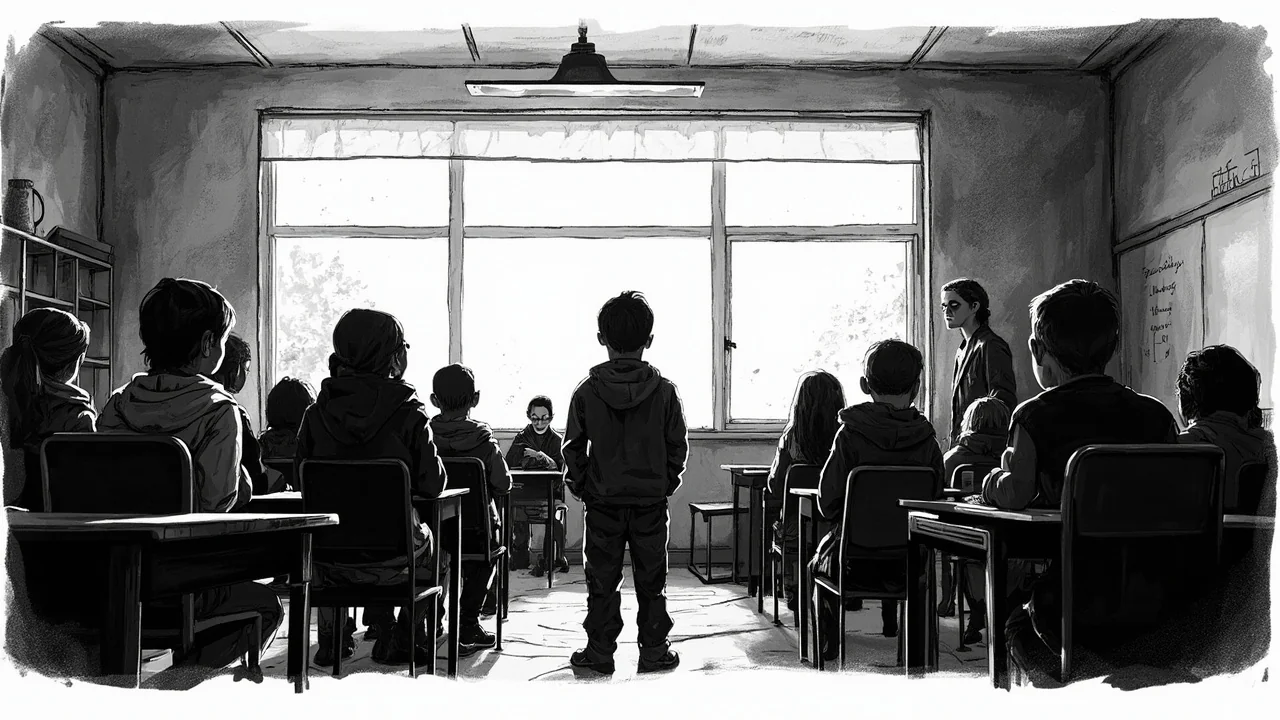
Seventy percent of Norwegian school leaders report a critical lack of equipment for students. The finding comes from a major survey of 721 elementary schools, revealing how budget cuts are hitting practical and aesthetic subjects hardest. At Lindhøy School on Tjøme in Vestfold, the impact is felt daily in classrooms meant for creativity and skill-building. Sixth-grader Theodor Barth Sanne stands in a woodworking shop that feels familiar, yet incomplete. 'We don't have that much woodworking,' he says. 'If we had more of it, I think it would have been my favorite subject.' His current favorite is math, but it's a choice made from necessity, not passion.
A Classroom Built on Scraps
The scarcity isn't abstract. To keep its woodworking program running, the school has resorted to gathering materials from construction sites and hardware stores, taking items that would otherwise be thrown away. Inger-Lise Sannes Vikstrøm, a 58-year-old teacher with experience in the arts and crafts subject, describes the situation as desperate. 'We also don't have enough adults to run the subject,' she said in a statement. 'It's so despairing. Mostly because this is a subject that reaches so many – both girls and boys.' The problem extends beyond one subject. In the adjacent sewing room, only three sewing machines are functional, creating long queues of students waiting for a turn. In the Food and Health class, the budget restricts meals to very simple dishes, leaving culinary aspirations unfulfilled.
Student Dreams Versus Fiscal Reality
Eleven-year-old Olivia Nerem-Woldsæter loves to cook at home, making whatever she wants. At school, the experience is diminished. 'Sometimes here at school we make, for example, just soup,' she says. 'It would have been very cool if we could make bread, or lasagna for example, from scratch.' She intuitively understands the constraint: 'No. I think it costs a bit too much money, and it takes a bit of time.' Her ambitions are simple yet telling of the skills gap being created. 'It would have been a bit cool to, like, learn to fry a steak, for example, medium rare,' she adds, mentioning a previous desire to become a chef. These are not frivolous wants. They represent foundational life skills and potential career pathways that are being stunted by a lack of basic resources.
Outdated Tools in a Modern Nation
School principal Hilde Marie Westhagen-Kirkevold listens to the students' experiences. She confirms one of the survey's key findings: the practical-aesthetic subjects are difficult to divide into smaller groups, requiring more teacher supervision per student. She shows off old tools, holding up a plane she remembers from her own childhood. 'The children are not as used to doing practical things as before. Therefore, you have to be more hands-on as a teacher,' she explains. 'The woodworking shop is not idle. But it is used less than we could wish. Much of our equipment is outdated and has not been used in many years. The saws are often dull. It becomes very simple woodworking as a result.' This reality creates a paradox. Norway, a nation celebrated for its digital infrastructure and innovation hubs, is failing to equip its next generation with the tactile, problem-solving skills that often underpin technological creativity. The shortages in physical workshops mirror a broader challenge in providing the hands-on learning essential for a well-rounded education.
The Systemic Strain on Practical Learning
The survey data paints a clear picture of systemic strain. Seven out of ten school leaders directly link the reduction in equipment and teaching aids to poor finances for the current school year. This isn't about luxury items but core materials: wood for crafting, fabric for sewing, ingredients for cooking. The consequence is a curriculum narrowed by budget, not pedagogy. Students like Theodor are denied the chance to discover a latent talent. Aspiring chefs like Olivia cannot practice fundamental techniques. The teacher-student ratio in these vital, engaging subjects becomes unmanageable, compromising safety and the quality of instruction. When schools must scavenge for materials, the educational experience becomes reactive and impoverished, rather than designed and inspiring.
A Broader Impact on Norway's Future Skills
This trend has implications beyond the classroom walls. The practical-aesthetic subjects – woodworking, sewing, cooking – are crucial for developing fine motor skills, spatial reasoning, patience, and an understanding of materials and processes. These are transferable competencies valuable in fields like engineering, design, architecture, and, notably, the hands-on prototyping essential in tech startups. By allowing these programs to atrophy, Norway risks creating a generation strong in theory but weak in practical application. The irony is palpable in a country investing heavily in becoming a Scandinavian tech hub while the tools for foundational making rust in its school basements. The digital transformation of society requires citizens who understand the physical world, not just the digital one.
Listening to the Next Generation
The students' voices are the most compelling indictment of the situation. Their requests are modest: the chance to work with proper materials, to cook a meal from scratch, to use a sharp saw or a working sewing machine. These are not demands for advanced technology but for the basic tools of applied learning. Principal Westhagen-Kirkevold's acknowledgment that equipment is 'outdated' and 'dull' underscores a failure to maintain the foundational infrastructure of education. In an era focused on digital learning platforms and STEM, the survey and the scenes from Lindhøy School serve as a critical reminder. Innovation is not solely born from a screen, it often starts with hands shaping wood, fabric, or food. Norway's challenge is to ensure its schools have the resources to foster that kind of creativity, or risk seeing it whittled away entirely.
The Path Forward Requires Investment
The solution, as identified by the school leaders themselves, is fundamentally financial. The lack of equipment is a direct consequence of budgetary decisions. Addressing it requires a renewed commitment to funding the tangible, material needs of schools, not just their digital or administrative costs. It means recognizing that investing in a woodworking shop or a home economics kitchen is an investment in problem-solving, self-reliance, and innovation. For a country like Norway, with its wealth and emphasis on quality of life, the current state of affairs in its practical classrooms presents a significant contradiction. Bridging this gap is essential to providing the comprehensive education that all students deserve and that the nation's future needs. The question remains whether the call from seventy percent of school leaders will be heard before more student passions are sidelined by blunt saws and empty cupboards.