
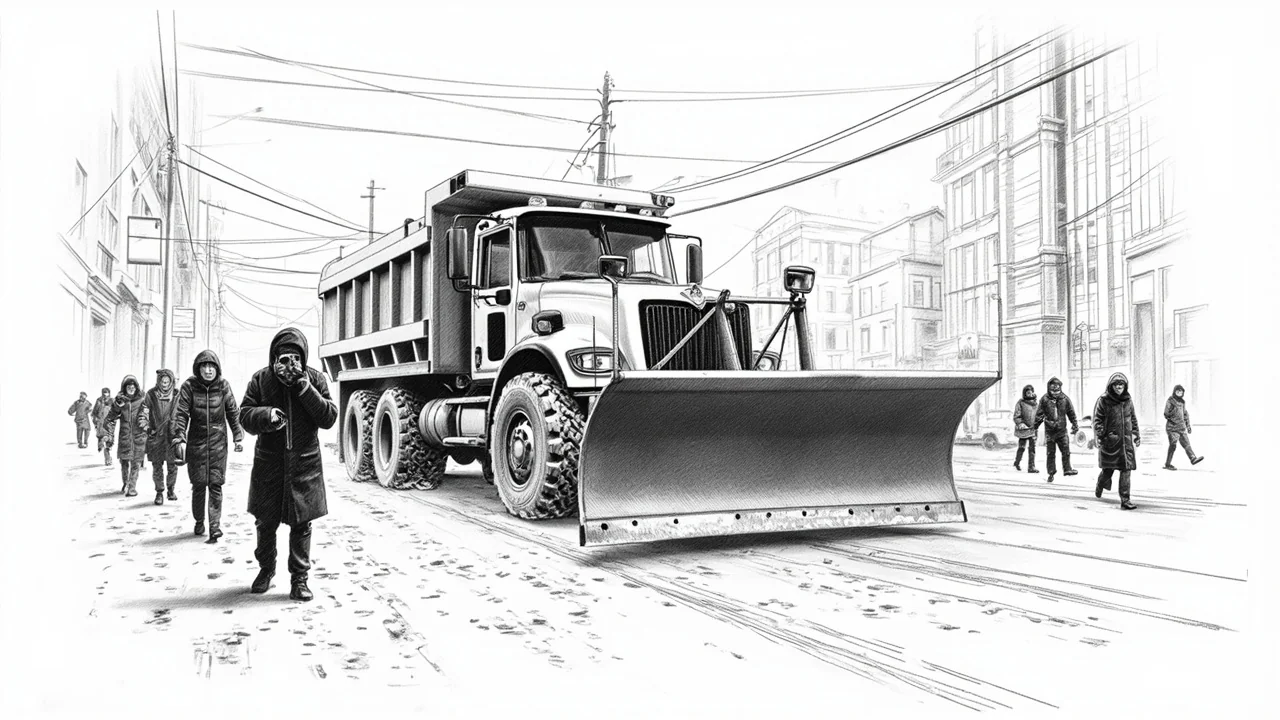
Norway's capital Oslo faced a major transport disruption on Tuesday morning when a municipal snowplow broke down at the city's central bus and rail interchange. The vehicle stalled directly on Jernbanetorget, the vast public square outside Oslo Central Station, blocking multiple bus lanes during the morning rush hour. For over an hour, dozens of bus routes were paralyzed, stranding thousands of commuters and highlighting the vulnerability of Oslo's winter transport network. The incident occurred as the city continues to manage the aftermath of significant snowfall, raising immediate questions about contingency planning and vehicle maintenance for critical winter services.
A Single Point of Failure
The stalled snowplow created a domino effect across the city's public transport system. Jernbanetorget is not just a square; it is the central nervous system for Oslo's bus network. Multiple dedicated bus lanes converge here, feeding into the national rail station and connecting with the metro, tram, and local train services. When the large vehicle became immobilized, it physically blocked the exit and entry routes for buses coming from key corridors like Karl Johans gate, Storgata, and the approach from the E18 highway. Commuters reported scenes of confusion as bus after bus queued behind the obstruction, unable to move forward or reverse. The timing, between 7:30 and 9:00 AM, maximized the disruption for workers and students. While the snowplow was eventually towed away and traffic normalized, the incident exposed a critical weakness: the reliance on a single, non-redundant piece of infrastructure for vital winter operations.
Systemic Pressures on Winter Readiness
This is not merely a story of one vehicle breaking down. It is a symptom of broader systemic pressures on Oslo's winter maintenance capabilities. The city's Agency for Urban Environment (Bymiljøetaten) is responsible for keeping over 3,600 kilometers of roads and streets clear. This fleet operates under immense strain during prolonged cold snaps. Analysts point to several contributing factors. First, an aging fleet of specialized vehicles faces increasing maintenance needs. Second, the complexity of coordinating plowing with public transport schedules in a dense urban center is immense. Third, climate change is creating more volatile winter conditions in southern Norway, with periods of heavy, wet snow followed by rapid thaws—conditions that challenge even the best-prepared systems. "A snowplow breaking down is a mechanical inevitability," said Lars Moe, a transport analyst with the Institute of Transport Economics. "The real question for the municipality is whether their operational protocols are robust enough to minimize the collateral damage when it happens. Today's event suggests there is room for improvement."
The Ripple Effect on Commuters and Business
The human and economic impact of the gridlock was significant. Thousands of commuters were late for work, appointments, and school. The disruption spilled over to the tram and metro lines as passengers, abandoning stalled buses, sought alternative routes, leading to overcrowding. Delivery vans and commercial traffic were also caught in the snarl, causing delays for goods and services across the city center. For a nation that prides itself on efficiency and punctuality, such a breakdown in the heart of the capital is more than an inconvenience; it is a blow to civic confidence. Social media was flooded with images and complaints from frustrated citizens. Many questioned why there wasn't a faster response or a dedicated rapid-recovery vehicle for such scenarios in the most critical transport hub. The incident serves as a case study in how a single-point failure in public service infrastructure can have disproportionate economic costs, from lost productivity to disrupted supply chains.
Political and Administrative Accountability
The breakdown immediately triggered political scrutiny. Opposition politicians in the City Council were quick to demand answers from the governing Labour and Green parties. They have called for a review of the winter maintenance contract and the age and reliability of the vehicle fleet. "This is a failure of operational preparedness," said Mina Finstad, a city council representative for the Conservative Party. "The citizens of Oslo deserve a winter service that doesn't collapse when one vehicle has a problem. We need to know if this was due to skipped maintenance, driver error, or simply bad luck, and what will be done to prevent a repeat." The Agency for Urban Environment has launched an internal review of the incident. Key questions include the cause of the mechanical failure, the response time of the recovery team, and whether communication with the public transport authority Ruter was effective. The findings will likely influence next year's budget negotiations for winter maintenance services.
A Broader Lesson for Nordic Urban Resilience
While the event was localized, it offers a broader lesson for all Nordic cities confronting harsh winters. Urban resilience is not just about having the right equipment; it's about designing systems with redundancy and clear failure protocols. In Stockholm, Helsinki, and Copenhagen, similar central hubs exist. Experts suggest that cities should conduct "stress tests" on their winter plans, simulating exactly this kind of scenario. Solutions could include prepositioning recovery equipment near major hubs during peak snow-clearing operations, establishing clearer priority corridors for emergency vehicles, and improving real-time public communication. The Oslo snowplow incident is a stark reminder that in an interconnected urban environment, the tools meant to solve a problem can themselves become the problem if not managed with foresight. As winters become less predictable, the demand for smarter, more adaptive infrastructure management will only grow.
Looking Ahead: Beyond the Immediate Fix
The snowplow has been moved, and the traffic flows again at Jernbanetorget. But the political and administrative aftermath is just beginning. The City Council will debate the incident, the agency's review will recommend changes, and commuters will remain wary the next time heavy snow is forecast. The true test will be whether this event leads to tangible improvements in system design or is dismissed as an isolated mishap. For Oslo, a city aiming to be a model of sustainable urban living, reliable winter mobility is non-negotiable. This morning's gridlock proved that reliability is a fragile thing, easily broken by a single stalled engine in exactly the wrong place. The challenge now is to build a system that can withstand such shocks, ensuring that the machinery of the city keeps moving, even when a key piece of it temporarily stops.