
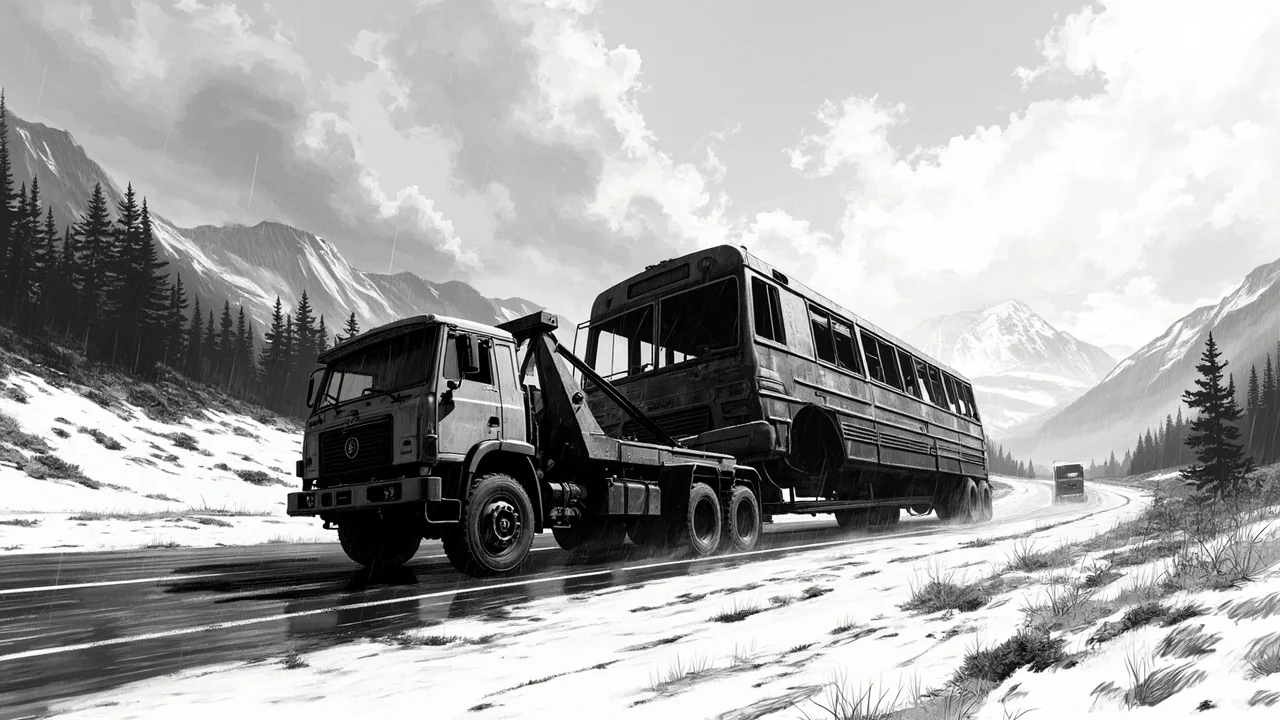
Norwegian road authorities issued a use ban for a tow truck carrying a crashed articulated bus. The vehicle was over 25 meters long. It failed a mandatory safety check at the Bergen traffic station for lacking proper brake lights and warning signs. This incident highlights critical transport safety protocols during severe winter weather warnings across southern Norway.
A Routine Check Reveals Major Flaws
Norwegian Public Roads Administration (NPRA) inspectors stopped the heavy recovery vehicle during a scheduled control. The tow truck was transporting a damaged articulated bus, creating a combined length exceeding 25 meters. Officials immediately identified two critical violations. The vehicle did not have the required additional brake light mounted at the rear of the load. It also lacked mandatory 'long transport' warning signs. These omissions led to an immediate use prohibition, grounding the vehicle until corrections are made.
"A recovery vehicle, which had a crashed articulated bus on its trailer, received a use ban for not having mounted an extra brake light at the back, and for not marking the vehicle with 'long transport' signs," the NPRA stated. The agency confirmed the combined rig was over 25 meters long. Such controls are standard procedure but carry increased importance during hazardous driving conditions.
Safety Protocols Under Scrutiny
This enforcement action comes amid an active yellow warning for heavy snowdrifts in the mountains of Southern Norway. The Meteorological Institute extended the alert until 1:00 PM Wednesday. It warns of local snowdrifts due to new snow and strong wind. Reduced visibility and snow packing on road surfaces are significant risks. Roads can close with little notice, and convoy driving may be enforced.
"Avoid travel in exposed areas and dress for the conditions," meteorologists advise. In this context, the safety failings of a professional recovery vehicle are particularly concerning. The missing brake light and signage increase collision risk for following drivers, especially in poor visibility caused by snow. Long vehicle combinations require clear marking to allow other motorists to judge safe passing distances.
Transport safety experts stress the importance of these rules. "For oversized loads, every mandated light and sign serves a specific communication purpose to other road users," explains Lars Holmen, a former NPRA senior inspector. "In winter conditions, that communication is even more vital. A missing brake light on a 25-meter combination in a snow squall is an accident waiting to happen. The ban was the correct decision."
A Broader Picture of Road Safety Enforcement
The tow truck incident was part of a larger control operation at the Bergen station. The NPRA regularly conducts these checks on heavy goods vehicles. They focus on technical roadworthiness, load security, and driver documentation. Use bans are issued for defects that pose an immediate danger. Less critical faults result in orders for repair within a set deadline.
This case involves a professional operator failing basic safety standards. It raises questions about compliance culture within some transport sectors. The recovery industry handles high-risk scenarios, often operating at accident sites or in extreme weather. Their vehicles must be beyond reproach. The NPRA has not named the operating company involved.
Norwegian law is strict on vehicle lighting and marking. Regulations for 'long vehicles' (over 12.4 meters) and 'extra-long loads' (over 19 meters) are precise. They dictate the placement of rear marker boards, side markers, and additional lights. The goal is to create a clear, unmistakable silhouette for other drivers. Non-compliance carries fines and operational stoppages.
Winter Demands Peak Preparedness
Norway's geography and climate make transport safety a perennial challenge. Mountain passes can become treacherous within minutes. The current weather pattern exemplifies this. New snow combined with strong winds creates sudden whiteout conditions. Drifting snow can block roads already cleared.
Professional drivers and transport companies have a heightened duty of care. Their vehicles must be equipped not just to function, but to communicate effectively in compromised environments. The failed tow truck, tasked with clearing a crash, ironically became a hazard itself. It underscores how quickly safety margins can erode if procedures are neglected.
"This is a timely reminder for all commercial operators," says Kari Nilsen, a transport logistics lecturer. "Pre-trip inspections are not a formality. They are a critical risk assessment. Every light, every sign, every strap matters. The authorities are watching, but more importantly, the conditions are unforgiving."
Looking Beyond the Traffic Stop
While the tow truck case is a specific regulatory failure, it sits within a wider national focus on road safety. Norway has some of the world's strictest traffic laws and has aggressively targeted road deaths. Initiatives like Vision Zero aim to eliminate serious fatalities and injuries. Technical inspections and traffic controls are key tools in this strategy.
The incident also touches on infrastructure resilience. As climate change increases the frequency of extreme weather events, the pressure on transport networks grows. Recovery and maintenance vehicles are first responders when roads become blocked or dangerous. Their reliability is a component of overall infrastructure health.
For the public, the message is twofold. First, authorities are actively monitoring vehicle safety, even for those tasked with cleanup. Second, winter warnings should be heeded. The Meteorologists' advice to avoid exposed areas is not given lightly. If a professional recovery vehicle can be deemed unsafe, ordinary motorists must exercise extreme caution.
The tow truck will remain banned until it meets all legal requirements. The company must rectify the lighting and signage defects before an NPRA re-inspection. The articulated bus, itself the subject of a prior incident, will have to wait for a compliant ride. In Norway's demanding winter, there is no shortcut for safety.