
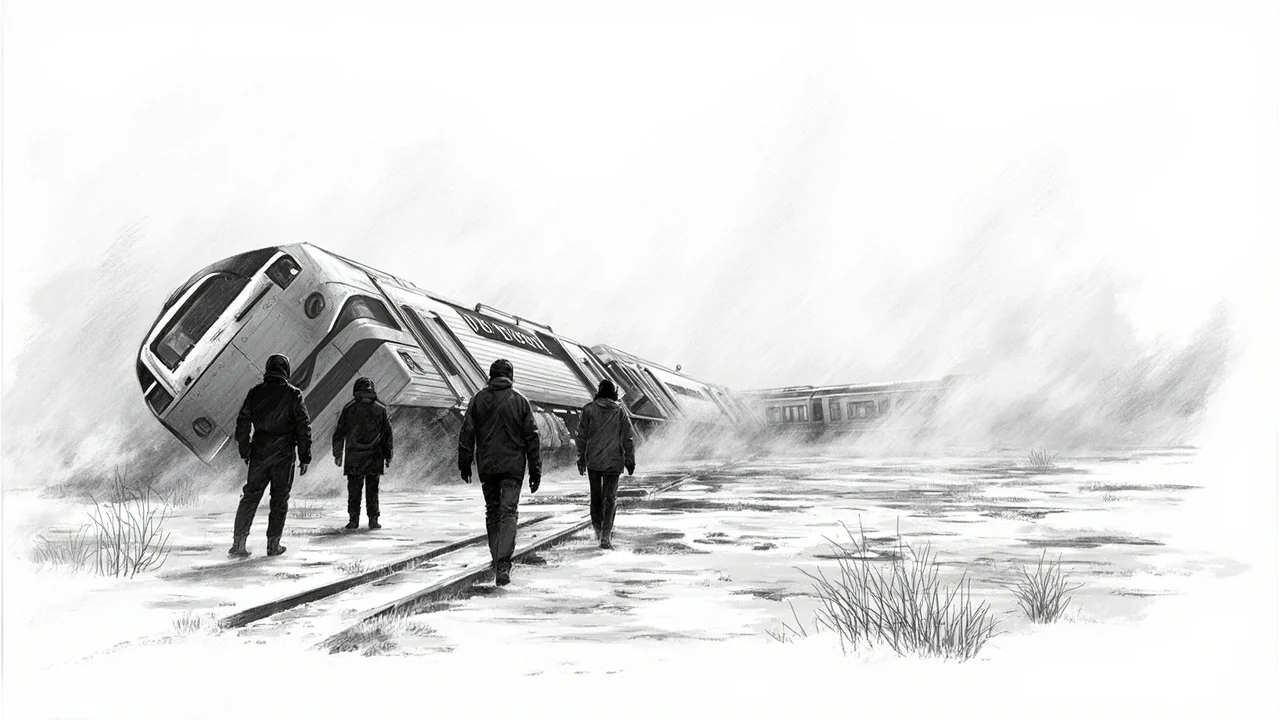
Norway's Nordland Line passenger train derailed near Bodø station Monday evening, with all 46 people on board reported safe. The locomotive's front axle left the tracks in heavy, wind-driven snow known as 'fokksnø,' according to police. No injuries were reported in the incident, which occurred around 6 PM as the train approached its final destination from Trondheim.
Operational leader Veronica Helen Nylund with Nordland Police District confirmed the passenger count in a police log statement. "The passengers are still on the train and are fine," wrote mission leader Remi Johansen in an updated log entry. He attributed the derailment primarily to the challenging weather conditions. The train remained stable on the track, with no risk of overturning.
SJ Norge, the train operator, confirmed the details and reported the incident to Norway's Accident Investigation Board for transport. Communications director Randi Ness stated the company was not aware of any personal injuries. The derailment adds to existing disruptions on the vital northern rail corridor, which was already operating a bus replacement service between Åsen and Levanger due to a major landslide in late August.
A Routine Journey Interrupted
The train, completing its long route from central Norway to the Arctic coast, was minutes from Bodø station when it derailed on Røsholtveien. Passengers, expecting to disembark after a journey of over 700 kilometers, instead found themselves waiting in a stationary carriage as emergency services assessed the situation. Police and rail officials prioritized confirming the safety and stability of the train before organizing an evacuation.
By 6:30 PM, plans were in motion to send another train from Bodø station to retrieve the passengers. Officials noted this transfer would take some time to arrange safely. The response highlights the logistical challenges of managing rail incidents in remote regions, especially during severe winter weather. The Nordland Line is a critical transport link for communities north of Trondheim, often described as Norway's lifeline to the Arctic.
The Culprit: Fokksnø
The immediate cause, according to authorities, was 'fokksnø.' This specific Norwegian weather phenomenon involves snow that is picked up and redeposited by strong winds, often creating dense, hard-packed accumulations on railways and roads. It can occur even when snowfall has ceased, as existing snow is blown across open ground. For railways, fokksnø can pack into switch points, cover the rails entirely, or create uneven drifts that disrupt a train's guidance system.
This type of derailment, where a single axle leaves the track while the train remains upright, is often less severe than a full derailment. It suggests the train was moving at a low speed, likely due to the adverse conditions as it approached the station. The fact that only the locomotive's front axle was affected, and not the passenger carriages, contributed to the positive outcome. Rail engineers note that modern rolling stock is designed to resist overturning in such scenarios, provided the train remains at low speed.
Compounding Crises on the Nordland Line
The Bodø derailment did not happen in isolation. It struck a rail network already under significant strain. Since August 30th, a major landslide near Levanger has severed the line, forcing a bus replacement service for a section of the track. This has created a cascade of operational problems, including a shortage of available train sets across the entire line.
The resource shortage has led to further cancellations; the local train service between Bodø and Rognan has also been replaced by buses. The derailment, therefore, represents a second major disruption on the same line within months, testing the resilience of Norway's northern transport infrastructure. These consecutive events raise questions about network vulnerability and redundancy, particularly for regions dependent on a single rail corridor.
The Safety Response and Investigation
SJ Norge's mandatory reporting to the Accident Investigation Board (AIBN) triggers a formal process. The AIBN will determine the scope of its investigation, which typically involves examining the track condition, the train's mechanical systems, weather data, and operational decisions. Their final report, which could take over a year, will aim to identify the root cause and issue safety recommendations to prevent similar incidents.
The immediate police role was to secure the scene and ensure public safety. With no injuries and a stable train, the focus shifted to a technical recovery operation. This will involve specialized rail crews and equipment to re-rail the locomotive and inspect the track for damage. The process is meticulous, as the integrity of the rail bed and infrastructure must be fully verified before service can resume.
Analysis: Arctic Infrastructure Under Pressure
This incident underscores the persistent challenge of maintaining robust transportation in Norway's Arctic and sub-Arctic regions. The Nordland Line is an engineering marvel, traversing difficult terrain and facing extreme seasonal weather. However, climate change is increasing the frequency of both major geophysical events, like the Levanger landslide, and intense winter weather episodes.
Fokksnø is a known hazard, but its intensity and impact can vary. Rail operators have protocols, including speed restrictions and increased mechanical clearing of tracks, but predicting specific drift locations remains difficult. The combination of the landslide-caused shortage and a weather-related derailment exposes a lack of slack in the system. There are limited alternative train sets and few parallel transport routes, leaving communities vulnerable to extended disruptions.
From a policy perspective, this event may fuel debates in the Storting about infrastructure investment north of Trondheim. Proposals for improving line resilience, such as building more passing loops, reinforcing slopes against landslides, or investing in more advanced weather monitoring and snow-clearing technology, often compete for funding with other national priorities. The economic and social cost of these disruptions, however, is significant for northern Norway.
Looking Ahead: Reliability in the North
For the passengers on the derailed train, the ordeal ended safely. Their experience, however, is a symptom of a broader issue. As Norway continues to develop its Arctic regions, with focus on energy, maritime industries, and settlement, reliable year-round transport is not a luxury—it is a prerequisite for economic stability and community welfare.
The Nordland Line is more than a railway; it is a symbol of national connectivity. Incidents like the Bodø derailment, while minor in terms of human cost, serve as stark reminders of the forces arrayed against that connectivity. The response from SJ Norge and infrastructure manager Bane NOR in the coming days, both in restoring service and communicating with the public, will be closely watched. The ultimate test will be whether this event accelerates tangible investments that make the line more resilient against the next storm, and the one after that. Can Norway's engineering prowess keep pace with its demanding northern climate?