
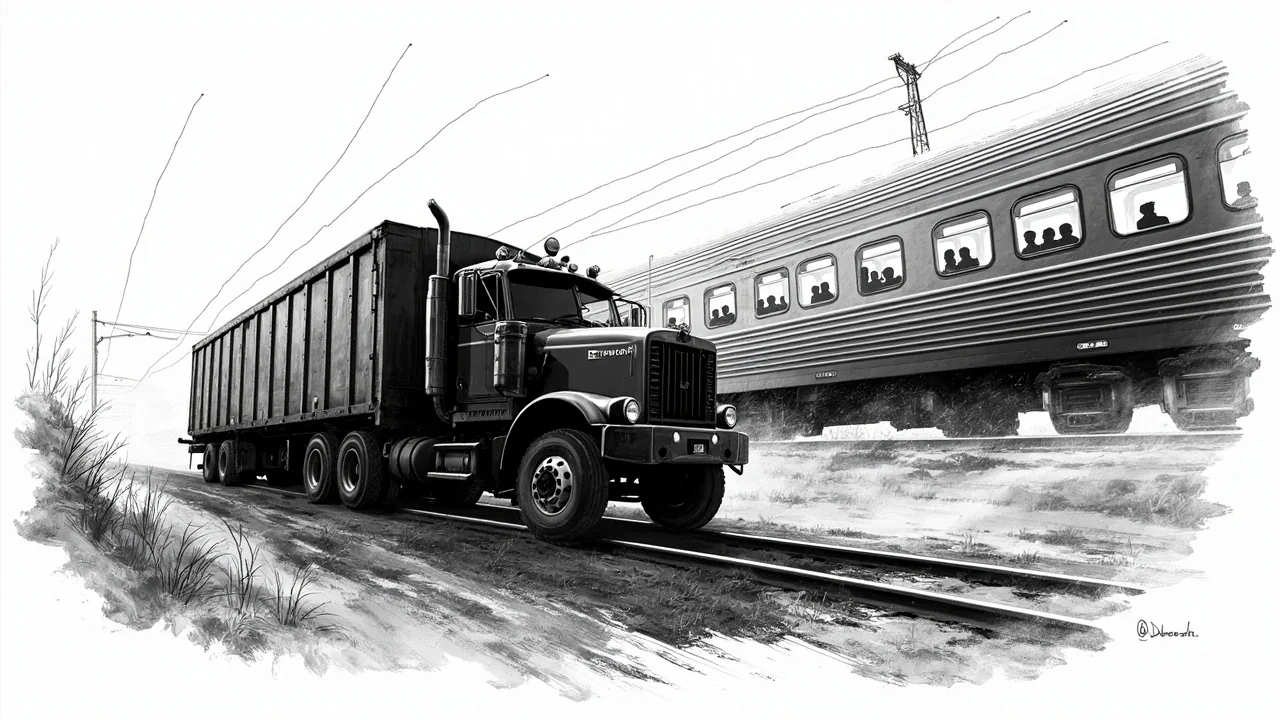
Norway’s railway network avoided a serious disaster Tuesday morning when a fully-laden passenger train stopped meters from a stranded truck on the tracks. The incident at Evanger station in Voss has triggered a police investigation and urgent safety reviews, highlighting the ever-present risks at level crossings.
The scene unfolded just before 8:30 AM. A commercial truck became stuck on the railway crossing at Evanger station, unable to move forward or reverse. Witness Ragnar Karevoll, who was driving a minibus for a school run, saw the driver struggling with chains, visibly agitated. "He was really worked up," Karevoll said. When Karevoll returned after completing his trip, a train had arrived on the scene, facing the immobilized vehicle.
"That’s when I thought this could have gone really badly," he recounted. The potential for catastrophe was immense. The oncoming train was a heavy intercity passenger service traveling between Voss and Bergen, carrying an estimated 100 people. At high speed, such a train requires several hundred meters to stop.
A Driver's Split-Second Decision
The sole reason this is not a tragedy is the alertness of the train’s driver. Siv Egge Westin, Communications Director for the state railway operator Vy, confirmed the driver had not received any prior warning about the obstruction. Seeing the truck in time, the driver initiated a full emergency brake. The train shuddered to a halt just a few meters from the truck’s cab.
"We should be very happy that this turned out okay," Westin stated. "We are very glad we had an awake and attentive driver in place who handled this extremely well." She praised the driver’s composure but acknowledged the psychological toll. "The driver is fine, but it is clearly an unpleasant experience."
The driver’s actions prevented what could have been one of Norway’s worst rail accidents in recent years. The force of a collision at line speed would have been catastrophic for both the truck driver and the train’s passengers. The incident immediately drew parallels to a fatal collision between a tractor and a train on the Gjøvik line earlier this year, which resulted in one death.
Immediate Response and Lingering Questions
Following the emergency stop, the railway line was blocked. A recovery vehicle arrived just after 9:00 AM, and the truck was removed within twenty minutes. Train traffic experienced minor delays but was largely unaffected. The physical disruption was brief, but the procedural and safety questions it raised are significant.
A critical unknown is the position of the crossing barriers. "I don’t know," Westin said when asked if the barriers were up or down when the truck became stuck. "But I would assume that is one of the things the police are checking out." This detail is central to the police investigation now underway. If the barriers were down, it indicates a catastrophic mechanical failure or a deliberate violation by the truck driver. If they were up, it points to a signaling system failure.
Westin issued a stark public reminder of the safety protocol. "Drive through the barrier if you are stuck between them. And if you are stuck, it is important to get out of the vehicle and away from the tracks as quickly as possible," she advised. This guidance is printed on warning signs at crossings but is often forgotten in moments of panic.
Systemic Vulnerabilities at Level Crossings
This near-miss exposes an inherent vulnerability in Norway’s otherwise safe transport infrastructure. The country has approximately 3,600 level crossings where roads intersect with active railway lines. While many have automatic barriers and lights, they represent points where human error, vehicle malfunction, and bad luck can intersect with massive kinetic force.
The Norwegian National Rail Administration (Bane NOR) has a long-term strategy to close or upgrade level crossings, particularly on high-speed lines. The goal is to separate road and rail traffic entirely through bridges or tunnels. However, this is a costly and decades-long process. In the interim, thousands of crossings remain.
Rail safety experts note that while technology like obstacle detection systems exists, its widespread deployment is expensive. The primary defense remains the vigilance of train drivers and strict adherence to rules by road users. Tuesday’s incident proves that this defense, while heroic in this case, has clear limits.
Analysis: A Wake-Up Call for Infrastructure Priorities
From a policy perspective, this event is likely to intensify debates about infrastructure spending. The government’s National Transport Plan allocates funds for railway safety, but projects often face delays due to budgeting and planning. An incident that nearly claims 100 lives shifts the cost-benefit analysis dramatically.
Opposition politicians may seize on the event to question whether safety upgrades are happening fast enough. The Conservative Party (Høyre) and the Progress Party (FrP) have previously advocated for accelerated investment in rail infrastructure. The current Labour Party (Ap)-led government will need to demonstrate that its plans are sufficient and that risk management is proactive, not reactive.
Furthermore, the incident highlights the human factor in complex systems. The train driver’s performance was exemplary, but the system should not rely on last-second heroics. It reinforces the argument for investing in positive train control systems and advanced crossing automation that can detect obstacles and automatically signal approaching trains, providing a crucial backup layer of safety.
For the residents of Voss and regular commuters on the Bergen Line, the sight of a train bearing down on a stranded truck will not be easily forgotten. It serves as a visceral, frightening reminder of the physics at play every day at seemingly mundane crossings. The investigation by police and railway authorities will seek to assign responsibility, but the broader lesson is systemic.
Norway’s railways are among Europe’s safest. Yet, as Tuesday morning demonstrated, safety is a continuous effort, not a permanent state. How quickly and effectively the system learns from this near-disaster will be the true test of its resilience. Will this event accelerate the closure of risky crossings, or will it fade as a narrowly-averted crisis? The answer depends on the political and administrative will generated in its wake.