
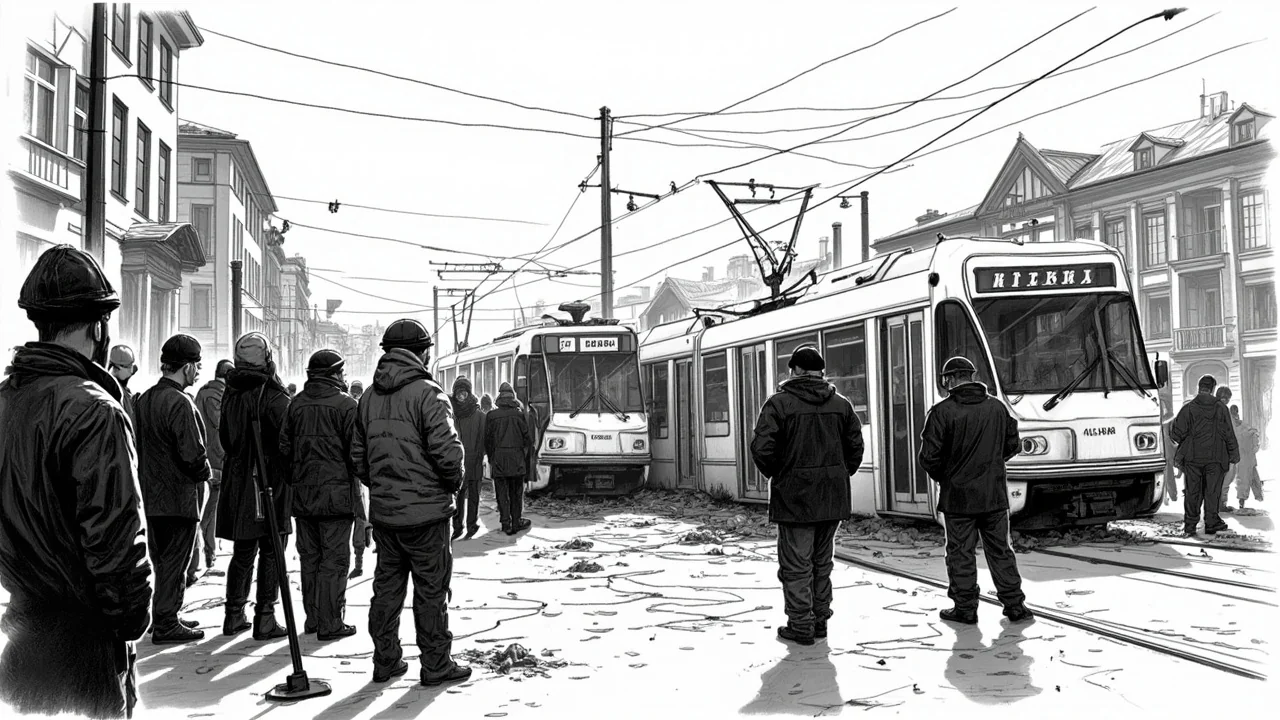
Norway's capital Oslo faces renewed scrutiny of its transport safety after a collision between a car and a tram on the busy Trondheimsveien thoroughfare. The incident occurred near the Sofienberg neighborhood, a densely populated area with significant tram and pedestrian traffic. Police secured the scene and are investigating the circumstances and extent of the damage. Authorities have not released details about potential injuries, a standard practice in ongoing investigations that often precedes a fuller public briefing.
This is not an isolated event. Oslo's tram network, a vital artery for the city's public transport system, has seen previous collisions at intersections and along shared roadways. Each incident triggers a familiar cycle: emergency response, investigation, and public questions about infrastructure. The location of this crash—Trondheimsveien—is a major east-west corridor, making any disruption significant for commuter flows. The immediate priority for police is to establish a clear sequence of events and determine liability.
A Recurring Challenge for Urban Planning
Oslo's commitment to becoming a greener city has led to a massive expansion of its tram and bicycle networks. This policy success creates new challenges in managing shared spaces. Trams, cars, bicycles, and pedestrians must coexist in increasingly tight urban corridors. The intersection where this collision occurred typifies the modern Oslo street: a mix of old infrastructure and new mobility solutions. Safety experts consistently note that such transitions require clear signage, predictable traffic patterns, and sometimes physical separation.
“Every collision is a failure of the system, not just the individuals involved,” says a transport planner familiar with Oslo's network, who spoke on condition of anonymity as they are not authorized to comment on active incidents. “Our investigations must look at signage, sight lines, traffic light phasing, and road design. The goal is to design environments where human error does not lead to serious consequences.” This systemic view is central to Norway's Vision Zero policy, which aims to eliminate all traffic fatalities and serious injuries.
The Immediate Aftermath and Investigation Protocol
Following the collision, police procedures swung into action. Securing the scene is the first step, ensuring no further danger to the public or emergency responders. Officers then begin the meticulous process of evidence collection. This includes photographing vehicle positions, measuring skid marks, interviewing witnesses, and securing any available dashcam or traffic camera footage. In Norway, such investigations are methodical and can take weeks or months before a final report is issued.
Traffic accident investigations in Oslo involve multiple agencies. The police handle the immediate scene and legal aspects. The Norwegian Public Roads Administration may be consulted on road design issues. Oslo’s municipal transport agency, Sporveien, which operates the trams, will conduct its own internal review of operations. This multi-agency approach aims to build a complete picture but can sometimes slow the public release of preliminary findings. The lack of immediate information on injuries is frustrating for the public but standard; authorities wait for confirmed facts from hospitals before commenting.
Trams: Backbone of a Car-Lite Capital
To understand the impact of this collision, one must understand the tram's role in Oslo. The city has aggressively reduced car parking and implemented tolls to fund public transport, making the tram and metro network indispensable. Lines 11, 12, and 13, which serve the Sofienberg area, connect central neighborhoods to the downtown core. A disruption on one line causes ripple effects across the network, leading to crowded buses and delays for thousands of commuters.
This dependency makes reliability and safety paramount. The tram system is generally safe, with a strong statistical record. However, its interaction with other road users remains a vulnerability. The trams are large, heavy, and quiet, especially the newer models. They cannot swerve and have a long stopping distance. This physics reality places a high burden on car drivers and cyclists to yield correctly and on city planners to create fail-safe intersections.
The Human Factor and Legal Implications
While technical investigations proceed, the human element remains. For those involved—the tram driver, the car occupants, and any witnesses—such an event is traumatic. Tram drivers, in particular, undergo rigorous training to handle emergencies, but being at the controls during a collision can have lasting effects. Norwegian law and union agreements provide strong support for operators involved in incidents, including immediate relief from duty and psychological counseling.
The legal implications depend entirely on the investigation's outcome. If a car driver is found to have violated traffic rules—such as failing to yield to a tram, which has priority—they can face significant fines and license penalties. If a technical fault or infrastructure flaw is identified, liability may shift. Norway's robust insurance and liability system ensures victims are compensated, but the process of determining fault is crucial for preventing future incidents.
A Broader Look at Scandinavian Urban Safety
Oslo’s challenge is not unique. Cities across Scandinavia are grappling with similar integration issues as they promote cycling and public transport. Copenhagen, Stockholm, and Helsinki all report conflicts at points where different transport modes merge. The Nordic model emphasizes preventative, design-based solutions over punitive measures after the fact. This incident will likely prompt a review of the specific intersection, potentially leading to redesigned lanes, adjusted traffic signals, or new barriers.
The Norwegian Public Roads Administration publishes extensive annual data on traffic accidents. While tram-involved incidents form a small percentage, each one is analyzed in depth. Past analyses have led to concrete changes: improved mirror systems at blind corners, better lighting at stops, and public awareness campaigns reminding drivers that trams always have the right of way. The data from this Sofienberg collision will feed into that ongoing safety evolution.
What Comes Next for Trondheimsveien?
The road will reopen, and services will normalize. The investigation will conclude, possibly with recommendations. The question for Oslo's city government is whether this incident becomes a catalyst for a broader review or is treated as an isolated case. Local politicians in the Sofienberg and Grünerløkka districts often face pressure from residents to calm traffic and improve pedestrian and cyclist safety. A tram collision adds a powerful argument to their calls for action.
Potential solutions are both technical and behavioral. Technically, cities are exploring smarter traffic lights that detect approaching trams and prioritize their passage. Behaviorally, continuous education is needed, especially for new residents and drivers unfamiliar with trams. Norway's driver's license test heavily emphasizes tram interaction, but compliance on the road is what matters.
This collision on a routine Oslo afternoon is a stark reminder. It highlights the complex, daily negotiation of space in a modern city committed to sustainable transport. The success of Oslo's car-lite vision depends on the safe integration of all the elements that now fill the space where cars once dominated. The response to this single event will test whether the city's infrastructure and policies are robust enough to handle that complexity, or if more fundamental changes are required to protect lives on streets like Trondheimsveien.