
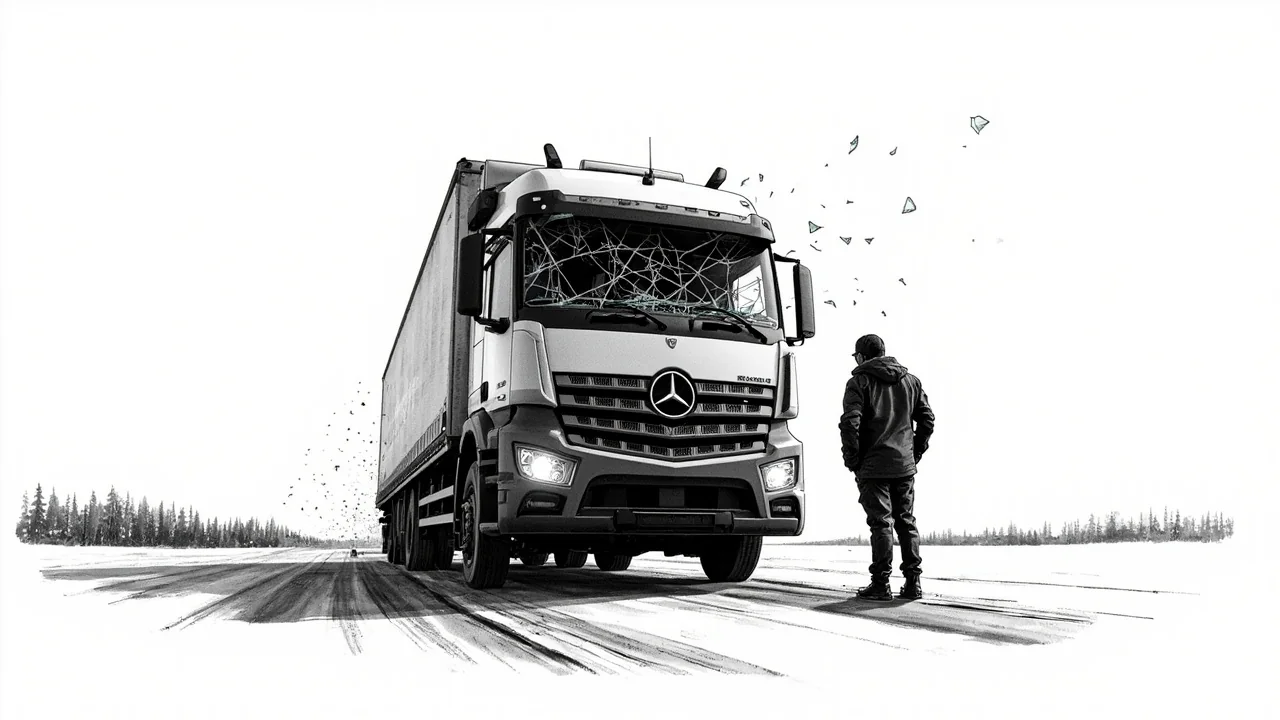
Norway police have charged a professional truck driver for operating a heavy goods vehicle with a completely shattered windshield. The incident, which unfolded on the E10 highway in Nordland county, raises serious questions about commercial transport safety standards and regulatory oversight. Officers intercepted the articulated lorry at the Sortland waste facility after receiving multiple public reports of the dangerous vehicle.
"The driver's view was severely compromised," said Thomas Jarnæs Coe of the Nordland Police District. "A vehicle must be in proper regulatory condition. It is easy for accidents to happen if you cannot see what is ahead." Police have issued an immediate prohibition on using the vehicle until repairs are made. The driver is currently being questioned as authorities investigate how long the truck traveled in this hazardous state.
A Dangerous Journey on Arctic Roads
The E10 highway where the truck was intercepted is a critical transport artery in Northern Norway. It winds through demanding terrain with steep gradients, sharp bends, and rapidly changing Arctic weather conditions. Driving a multi-tonne vehicle with a compromised view on such a road represents an extreme risk, not just to the driver but to every other road user. The fact that public tips were necessary to stop the vehicle suggests a failure in both the driver's judgment and potentially the operator's daily safety checks.
Norwegian law is explicit on this point. The Road Traffic Act (§ 3-1) states that vehicles must be in such condition and equipped in such a way that no danger or undue inconvenience is caused. A shattered windshield directly violates the Norwegian Public Roads Administration's (Statens vegvesen) regulations on vehicle roadworthiness. For professional drivers and transport companies, adherence to these rules is not optional; it is a fundamental condition of their operating license.
The Weight of Professional Responsibility
This case moves beyond a simple traffic violation. The driver held a professional license to operate a vehicle combination likely exceeding 40 tonnes. This license carries an elevated duty of care. The Norwegian Transport Federation (Transportbedriftene), which represents haulage companies, consistently emphasizes that safety is the industry's highest priority. Incidents like this undermine public trust and put responsible operators at a disadvantage.
"Professional drivers are the backbone of our logistics chain, especially in remote regions," said a veteran transport safety consultant based in Oslo, who requested anonymity to speak freely. "The vast majority are highly skilled and safety-conscious. But one blatant violation can cast a shadow over the entire sector. It prompts questions: Was this a pressured driver ignoring a defect to meet a deadline? Was there a failure in the company's maintenance protocol? These are issues the police and likely the Norwegian Labour Inspection Authority will examine."
Regulatory Consequences and Industry Impact
The immediate legal consequence for the driver is a substantial fine and penalty points on their license. Under Norwegian law, driving a vehicle in a dangerously defective state can result in a fine of several thousand kroner. However, the professional repercussions could be more severe. The transport company that employs the driver could face sanctions from the Norwegian Road Authority, including audits of their entire maintenance and safety regime. Their operator's license could be under review.
This incident occurs amid a national focus on road safety, particularly for vulnerable users and in challenging northern climates. Norway has some of the world's strictest vehicle inspection requirements, with periodic mandatory checks (EU-kontroll) for heavy vehicles. This case illustrates a gap between scheduled inspections and daily pre-trip inspections, which are the driver's and operator's responsibility. It highlights the critical importance of a robust safety culture where drivers feel empowered to refuse to drive a defective vehicle without fear of reprisal.
A Broader Safety Culture Question
While mechanically straightforward, this event opens a complex discussion about workplace culture in transport logistics. Did economic pressure play a role? Was the driver concerned about the cost or delay of replacing a large truck windshield? The Norwegian logistics industry is highly competitive, with tight margins. However, no deadline justifies endangering lives. Industry bodies must use this as a case study to reinforce the message that safety is non-negotiable.
The public's role in reporting the vehicle was also crucial. It shows a collective awareness of road safety. "We encourage people to contact us if they see something dangerously wrong on the roads," Coe noted. This public vigilance acts as an additional layer of oversight, complementing police patrols and automated systems.
Looking Beyond the Shattered Glass
As the police conclude their investigation, the outcomes will be watched closely. A strong regulatory response is necessary to deter future negligence. This should involve not just penalizing the driver but also examining the operating company's practices. Did they have a clear, documented process for drivers to report defects? Was there a culture that prioritized schedules over safety checks?
For Norway's transport sector, reputation is everything. The country relies on efficient, safe haulage to move goods along its long coastline and through its mountainous interior. Trust is the commodity that keeps this system functioning. This single truck with a broken windshield is a stark reminder that maintaining that trust requires constant vigilance, from the boardroom to the driver's seat. The true test will be what the industry learns from this alarming episode on the road to Sortland.