
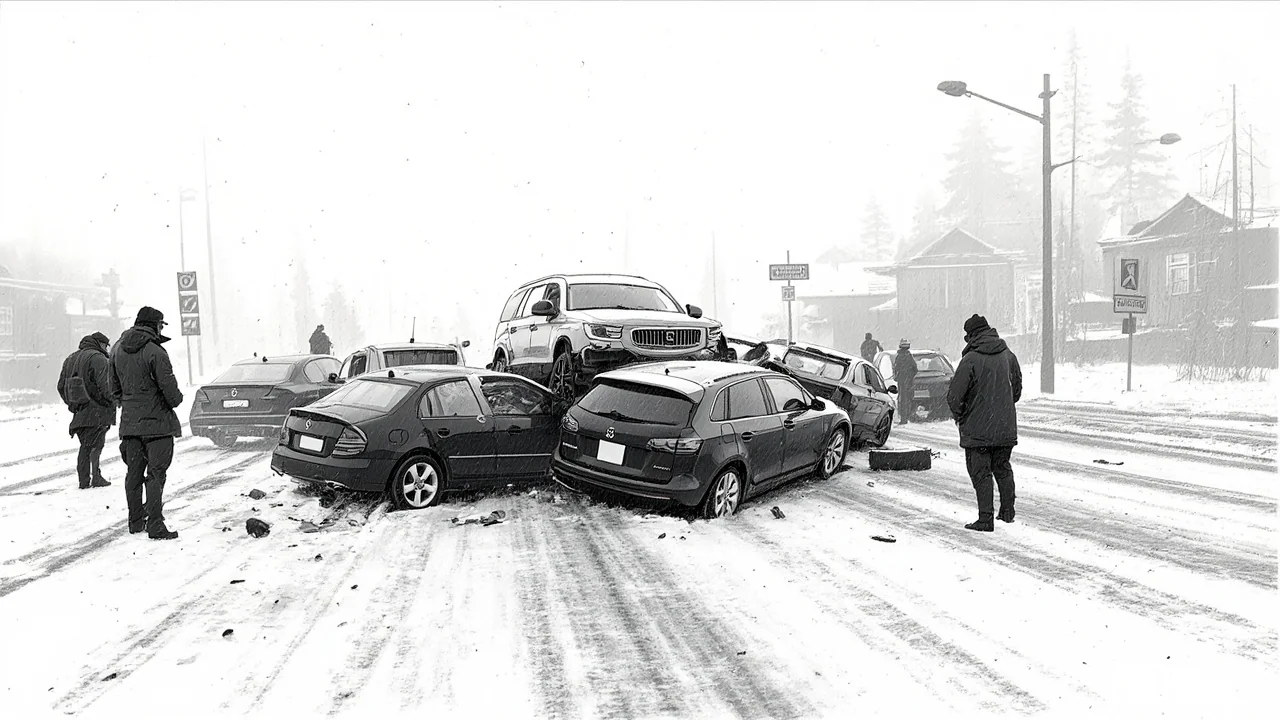
Norway's E18 motorway near Asker became the scene of a major traffic disruption Monday afternoon after a pile-up involving nine cars. The collision occurred just after 4 PM during the evening rush hour, forcing the closure of an exit lane and creating significant delays for commuters heading west from Oslo. Heavy snowfall, which began earlier in the afternoon, is considered a primary contributing factor to the incident.
Emergency services from Asker and Bærum municipalities responded quickly to the scene. Police confirmed there were no reports of serious injuries, though several individuals were assessed by paramedics for minor complaints. The focus shifted rapidly from medical response to clearing the wreckage and restoring traffic flow on one of the country's busiest commuter arteries.
"Our first priority was ensuring the safety of those involved," a police operations manager said in a statement. "Given the number of vehicles, we are relieved the consequences were not more severe. The weather conditions clearly played a central role." The accident blocked the exit lane for Asker, creating a bottleneck that backed up traffic towards Oslo for several kilometers.
A Recurring Seasonal Challenge
This incident is not an isolated event but part of a recurring pattern each winter. The E18 corridor between Oslo and Drammen, where Asker is located, handles some of the densest traffic volumes in Norway. Sudden weather changes, particularly the first significant snowfalls of the season, frequently test driver preparedness and road maintenance protocols.
Traffic data from the Norwegian Public Roads Administration (Statens vegvesen) consistently shows a spike in collisions during the transition from autumn to winter. Drivers often fail to adjust their speed and following distance adequately for the reduced friction caused by fresh snow on cold asphalt. The Monday afternoon timing of this crash, combining dusk, rush-hour congestion, and deteriorating weather, created a high-risk scenario.
"The first snow always catches some people out," said Lars Tingelstad, a senior advisor at the Norwegian Automobile Federation (NAF). "We have good winter tire laws, but tires alone are not enough. Drivers must actively adapt their behavior. Increasing distance, reducing speed, and smooth inputs are critical. This crash appears to be a classic case of multiple vehicles being unable to stop in time on a slippery surface."
The Economic Ripple Effect of Road Closures
Beyond the immediate safety concerns, accidents like this have a tangible economic impact. The E18 is a vital logistics and commuter route. Every hour of closure or severe congestion disrupts supply chains, delays workers, and increases fuel consumption and emissions from idling vehicles.
For the hundreds of drivers caught in the ensuing queue, the crash meant lost personal time and missed appointments. The collective delay, measured in "vehicle-hours lost," is a standard metric used by transport economists. A multi-hour blockage involving thousands of cars can easily equate to hundreds of lost working days in economic terms.
Furthermore, such incidents strain public resources. The coordinated response from police, fire, and ambulance services represents a significant cost. Road clearing operations require specialized vehicles and crews working in hazardous conditions. While safety is paramount, the public expense of managing preventable weather-related collisions is substantial.
Analyzing Norway's Winter Road Readiness
The Asker pile-up prompts an annual debate about Norway's winter road management. The country is renowned for its expertise in handling Arctic conditions, yet urban and suburban motorways remain vulnerable. Pre-emptive salting and brining operations are standard, but their effectiveness diminishes under heavy, continuous snowfall during peak traffic periods.
Some experts argue for enhanced use of variable message signs to warn drivers of deteriorating conditions ahead in real-time. Others suggest a broader public awareness campaign ahead of the winter season, beyond the standard reminders about winter tires.
"We have the technology and the procedures," Tingelstad noted. "The challenge is the human factor. There's a gap between knowing the roads are slippery and actually driving as if they are. Enforcement of safe following distances in winter conditions could be one area for greater focus."
Another consideration is road design. While Norway's major highways are built to high standards, exit and entry ramps, where speed differentials occur, can be particular risk zones during ice and snow. Assessing whether specific high-risk junctions need improved design or more aggressive winter maintenance is an ongoing process for road authorities.
A Community Response in the Fjord Landscape
The response to the accident also highlights the interconnectedness of municipal emergency services in the densely populated area around the Oslofjord. Asker, Bærum, and neighboring municipalities have mutual aid agreements. The rapid deployment of resources to this incident demonstrates the practiced coordination required in the region.
The local community also plays a role. Reports from the scene indicated that other drivers stopped to offer initial assistance before emergency crews arrived, a common response in Norwegian road culture. This immediate community aid can be crucial in the first minutes after a collision.
However, authorities consistently warn untrained individuals about the dangers of exiting their vehicles on a busy, slippery motorway. The safest action is often to move one's own vehicle to a safe place if possible, activate hazard lights, and call emergency services (112 in Norway) without venturing into traffic.
Looking Ahead: Prevention in a Changing Climate
As Norway experiences the effects of a changing climate, winter weather patterns may become more volatile. Periods of mild weather followed by intense snowfall could become more frequent, potentially increasing the risk of drivers being unprepared.
This reality places greater importance on adaptive strategies. Could weather-linked speed limits, dynamically changed based on sensor data from the road surface, be a future solution? Are there lessons to be learned from other northern countries with similar highways? The Asker incident, while thankfully not tragic, serves as a concrete case study for traffic safety planners.
The ultimate goal is to move from reactive response to proactive prevention. This involves continuous improvement in weather forecasting for road management, public education that resonates with drivers, and road engineering that mitigates risks. Every winter season provides new data, and every multi-vehicle collision offers hard lessons.
For now, the stretch of E18 near Asker has returned to normal flow. The wrecked cars have been towed, the debris cleared, and the evening commute is a distant memory. But the questions raised by nine cars colliding in the snow remain, waiting for answers before the next winter storm arrives on the busy roads of Viken county.