
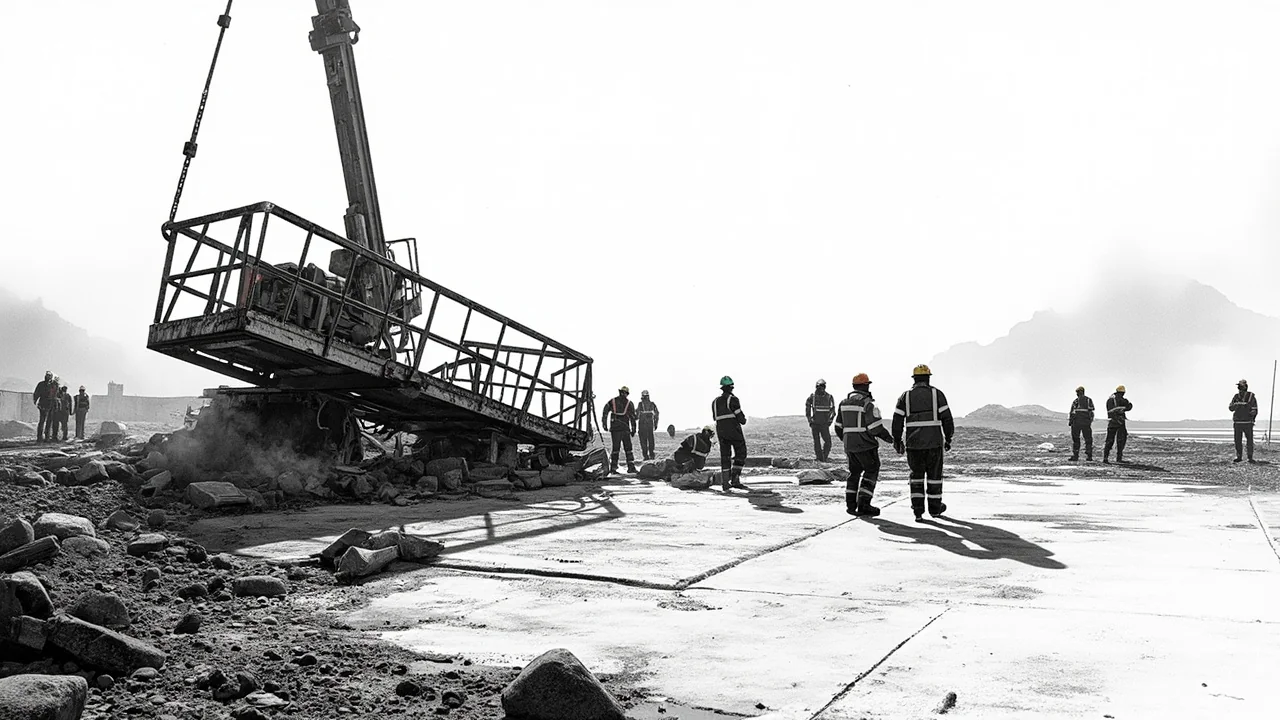
Norway's workplace safety record faces scrutiny after a serious accident in Arendal left one worker critically injured. The incident occurred at approximately 9:30 AM when a mobile elevating work platform, commonly known as a lift or cherry picker, reportedly slid and overturned. The operator, who was in the basket at the time, fell an undetermined distance and was transported unconscious to Arendal Hospital. Police operations leader Linn Andresen confirmed the severity of the situation, stating the victim's condition was grave.
Emergency services secured the industrial site in the Agder region on Norway's southern coast. Police have launched an immediate investigation, cordoning off the area and beginning interviews with witnesses. The Norwegian Labour Inspection Authority, known as Arbeidstilsynet, has been notified and will conduct a parallel, technical investigation. Forensic technicians from the police are also on scene to document evidence and determine the mechanical sequence of the failure.
A Community in Shock and a System Under Pressure
The quiet port city of Arendal, known more for its archipelago and historic wooden houses than industrial accidents, is grappling with the news. Such severe workplace incidents are statistically rare in modern Norway, a nation that consistently ranks highly in global safety indexes. This accident strikes at the core of the country's self-image as a meticulously regulated and safe working environment. Every serious injury represents a systemic failure, prompting urgent questions from unions, employers, and regulators.
"When a lift overturns with a person inside, we are looking at a catastrophic breakdown in multiple safety protocols," said Lars Holmgren, a veteran safety instructor with the Norwegian United Federation of Trade Unions (Fellesforbundet). "These machines have stabilizers, load limits, and operational procedures designed precisely to prevent this. The investigation must look at equipment maintenance, ground conditions, operator training, and whether production pressures played a role."
The Crucial Role of Arbeidstilsynet
The involvement of the Labour Inspection Authority signals the official gravity of the event. Arbeidstilsynet possesses the legal power to halt all work on a site, seize equipment, and demand internal documents from the employer. Their investigation will be technical and exhaustive, examining the lift's service history, the qualifications of the operator, and the company's overall safety management system. In cases of severe negligence, they can recommend significant fines or, in extreme circumstances, criminal charges be brought against company management.
This accident occurs against a backdrop of ongoing concern from Norwegian trade unions about the outsourcing of maintenance and construction work. They argue that subcontracting chains can sometimes dilute safety accountability and training standards. While it is too early to know if this was a factor in Arendal, the question of who the employer was and their safety record will be a central line of inquiry. The police have not yet released the name of the company involved, pending family notification.
A National Pattern or an Isolated Tragedy?
Norway's official statistics show a long-term decline in fatal workplace accidents, from over 50 per year in the 1970s to typically under 20 in recent years. However, each number represents a profound human tragedy. The most dangerous sectors remain construction, fishing, and transportation. A mobile work platform accident of this severity will inevitably draw comparisons to previous incidents in the construction and maritime industries, where falls from height are a leading cause of death and serious injury.
"The numbers are low, but they are not zero," stated Kari Nesse, a professor of safety science at the University of Stavanger. "Complacency is the enemy of safety. Norway has excellent regulations, but regulations only work when they are actively lived and enforced every single day, on every single site. An accident like this is a brutal reminder that risk can never be fully engineered out; it requires constant vigilance from everyone, from the project manager to the person on the tool."
The psychological impact on the work crew and first responders is also a critical concern. Witnessing a colleague suffer a life-threatening injury can cause lasting trauma. Most large Norwegian companies and all public services have systems for post-incident psychological support, but the effectiveness of these measures in the immediate aftermath of a crisis is variable.
The Human Cost Beyond the Statistics
Behind the police statements and the launch of official investigations lies a shattered family and a circle of friends awaiting news at Arendal Hospital. The worker's identity has not been made public, respecting the family's privacy during a time of extreme distress. The Norwegian welfare system, including the National Insurance Scheme (Folketrygden), will provide coverage for medical treatment and rehabilitation, but the road to recovery—if possible—will be long and arduous.
This incident also forces a momentary pause in Norway's bustling industrial and construction sectors. Safety briefings across the country this week will likely reference the Arendal accident, urging workers to double-check procedures and speak up about unsafe conditions. This reflexive cultural response—to learn immediately from tragedy—is a cornerstone of the Norwegian safety philosophy.
What Happens Next?
The police investigation will focus on establishing the precise facts of the incident and determining if any criminal liability exists, such as for gross negligence. This process can take months. The Labour Inspection Authority's investigation may yield quicker preliminary findings, which could lead to immediate corrective orders for the company involved or even for the entire industry if a common flaw is discovered.
The most important outcome, beyond the care for the injured worker, will be the lessons learned. Will the investigation reveal a specific mechanical fault in a particular lift model? Was it a case of incorrect setup on unstable ground? Or did procedural shortcuts, perhaps influenced by deadline pressures, create the conditions for disaster? The answers will shape new safety advisories, training modules, and possibly even amendments to Norway's already strict Working Environment Act (Arbeidsmiljøloven).
For now, a community holds its breath, and a nation renowned for safe working practices is reminded of the fragile line between routine and catastrophe. The true test of Norway's safety culture is not the absence of accidents, but the rigor and transparency with which it responds when the unthinkable happens. The coming weeks will show if that culture holds strong under the weight of a single, devastating fall in Arendal.