
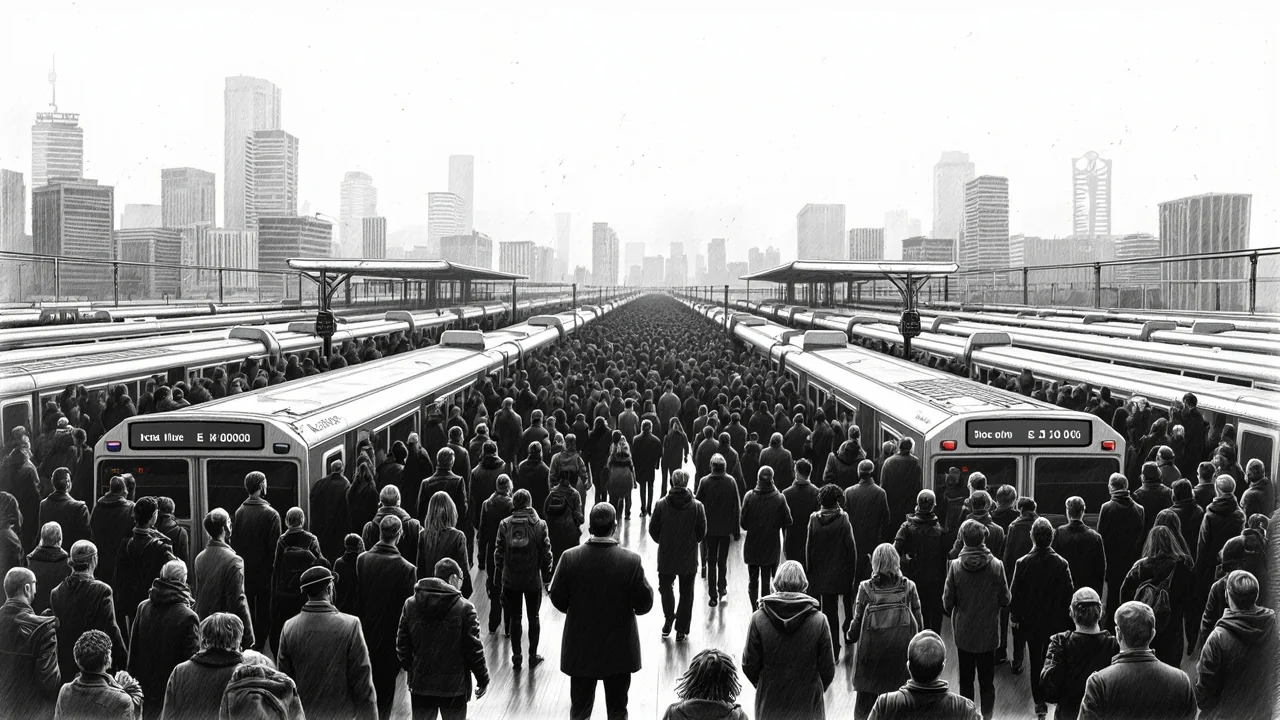
Oslo's T-bane metro system ground to a halt for over 150,000 daily commuters Tuesday morning after a train with technical problems blocked a critical eastbound track at Brynseng station. The failure caused significant delays across lines 1 through 5 and suspended all service between the major transit hub at Helsfyr and the central Stortinget station, paralyzing the network's core during rush hour.
Ruter press officer Øystein Dahl Johansen confirmed the stoppage in a statement. "Due to a train with technical problems in the westbound direction at Brynseng, no trains are running between Helsfyr and Stortinget at this time," Johansen said. The disruption created a domino effect across the entire system, stranding passengers at platforms across the city and causing overcrowding on substitute bus services and remaining train lines.
Scale of the Disruption
The affected corridor between Helsfyr and Stortinget is the central artery of Oslo's metro network. Helsfyr serves as a key interchange where eastern lines converge before entering the city center through shared tunnels. The blockage at Brynseng, just one station west of Helsfyr, created an impassable bottleneck. Commuters reported delays exceeding 45 minutes, with some abandoning their journeys entirely. Social media filled with images of packed platforms and frustrated passengers seeking alternative routes through an already strained city transport system.
This incident highlights the vulnerability of a system where multiple lines depend on a single-track section through the city center. When one point fails, the effects ripple outward. The T-bane, which carries over 350,000 passengers on an average weekday, is the backbone of Oslo's public transport. Its reliability is critical for the city's function, affecting workers, students, and the broader economy. Morning peak disruptions of this magnitude have a direct impact on business operations and public services across the capital.
A System Under Pressure
Oslo's metro has been a point of both pride and contention. The network has expanded significantly over the past two decades, notably with the opening of the Ring Line and the Lørenskog extension. However, its aging infrastructure and increasing passenger loads have led to more frequent service interruptions. The trains and signaling systems on parts of the eastern network are among the oldest in operation. While major upgrades are planned, including the new Fornebubanen line, they do little to address the immediate reliability concerns of daily users.
Tuesday's failure is not an isolated event. Similar technical faults and signaling problems have caused major disruptions several times in recent years. Each incident renews debate about investment priorities, maintenance schedules, and the need for greater system resilience. Politicians from both the governing and opposition parties have repeatedly called for accelerated modernization plans and increased contingency measures, especially as Oslo's population continues to grow and push the transport network to its limits.
The Commuter Experience
For the people caught in the disruption, the abstract issue of infrastructure becomes a concrete problem of missed appointments, late arrivals at work, and personal stress. "I've been standing here for half an hour with no information," said one commuter at Tøyen station, who declined to give her name. "The screen just says 'delayed.' There are too many people for any bus to help." This lack of real-time, specific information during major outages is a frequent complaint. While Ruter's app and website provide alerts, passengers at stations often rely on overcrowded platform screens that offer minimal detail.
The disruption also tests Oslo's alternative transport network. City buses and trams, already operating at capacity during peak hours, cannot absorb a sudden influx of thousands of stranded metro passengers. Taxis become scarce and expensive, and bicycle lanes see increased traffic. The incident underscores how deeply the city relies on the smooth operation of its rail-based transit and how few robust backups exist for a failure of this scale.
Response and Recovery
Ruter's operational teams worked to clear the defective train and restore service as quickly as possible. The standard protocol involves attempting to repair the train on-site or, if that fails, towing it to a depot to clear the track. This process can take hours, depending on the nature of the fault and the availability of specialized recovery equipment. During the outage, Ruter typically advises passengers to use local bus services or to delay their travel, options that are of limited use during the morning commute.
By late morning, service began a slow return to normal as the disabled train was moved. However, the backlog of trains and crews out of position meant residual delays persisted throughout the day. The incident will likely prompt a review by Sporveien, the municipal company that operates the infrastructure. Any technical failure of this magnitude requires a fault report and an analysis to determine if it points to a wider systemic issue needing address.