
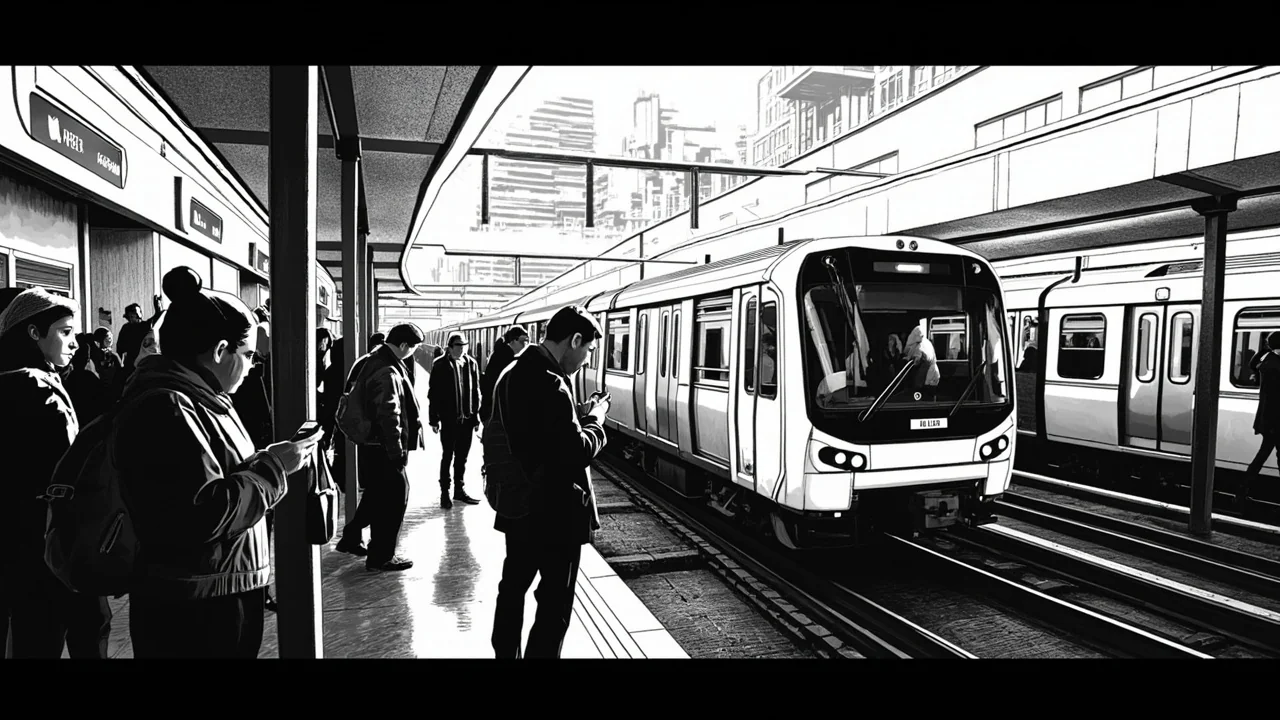
Norway's capital city faced a major public transport crisis Tuesday morning as unexpected delays struck every single line of the Oslo Metro system. The widespread disruption, caused by a technical fault at the critical Tøyen station, left thousands of commuters stranded and highlighted the vulnerability of the city's transit network during peak hours. Ruter, the public transport authority, confirmed the delays were expected to last until at least 9:00 AM, but warned repairs could take longer.
"The delays are due to a switch failure at Tøyen. Crews are on their way to fix the problem, but it is difficult to say how quickly it will be resolved," said press officer Eilif Swensen in a statement. "Until further notice, there will be delays as trains must pass Tøyen slowly." The announcement, citing "unforeseen circumstances," offered little immediate solace to passengers facing a chaotic start to their workday. The Tøyen station is a central junction where multiple lines converge, meaning a single point of failure there can ripple out across the entire network.
A City Slowed to a Crawl
The impact was immediate and citywide. Platforms at major hubs like Majorstuen, Nationaltheatret, and Jernbanetorget became increasingly crowded as scheduled services failed to arrive. Commuters reported waits of 20 to 30 minutes beyond normal timetables, with some trains moving at walking pace through affected sections. For a city where the T-bane is the backbone of daily movement, transporting over 300,000 passengers on an average weekday, the system-wide failure represented a significant breakdown. The timing, during the crucial morning rush between 7:00 and 9:00 AM, maximized the disruption for students, office workers, and service employees.
Social media channels filled with frustration as passengers shared images of packed stations and updated one another on the glacial progress of their journeys. The lack of a precise timeline for a fix added to the anxiety, with many forced to seek alternative routes via buses, trams, or bicycles on a cold February morning. The incident exposed the limited redundancy in the system when a key piece of infrastructure fails. Unlike road networks where traffic can divert, metro systems have few alternatives once a central node is compromised.
Infrastructure Under Scrutiny
This morning's failure will inevitably trigger a fresh round of scrutiny for Oslo's public transport infrastructure. The T-bane has undergone significant expansion and modernization in recent decades, including the opening of the new Fornebubanen line, a major project designed to increase capacity. However, Tuesday's incident underscores that new lines do not eliminate risk from aging components or single points of failure in the core network. The switchgear at Tøyen, a mechanical system that guides trains from one track to another, is a critical yet vulnerable piece of technology.
Transport analysts note that while Oslo's system is generally reliable, its punctuality and resilience are periodically tested by such technical faults. "A switch failure at a major hub is one of the worst-case scenarios for a metro operator," said Lars Holm, a public transport consultant familiar with the Oslo network. "It doesn't require a major accident to cause major disruption. The system's design, with multiple lines funneling through a few central stations, creates inherent bottlenecks. When one fails, there is no plan B." He points to similar incidents in other European capitals, where investment in digital signaling and redundant track layouts is increasingly seen as essential for resilience, not just capacity.
The Economic and Social Ripple Effect
The cost of a metro shutdown extends far beyond annoyed commuters. Economists estimate that widespread transport disruption in a city like Oslo carries a direct productivity cost running into millions of kroner per hour, as workers arrive late or miss appointments. The indirect costs, including increased road congestion as people switch to cars, environmental impact from idling traffic, and stress on alternative bus and tram services, compound the problem. For hourly workers, late arrival can mean lost wages, turning a technical glitch into a personal financial issue.
The social contract of urban living relies on predictable mobility. When that predictability vanishes, it erodes public trust in the systems managed and funded by the municipality. This comes at a sensitive time for Oslo's city government, which has actively promoted public transport and cycling while implementing policies to discourage private car use in the city center. The success of that entire strategy hinges on the metro being a dependable alternative. Incidents like today's provide ammunition for critics who argue the city has moved too fast in restricting cars before ensuring transit is fail-safe.
A Recurring Challenge for Nordic Capitals
Oslo is not alone in facing these challenges. Similar system-wide delays have paralyzed the metro networks in Stockholm and Helsinki in recent years, often due to signaling errors or technical faults at central stations. The Nordic model of extensive, publicly owned metro systems faces a common dilemma: maintaining and upgrading aging core infrastructure while financing ambitious new expansions. Budgets are finite, and visible new lines often attract more political support than invisible upgrades to switches, signals, and control systems buried in decades-old tunnels.
The response from Ruter will now be closely watched. Beyond the immediate repair, pressure will mount for a transparent explanation of what caused the switch failure and what steps will be taken to prevent a recurrence. This may involve accelerated investment in newer switching technology, enhanced diagnostic systems to predict failures, or even operational reviews to see if temporary contingency routing is possible during such events. The question for city planners is whether to invest in making the central hubs less vulnerable, or to develop a network with more distributed routing options, reducing dependence on any single station.
Looking Down the Line
As service gradually returned to normal after the morning peak, the conversation shifted from immediate inconvenience to long-term reliability. For a nation that prides itself on engineering excellence and efficient governance, a total metro gridlock is a noticeable blemish. It serves as a stark reminder that the sophisticated, functional society Norway has built remains dependent on physical systems that can and do fail. The test is not in preventing every failure—an impossible task—but in responding with transparency, investing in resilience, and minimizing the impact on citizens.
Will this event be a fleeting frustration, forgotten by next week, or a catalyst for a deeper investment in the sinews of the city's transport network? The answer may determine how Oslo weathers the next inevitable fault. As the city continues to grow, with ambitions to become a nearly car-free urban center, the reliability of its metro isn't just a convenience; it's the foundation of its future.