
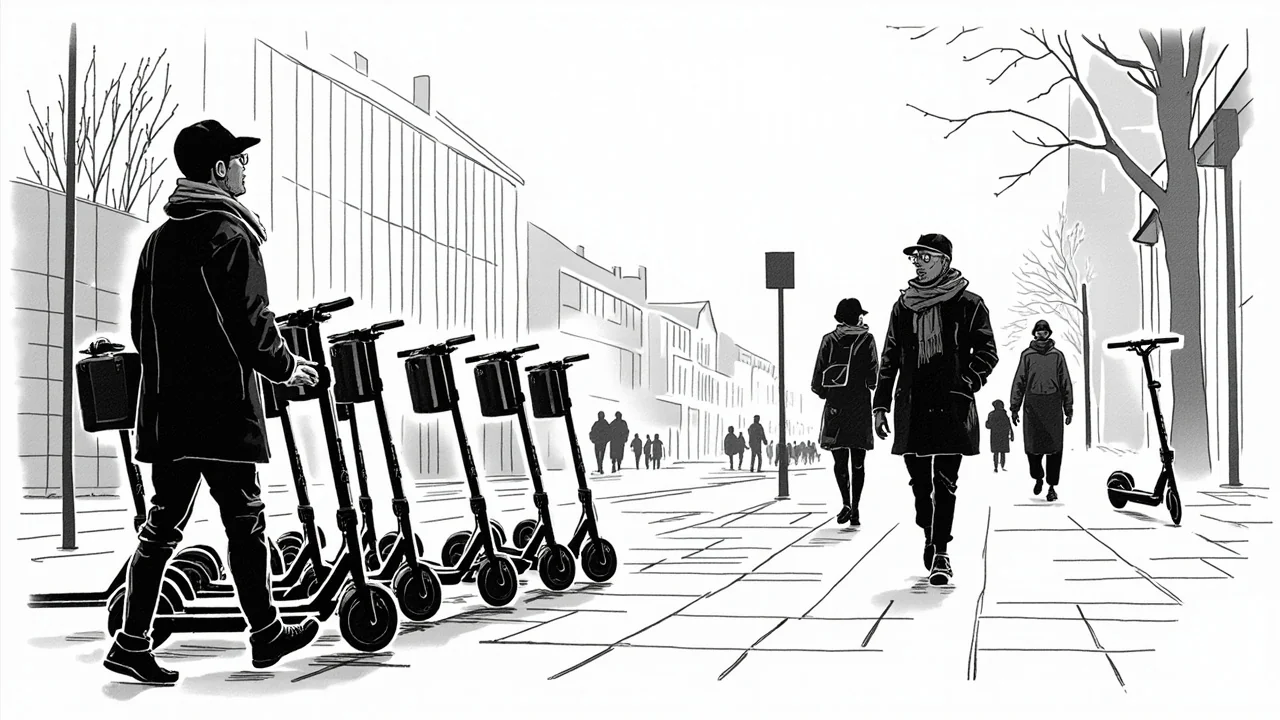
Norway's capital Oslo is preparing to ban electric scooters from its city-center sidewalks, following a parliamentary vote that empowers local authorities to crack down on what many pedestrians call reckless riding. The Storting voted Tuesday to grant municipalities the necessary legal authority, clearing the path for a ban that could affect over 100,000 registered e-scooter users in the Oslo region. City Councilor for Environment and Transport Marit Vea of the Liberal Party (V) confirmed the move, stating the goal is to create a better city for pedestrians where conflict is reduced.
"It is good that more parties are joining the Liberals' proposal to get e-scooters off the pavement," Vea said. "The goal is a better city for pedestrians, where the level of conflict is reduced, and the use of e-scooters becomes safer for everyone." Vea, who also serves as a deputy representative in the Storting, was one of the politicians who brought the proposal forward. The decision marks a significant shift in urban mobility policy, prioritizing pedestrian safety over the unregulated convenience of shared micro-mobility.
The Push for Pedestrian Priority
For years, residents, particularly the elderly, visually impaired, and parents with young children, have reported feeling unsafe on Oslo's sidewalks. The current rule mandates e-scooters not exceed 6 km/h on pavements, but this limit is frequently ignored. This has led to widespread complaints of near-misses and a pervasive sense of unease. The city council lacked the direct authority to impose stricter local bans, forcing the issue to be decided at the national parliamentary level. The newly passed legislation provides the "necessary legal basis to regulate the use of electric scooters on sidewalks," directly instructing the government to enact the changes.
Urban planner and mobility expert Henrik Andersen notes this reflects a broader Scandinavian trend. "Cities like Copenhagen and Stockholm have also grappled with the e-scooter dilemma," Andersen said. "The initial laissez-faire approach is giving way to stricter regulation. Oslo's move is notable because it uses a new national legal tool to enact a very local, physical solution—clearing the footpaths." The policy directly addresses the core conflict: sidewalks are designed for pedestrian flow at walking speeds, not for silent vehicles traveling several times faster.
From Parliamentary Vote to Pavement Enforcement
The Storting's decision does not enact an immediate ban but provides the legal framework for Oslo's city government to do so. The City Council, led by Vea's department, must now draft and pass specific municipal regulations. This process will involve defining the exact geographic boundaries of the ban—likely focusing on the dense inner city—and establishing clear enforcement protocols. Key questions remain about where e-scooters should be ridden instead. The likely expectation is that riders will use bicycle lanes, where they are legally considered bicycles, or the roadway itself in areas without cycling infrastructure.
This shift poses its own challenges. "Integrating e-scooters into bike lanes requires clear communication and potentially behavioral changes from both cyclists and scooter users," said Traffic Safety Officer Lars Holm. "The speed differential between a traditional bicycle and an e-scooter can still cause conflicts if not managed." The city may need to invest in signage and public awareness campaigns to ensure a smooth transition and prevent simply displacing the problem from sidewalks to cycle paths.
Industry Response and Ridership Impact
The ban will significantly impact e-scooter rental companies like Tier, Voi, and Bolt, which operate vast fleets in Oslo. The industry has historically advocated for self-regulation and geofencing technology to control speeds in sensitive areas. A full sidewalk ban in the urban core represents a stricter level of control than they have previously faced. In a statement, a spokesperson for one major operator said they "remain committed to collaborating with Oslo to ensure safe, sustainable micro-mobility," but emphasized the need for "adequate alternative infrastructure" for riders.
For the estimated 100,000 regular users, the ban changes the calculus of using an e-scooter for the famous "last mile" of a commute. A trip from the national railway station, Oslo S, to a government office in the central Vaterland district would no longer be possible on the sidewalk. Riders would need to navigate to a designated bike lane or road, potentially making short, convenient trips less attractive. This could lead to a decline in ridership or a change in usage patterns, with more scooters used for longer trips along arterial routes with proper infrastructure.
A Model for Other Norwegian Cities?
Oslo's action, enabled by the Storting, sets a powerful precedent. Other Norwegian urban centers struggling with similar conflicts—such as Bergen, Trondheim, and Stavanger—now have a clear legal pathway to follow. The national amendment effectively decentralizes the decision, allowing each municipality to tailor its approach based on local pedestrian density and street design. "This is a classic example of local problem-solving requiring national legislative support," observes political scientist Kari Nordseth. "The Storting has handed the tools to the municipalities. Now we will see how many decide to use them."
The debate encapsulates a larger discussion about street space allocation in the 21st-century city. As Oslo promotes walking, cycling, and public transit to meet its climate goals, the place of privately-operated, digitally-enabled micro-vehicles remains contested. This ban draws a clear line: pedestrian safety and comfort in shared public space is a non-negotiable priority. The coming months will test how effectively this line can be enforced on the ground, and whether clearing the sidewalks truly leads to safer coexistence for all who move through the streets of the capital.