
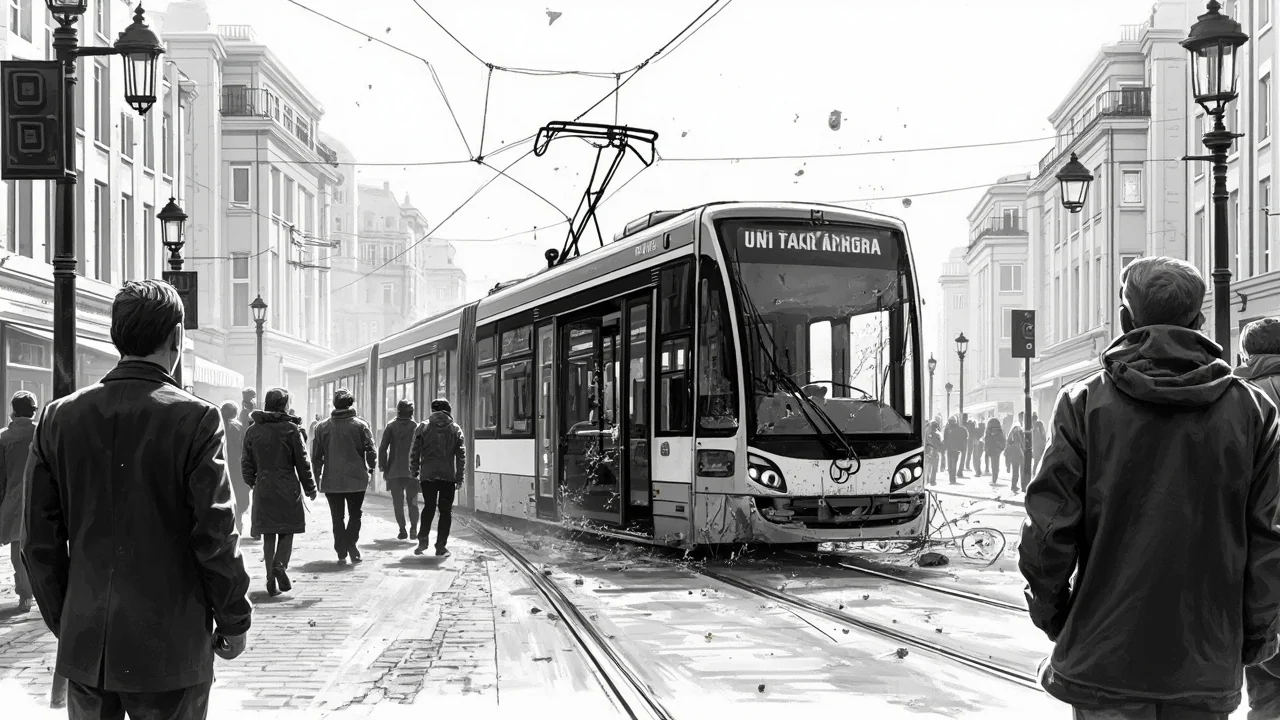
Norway's capital faced a major disruption today after a collision between a car and a tram in central Oslo. Police cordoned off the intersection of Storgata and Youngstorget, a key traffic node, as emergency services responded to the incident. Officials stated they are working to establish the extent of injuries and the precise circumstances that led to the crash, which halted tram lines 11, 12, 17, and 18 during the morning commute.
A Recurring Challenge for Urban Planning
This incident is not an isolated event but part of an ongoing challenge for Oslo's integrated transport network. The city has aggressively pursued a 'vision zero' policy for traffic fatalities and serious injuries, with a strong emphasis on protecting vulnerable road users and prioritizing public transit. Trams, or 'trikk', are central to this green transition, carrying over 130,000 passengers daily on a network that has expanded significantly in recent decades. However, the shared space where 40-tonne trams meet private vehicle traffic creates inherent risk zones. Today's crash at Youngstorget—a busy plaza surrounded by government offices, media headquarters, and cultural venues—highlights the complexity of managing mixed traffic flows in a dense, growing city.
The Anatomy of a Tram Collision
While details from today's investigation remain pending, historical data and transport safety experts point to common factors. Trams have a long braking distance and operate on fixed tracks, limiting their ability to avoid obstacles. Right-of-way conflicts at intersections are a frequent cause. The Oslo Public Transport Administration (Ruter) and the Norwegian Public Roads Administration have invested in signal priority systems and dedicated lanes, but intersections remain the system's weakest points. A 2022 report by the Institute of Transport Economics noted that while tram travel is overwhelmingly safe for passengers, collisions with other vehicles represent the most significant safety risk associated with the mode. Each incident triggers a standard protocol: immediate service suspension, a police-led technical investigation, and an internal review by Ruter and the tram operator Sporveien to identify any systemic failures.
Balancing Growth with Safety
Oslo is in a period of unprecedented urban development. Population growth and a municipal policy to reduce private car use—including the removal of hundreds of parking spaces and the creation of car-free zones—have pushed more residents onto trams, buses, bicycles, and foot. This policy has been successful in lowering overall car traffic and emissions, but it increases the pressure on the remaining shared infrastructure. The tram network is being stretched to new neighborhoods like Fornebu and Majorstuen, while existing arteries like Storgata, where this crash occurred, handle increasing frequency. Transport analysts suggest that the next phase of Oslo's mobility revolution must focus on 'physical segregation'—where possible, completely separating tram lines from road traffic with curbs, platforms, or alternative routing. The high cost and disruptive nature of such infrastructure projects mean they are implemented gradually, leaving a transitional period of elevated risk.
Comparative Lessons from Nordic Capitals
Oslo's situation is mirrored in other Nordic cities that champion public transit. Helsinki, with a comparable tram system, has seen a reduction in serious collisions after implementing an extensive program of raised crossings and traffic calming measures around tram lines. Copenhagen, which relies more heavily on bicycles and metro, faced its own set of integration challenges when introducing new bus rapid transit corridors. The common lesson is that engineering and design are more effective than signage and public awareness campaigns alone. Norway's strict liability rules in traffic accidents, which often place greater responsibility on larger vehicles, also shape driver behavior around trams. However, as today's event shows, legal frameworks cannot prevent all incidents where human error or technical failure occurs.
The Path Forward for Oslo's Streets
The immediate aftermath of a crash focuses on emergency response and service restoration. The longer-term response, however, involves city planners, engineers, and policymakers. Each incident adds data points to a safety model. It will likely renew debates in the City Council about accelerating the pace of tram corridor separation. It also places attention on vehicle technology, such as advanced driver assistance systems in cars that can detect trams, and improved external warning systems on the trams themselves. For the thousands of daily commuters, the incident is a stark reminder of the physical reality of shared urban space. Oslo's ambitious goals to become a nearly car-free city center depend on the perceived and actual safety of its public transit system. A reliable, safe tram network is the cornerstone of that ambition. As the investigation into the Storgata collision proceeds, its findings will not only assign responsibility but will also inform the next chapter of Oslo's transport evolution, where safety must keep pace with growth.
The collision today serves as a critical stress test for Oslo's integrated mobility model. It questions whether the current mix of enforcement, engineering, and education is sufficient for a system operating at ever-higher capacity. The city's success in reducing car dependency is admirable, but as traffic morphs rather than disappears, ensuring the safety of all road users—whether in a tram, a car, or on foot—requires continuous investment and adaptation. The true measure of Oslo's transport policy will be how it learns from and responds to incidents like this, transforming reactive investigations into proactive, life-saving infrastructure.